


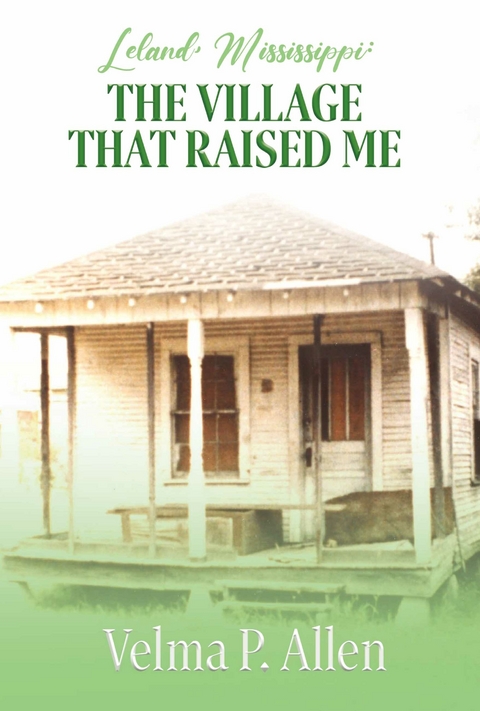
Leland, Mississippi: The Village That Raised Me (eBook)
314 Seiten
Bookbaby (Verlag)
978-1-0983-5929-4 (ISBN)
Leland, Mississippi. once considered the "e;Hellhole"e; of the Delta, transformed itself into a vibrant little community which was able to provide support and encouragement when Velma Allen needed it most. This segregated Mississippi community withheld many basic amenities from her, but because of a determined mother ,her church, teachers, and numerous individuals in the Leland community, she overcame the appalling shortcomings she experienced financially and experientially. "e;Leland, Mississippi: The Village That Raised Me"e; is a personal memoir intertwined with a cultural history. This is an ode to a community and the Christian faith that held it together.
Chapter Three:
Having “The Talk” in Leland
Today, we often hear people asking Black people – especially mothers – about “The Talk” we are all supposedly having with our sons to keep them alive. Of course, we – daughters and sons – were given the facts of our situation: there were people around us who held hatred in their hearts for us and anyone else who shared our skin color, but they were definitely in the minority. We also imagined that many of them were forced to act certain ways because of their own family pressures, societal pressures, and such. Those people were denied their rights too because they were imprisoned by the bigoted ideas that they were taught or that they had to pretend they believed.
But we were also taught that most people respected hard work, civility, and good manners. We were taught to exemplify all those qualities in addition to watching out for the misguided souls who held all these irrational views and wanted to hurt other people for no reason other than the color of their skin. We were not taught to hate people of other races or religions. There were too many kind people all around us of all races and nationalities all around us.
Lessons were woven into our daily interactions with each other and with the White people we might encounter in one way or another. For example, I remember walking downtown Leland on Saturday night with Mama when we were met by some young teen-aged White girls who were approaching us on the sidewalk. Mama said to me, “Move over so they can pass by.” I said, “Mama why do we have to move over, and they didn’t?”
She said, “That’s how it is.” I never understood.
I still have a complex about the practice of moving over for other people to pass by. I know that this is a holdover from my youth, when I was nine or ten and my mama had to practically get off the sidewalk so these teens could pass by because they were White. They fully expected us to move over, and we did.
That seems such a small thing, but it had such a profound effect on me that to this day, I tense up inside when I am directly approaching someone who is not making a move to share the space equally with me. I refuse to move all the way over when approaching people coming from the opposite direction. I move some of the distance over and fully expect them to move some of the distance the other way unless they are little children or the elderly.
It has nothing to do with hating them, but more to do with my silent statement that “You are not worth more than I am; we are equals and we are both entitled to that space.”
I will also defer out of consideration for persons who have some legitimate reason for not being able to share the space which we are about to be in, but not just because of race.
I also recall Mama buying something in the “ten-cents” store (what we called the Sterling Five and Dime store on Main Street in Leland), as we were being waited on by a young, teenaged White girl. Mama responded to a question she asked by saying “Yes ma’am”.
I said, “Mama why are you saying Yes ma’am to her? She is just a girl.”
Mama said, “Yes, but she is a “little missy girl” and we have to start saying “Yes ma’am” to them when they get to be little “missies.” I thought, “She is a girl like me – a little older, but still a girl.”
This made no sense to me. “Yes ma’am” to grown women made sense, but now my mother had to say, “Yes ma’am” to these young girls instead of the other way around?”
Mama explained away all kinds of things by saying, “That’s how it is.”
Yes, there were always talks and explanations and discussions, woven casually into our day-to-day life experiences. There was no one “Talk.” There were many “Talks.” I have always wondered, however, “What kinds of discussions were White people having with their children?”
Today, as we are all talking about how Black mothers must explain all these things to their Black children, I am wondering if White mothers are having “The Talk” with their children and when White woman are going to start having “The Talk” with their fathers and brothers, husbands, uncles, and grandfathers.
Are they going to have “The Talk” with their daughters about showing respect to others and being careful about the kinds of men they bring into their lives who may be fathering their children and teaching them this ridiculous hatred? Do they worry about grooming another generation of killer cops, lynchers, bad politicians and the like ,whose goal in life is keeping their knees on the necks of people who are less fortunate than they are, who have a different skin color, come from a different country of origin, or some other asinine thing that, they believe, gives them rights and privileges that some of us should not enjoy?
Why must the onus continue to be on those of us who are Black to teach the victims of this hatred how to be better victims and explain that this is how you stay out of trouble and maybe even stay alive?
I have heard so many people casually dismiss the prejudices shown by the men in their lives and explain that this is just “the way they are.” I’ve been to homes where the wife has said, “Don’t mind my husband; he is prejudiced, but I am not like that.” I have had good friends explain that their fathers are racist, and they had to tell them that if they offended me, they would not tolerate their racist behavior. Do White wives and mothers try to explain “right and wrong” to these men they sleep with, eat with, give birth to, raise, and spend most of their time with? If not, what does it say about them that they do not have a “Talk” to at least enlighten their friends and family and to express strong disapproval of actions based on hate and racism?
I do not understand this just like I did not understand that Mama and I had to get off of the sidewalk so the White girls could pass, and Mama felt she had to say, “Yes ma’am” to teenaged White “missies”. Does the answer still have to be “That’s just how it is?”
Shouldn’t we all be having “The Talk” – not just Black mothers? We cannot do this alone. We all need to save all our sons – and daughters – yours and mine.
This made no sense to me. “Yes ma’am” to grown women made sense, but now my mother had to say, “Yes ma’am” to these young girls instead of the other way around?”
Mama explained away all kinds of things by saying, “That’s how it is.”
Yes, there were always talks and explanations and discussions, woven casually into our day-to-day life experiences. There was no one “Talk.” There were many “Talks.” I have always wondered, however, “What kinds of discussions were White people having with their children?”
Today, as we are all talking about how Black mothers must explain all these things to their Black children, I am wondering if White mothers are having “The Talk” with their children and when White woman are going to start having “The Talk” with their fathers and brothers, husbands, uncles, and grandfathers.
Are they going to have “The Talk” with their daughters about showing respect to others and being careful about the kinds of men they bring into their lives who may be fathering their children and teaching them this ridiculous hatred? Do they worry about grooming another generation of killer cops, lynchers, bad politicians and the like ,whose goal in life is keeping their knees on the necks of people who are less fortunate than they are, who have a different skin color, come from a different country of origin, or some other asinine thing that, they believe, gives them rights and privileges that some of us should not enjoy?
Why must the onus continue to be on those of us who are Black to teach the victims of this hatred how to be better victims and explain that this is how you stay out of trouble and maybe even stay alive?
I have heard so many people casually dismiss the prejudices shown by the men in their lives and explain that this is just “the way they are.” I’ve been to homes where the wife has said, “Don’t mind my husband; he is prejudiced, but I am not like that.” I have had good friends explain that their fathers are racist, and they had to tell them that if they offended me, they would not tolerate their racist behavior. Do White wives and mothers try to explain “right and wrong” to these men they sleep with, eat with, give birth to, raise, and spend most of their time with? If not, what does it say about them that they do not have a “Talk” to at least enlighten their friends and family and to express strong disapproval of actions based on hate and racism?
I do not understand this just like I did not understand that Mama and I had to get off of the sidewalk so the White girls could pass, and Mama felt she had to say, “Yes ma’am” to teenaged White “missies”. Does the answer still have to be “That’s just how it is?”
Shouldn’t we all be having “The Talk” – not just Black mothers? We cannot do this alone. We all need to save all our sons – and daughters – yours and mine.
The next time someone asks a Black mother if she had “The Talk” with her...
| Erscheint lt. Verlag | 6.6.2021 |
|---|---|
| Sprache | englisch |
| Themenwelt | Literatur ► Biografien / Erfahrungsberichte |
| ISBN-10 | 1-0983-5929-1 / 1098359291 |
| ISBN-13 | 978-1-0983-5929-4 / 9781098359294 |
| Informationen gemäß Produktsicherheitsverordnung (GPSR) | |
| Haben Sie eine Frage zum Produkt? |
 EPUB (Adobe DRM)
Größe: 9,6 MB
Kopierschutz: Adobe-DRM
Adobe-DRM ist ein Kopierschutz, der das eBook vor Mißbrauch schützen soll. Dabei wird das eBook bereits beim Download auf Ihre persönliche Adobe-ID autorisiert. Lesen können Sie das eBook dann nur auf den Geräten, welche ebenfalls auf Ihre Adobe-ID registriert sind.
Details zum Adobe-DRM
Dateiformat: EPUB (Electronic Publication)
EPUB ist ein offener Standard für eBooks und eignet sich besonders zur Darstellung von Belletristik und Sachbüchern. Der Fließtext wird dynamisch an die Display- und Schriftgröße angepasst. Auch für mobile Lesegeräte ist EPUB daher gut geeignet.
Systemvoraussetzungen:
PC/Mac: Mit einem PC oder Mac können Sie dieses eBook lesen. Sie benötigen eine
eReader: Dieses eBook kann mit (fast) allen eBook-Readern gelesen werden. Mit dem amazon-Kindle ist es aber nicht kompatibel.
Smartphone/Tablet: Egal ob Apple oder Android, dieses eBook können Sie lesen. Sie benötigen eine
Geräteliste und zusätzliche Hinweise
Buying eBooks from abroad
For tax law reasons we can sell eBooks just within Germany and Switzerland. Regrettably we cannot fulfill eBook-orders from other countries.
aus dem Bereich


