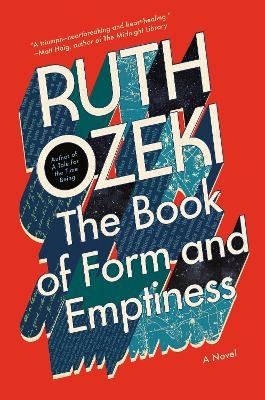
The Book of Form and Emptiness
Viking (Verlag)
978-0-593-48940-6 (ISBN)
- Titel erscheint in neuer Auflage
- Artikel merken
“No one writes like Ruth Ozeki—a triumph.” —Matt Haig, New York Times bestselling author of The Midnight Library
“Inventive, vivid, and propelled by a sense of wonder.” —TIME
“If you’ve lost your way with fiction over the last year or two, let The Book of Form and Emptiness light your way home.” —David Mitchell, Booker Prize-finalist author of Cloud Atlas
A boy who hears the voices of objects all around him; a mother drowning in her possessions; and a Book that might hold the secret to saving them both—the brilliantly inventive new novel from the Booker Prize-finalist Ruth Ozeki
One year after the death of his beloved musician father, thirteen-year-old Benny Oh begins to hear voices. The voices belong to the things in his house—a sneaker, a broken Christmas ornament, a piece of wilted lettuce. Although Benny doesn't understand what these things are saying, he can sense their emotional tone; some are pleasant, a gentle hum or coo, but others are snide, angry and full of pain. When his mother, Annabelle, develops a hoarding problem, the voices grow more clamorous.
At first, Benny tries to ignore them, but soon the voices follow him outside the house, onto the street and at school, driving him at last to seek refuge in the silence of a large public library, where objects are well-behaved and know to speak in whispers. There, Benny discovers a strange new world. He falls in love with a mesmerizing street artist with a smug pet ferret, who uses the library as her performance space. He meets a homeless philosopher-poet, who encourages him to ask important questions and find his own voice amongst the many.
And he meets his very own Book—a talking thing—who narrates Benny’s life and teaches him to listen to the things that truly matter.
With its blend of sympathetic characters, riveting plot, and vibrant engagement with everything from jazz, to climate change, to our attachment to material possessions, The Book of Form and Emptiness is classic Ruth Ozeki—bold, wise, poignant, playful, humane and heartbreaking.
Ruth Ozeki is a novelist, filmmaker, and Zen Buddhist priest. She is the best-selling author of four novels: The Book of Form and Emptiness, winner of the UK’s 2022 Women’s Prize for Fiction; My Year of Meats; All Over Creation; and A Tale for the Time Being, which won the LA Times Book Prize and was a finalist for the 2013 Booker Prize and the National Book Critics' Circle Award. Her nonfiction work includes a memoir, The Face: A Time Code, and the documentary film, Halving the Bones. A longtime Buddhist practitioner, Ruth is affiliated with the Brooklyn Zen Center and the Everyday Zen Foundation. She is the Grace Jarcho Ross 1933 Professor of Humanities at Smith College.
PART ONE
Home
Every passion borders on the chaotic, but the collector's
passion borders on the chaos of memories.
-Walter Benjamin, "Unpacking My Library"
The Book
1
So, start with the voices, then.
When did he first hear them? When he was still little? Benny was always a small boy and slow to develop, as though his cells were reluctant to multiply and take up space in the world. It seems he pretty much stopped growing when he turned twelve, the same year his father died and his mother started putting on weight. The change was subtle, but Benny seemed to shrink as Annabelle grew, as if she were metabolizing her small son's grief along with her own.
Yes. That seems right.
So, perhaps the voices started around then, too, shortly after Kenny died? It was a car accident that killed him-no, it was a truck. Kenny Oh was a jazz clarinetist, but his real name was Kenji, so we'll call him that. He played swing mostly, big band stuff, at weddings and bar mitzvahs and in campy downtown hipster clubs, where the dudes all wore beards and porkpie hats and checkered shirts and mothy tweed jackets from the Salvation Army. He'd been playing a gig, and afterward he went out drinking or drugging or whatever he did with his musician friends-just a little toot, but enough so that on his way home, when he stumbled and fell in the alley, he didn't see the necessity of getting up right away. He wasn't far from home, only a few yards from the rickety gate that led to the back of his house. If he'd managed to crawl a bit further, he would have been okay, but instead he just lay there on his back, in a dim pool of light cast by the streetlamp above the Gospel Mission Thrift Shop dumpster. The long chill of winter had begun to lift, and a spring mist hung in the alleyway. He lay there, gazing up at the light and the tiny particles of moisture that swarmed brightly in the air. He was drunk. Or high. Or both. The light was beautiful. Earlier in the evening, he'd had a fight with his wife. Maybe he was feeling sorry. Maybe in his mind he was vowing to be better. Who knows what he was doing? Maybe he fell asleep. Let's hope so. In any case, that's where he was still lying an hour or so later, when the delivery truck came rattling down the alleyway.
It wasn't the truck driver's fault. The alley was filled with ruts and potholes. It was littered with half-emptied garbage bags, food waste, sodden clumps of clothes and broken appliances, which the dumpster divers had left behind. In the flat, gray light of the drizzling dawn, the truck driver couldn't distinguish between the debris and the musician's slim body, which by then was covered in crows. The crows were Kenji's friends. They were just trying to help by keeping him warm and dry, but everyone knows that crows love garbage. Is it any wonder that the driver mistook Kenji for a garbage bag? The driver hated crows. Crows were bad luck, and so he aimed his truck right at them. The truck was carrying crates of live chickens to the Chinese slaughterhouse at the end the alleyway. He stepped on the gas and felt the body bump beneath the wheels as the crows flew up in front of his windshield, obscuring his view and causing him to lose control and careen into the loading dock of the Eternal Happiness Printing Company Ltd. The truck tipped, and the crates of chickens went flying.
The noise of squawking birds woke Benny, whose bedroom window overlooked the dumpster. He lay there, listening, and then the back door slammed. A high, thin cry rose from the alley, uncoiling like a rope, like a living tentacle, snaking up into his window and hooking him, drawing him from bed. He went to the window, parted the curtains, and peered down into the street. The sky was just growing light. He could see
| Erscheinungsdatum | 22.09.2021 |
|---|---|
| Sprache | englisch |
| Maße | 152 x 229 mm |
| Gewicht | 675 g |
| Themenwelt | Literatur ► Fantasy / Science Fiction ► Fantasy |
| Literatur ► Romane / Erzählungen | |
| Schlagworte | ART • a tale for the time being • best book club books • book club • book club recommendations • books fiction • Classic • Classic Literature • Coming of Age • coming of age books • Drama • family sagas • Fantasy • Feminism • Fiction • fiction books • Friendship • gifts for book lovers • gifts for librarian • librarian gifts • literary fiction • Literature • magical realism • magical realism books • magical realism fiction • magical realism novel • Magical Realism novels • marriage books • music • Novels • Philosophy • realistic fiction books • Romance • ruth ozeki books • tale for the time being |
| ISBN-10 | 0-593-48940-3 / 0593489403 |
| ISBN-13 | 978-0-593-48940-6 / 9780593489406 |
| Zustand | Neuware |
| Informationen gemäß Produktsicherheitsverordnung (GPSR) | |
| Haben Sie eine Frage zum Produkt? |
aus dem Bereich