Revenge on the Camino (eBook)
350 Seiten
Bookbaby (Verlag)
978-1-0983-5045-1 (ISBN)
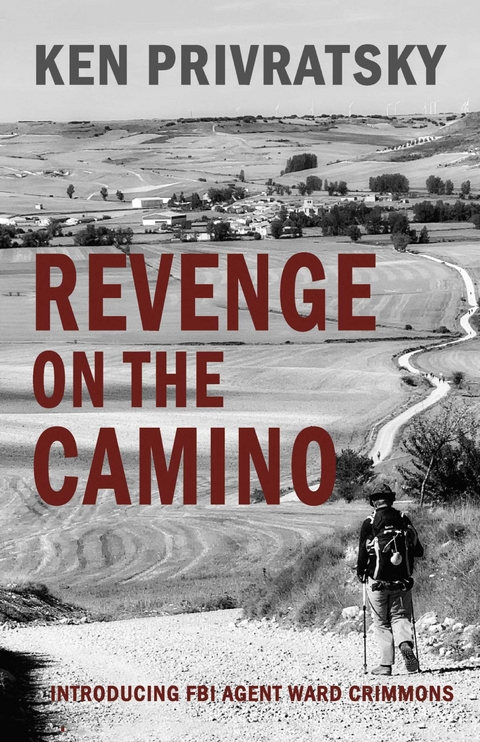
The famous pilgrimage route Camino de Santiago becomes the setting for vengeance by two brothers and a former Basque terrorist. Their killings frighten villagers and interrupt the pilgrimage of FBI Agent Ward Crimmons, who is walking the Camino in memory of his deceased wife, along with his brother-in-law, a general in Spain's famous Civil Guard. As victims multiply and Spanish police search for clues, Ward learns some of the country's dark history and becomes unexpectedly involved in trying to find the killers. Revenge on the Camino is the first book in a trilogy introducing Agent Crimmons and spanning the Camino de Santiago. He arrives in Europe as the first brutal murder takes place over a hundred miles away. Readers walk the trail with him, experiencing the captivating scenery and legends of the Camino while, elsewhere, investigators try to get inside the minds of the killers. Story lines merge and lead to a riveting climax, leaving us to wonder whether Ward himself could become a target.
2
Lieutenant Colonel Manuel Garcia snuffed his cigarette on the pavement with his shoe and pulled open the door. He was a small man in stature, well-built with graying hair, thick eyebrows, and dark piercing eyes. Today, he was sporting the dark green dress jacket with epaulets marking his rank and signaling to many he was the commandant of the Civil Guard in Burgos. Garcia maintained his fitness, which was getting harder these days as he had few opportunities to be out of the office. Major Antonio Salazar, his chief investigator, was waiting in the hallway. A much larger man and balding although ten years younger, he wore the field uniform consisting of a dark green short-sleeved shirt with cargo pants and held a baseball-type cap with the emblem of the Civil Guard. Garcia had been in a meeting in León with other commandants. He had excused himself as soon as he received the call about the grizzly murder.
Garcia had lived his entire life around Burgos and worked his way through the ranks in the Civil Guard before being rewarded with his promotion to lieutenant colonel and selection as commandant. Happily married to him for all of that time, his wife, Carmen, had learned long ago that being married to a policeman meant many hours alone at home. Years before, he had held Salazar’s position in Burgos. Salazar had been on his team at that time, and Garcia was pleased that he had risen to be the head of investigations. They were good friends and had investigated many crimes together. With less than 400 murders annually throughout Spain, a country of forty-six million people, killings remained unusual, especially since the Basque nationalist and separatist party Euskadi ta Askatasuna, commonly known as ETA, had disbanded recently. Formed as a political party in 1959 promoting Basque culture and separation from Spain and France, ETA had evolved into its own paramilitary group and waged a violent campaign against the two governments. The organization admitted responsibility for hundreds of assassinations, deaths, and bombings over the years before reaching a ceasefire agreement in 2010 and ultimately disbanding in 2018. It had set off a car bomb next to the Civil Guard barrack blocks away in 1999, killing a couple dozen people including one of Garcia’s friends. Garcia had pursued its members in past years and came to appreciate the calmer years after the ceasefire. When he received the alert from Salazar earlier in the day, he knew that this murder was different and had potential to create concerns at high levels of the government like those previous ETA attacks. He therefore cut his meeting short in León and drove back to Burgos.
“Good afternoon, sir. The team has started digging into this. We’ll regroup midafternoon to go over what we’ve found. You’re welcome to join us if you want. You’ll see that this case is unusual. The pathologist is waiting for us,” said Salazar.
“Very good, Tony. Tell me as much as you can as we walk to the lab.” Addressing subordinates by first names was common with close working relationships. Garcia had never been a high-pressure supervisor, but he held everyone to high standards and did not suffer fools anywhere lightly. He genuinely liked the people who worked for Salazar. Several had been working with him when he left the office. All were highly trained, hard-working, and selfless.
Salazar had his leather notebook in hand but did not refer to it. “The body was found just before dark last night on the Camino outside of Hornillos. Two Italian cyclists were finishing up their ride for the day. After they started downhill toward the village, they saw a mound on the trail. They were looking into the setting sun at the time and didn’t have a clear view. By the time they came up on it, they were almost next to the body, the head on the side next to the feet, the stump of the neck covered up by the pack, and lots of blood on the path. One of the guys rode into Hornillos looking for help while the other waited nearby. They said they didn’t know whom to call. A villager called our headquarters. Patrols were there within an hour and secured the area. As you know, we’ve got a good relationship with the pathologist, Doctor Ramos. We called her as we were leaving. She joined us at the scene. When we arrived, it was dark of course. It was bad. We put up lights and taped off the area. At daybreak, we put up a tent.”
“What did you find?”
“It was like the man just fell forward. His hands were still in the loops of the walking poles. Except for the head missing and at his feet, the guy could have been sleeping on his stomach with his pack on. There was no struggle. It appeared he didn’t know what hit him. We examined the area around the body as best as we could. Paths on the Camino get thousands of walkers each day as well as bikers. The trail was packed pretty hard, but there were still lots of different footprints on both sides as well as bike tire marks. Forensics took a few impressions. We took more pictures, though, especially when the sun came up. We were at the scene all night. No other people arrived on the trail, but we knew they would soon. We made the decision with Doctor Ramos to remove the body exactly like we found it. My team is still out in the village this morning talking to people.”
“What about the bikers who found the body?” Garcia asked.
“They’re at a hostel in Hornillos. We’ve got their IDs. We told them not to leave. They weren’t happy about that. We’re getting statements and then will release them.”
What Salazar had said about the fast response made Garcia feel good. He pressed his people to respond to calls quickly and professionally. He took great pride in the Civil Guard, the oldest law enforcement organization in Spain and the only one to retain a paramilitary structure preserving military ranks. Its responsibilities included rural areas, smaller cities, waterways, and the sea. Law enforcement in Spain, however, came from several different organizations. The Civil Guard differed from the National Police, which focused more on crimes in larger cities and provincial capitals, and from the Local Police, which reported directly to community mayors to enforce traffic and combat petty crime. Direction to both the Civil Guard and the National Police came from the Ministry of the Interior but through different chains of supervision. The Civil Guard also reported to the Ministry of Defense because its responsibilities changed in times of war. All organizations cooperated generally, although sometimes the extent of this pivoted on personalities. Unlike in some countries, most police in Spain were well armed, especially the Civil Guard. The preferred hand weapon for them was the German-made Sig Sauer nine-millimeter. The multiple police forces confused many tourists, though, as they saw different names and uniforms, not knowing whom to call as problems arose. It became even more confusing if tourists traveled across Spain because some autonomous communities had their own police forces. Garcia used to laugh about it, but he had grown to respect all the organizations. Those in Burgos had worked closely together for years, largely as a result of Garcia’s outreach efforts, first as young investigator and now continuing as the officer responsible for all Civil Guard activities around the area. He also had worked hard to improve relations between the communities since police forces had developed reputations for brutality under the Franco years, particularly in this part of Spain. His efforts had paid off.
“Okay. Good work, Tony. Let’s see what more Ana can tell us.”
The two men scanned their electronic badges at the entry to the crime lab and entered the changing area where they both donned medical pajamas, caps, masks, and gloves. Garcia shivered his shoulders as he opened the door and felt the chill air of the laboratory, quite a change from the high temperature outside. He had entered that door many times in his career and never could get used to the bleakness of the room under bright lights, the sterile floor, stainless steel cabinets, and the smell of antiseptic. There in the center was the body of the man found on the trail on top of a shiny steel gurney, exactly as others had found it, still clothed, pack on back, head oddly canted on its side next to the left foot, eyes and mouth open, dirt covering the nose and left cheek where it likely first struck the ground before rolling over to its final position. A second empty gurney with a camera and some instruments on top was at the side. The pathologist, Doctor Ana Ramos, was talking to two assistants as Garcia and Salazar entered and turned to greet them.
“Good morning, gentlemen. Sorry to pull you away from your meeting in León under these circumstances, sir,” she said with a nod toward Garcia. She was standing by the gurney in full medical garb with mask on. Ramos had been the forensic pathologist supporting the Civil Guard in Burgos for a decade. She was a middle-aged, pretty woman with light blond hair and a face that always seemed to be cheerful, something one did not expect to discover in a woman who always dealt with dead bodies. She worked for the Anatomic Forensic Institute, which handled crimes for law enforcement offices all over Spain, but her supervisors had kept her focused on Burgos because of close working relationships with police agencies.
“I waited to remove anything until you arrived. I joined Major Salazar and Captain Coronado at the murder scene last night. I say that because it seems pretty obvious we are dealing with a sadistic homicide. She pointed to the body on the gurney behind her. This is exactly as we found the victim on the trail. I even measured...
| Erscheint lt. Verlag | 1.5.2021 |
|---|---|
| Sprache | englisch |
| Themenwelt | Literatur ► Krimi / Thriller / Horror |
| ISBN-10 | 1-0983-5045-6 / 1098350456 |
| ISBN-13 | 978-1-0983-5045-1 / 9781098350451 |
| Informationen gemäß Produktsicherheitsverordnung (GPSR) | |
| Haben Sie eine Frage zum Produkt? |
 EPUB (Ohne DRM)
Größe: 1,5 MB
Digital Rights Management: ohne DRM
Dieses eBook enthält kein DRM oder Kopierschutz. Eine Weitergabe an Dritte ist jedoch rechtlich nicht zulässig, weil Sie beim Kauf nur die Rechte an der persönlichen Nutzung erwerben.
Dateiformat: EPUB (Electronic Publication)
EPUB ist ein offener Standard für eBooks und eignet sich besonders zur Darstellung von Belletristik und Sachbüchern. Der Fließtext wird dynamisch an die Display- und Schriftgröße angepasst. Auch für mobile Lesegeräte ist EPUB daher gut geeignet.
Systemvoraussetzungen:
PC/Mac: Mit einem PC oder Mac können Sie dieses eBook lesen. Sie benötigen dafür die kostenlose Software Adobe Digital Editions.
eReader: Dieses eBook kann mit (fast) allen eBook-Readern gelesen werden. Mit dem amazon-Kindle ist es aber nicht kompatibel.
Smartphone/Tablet: Egal ob Apple oder Android, dieses eBook können Sie lesen. Sie benötigen dafür eine kostenlose App.
Geräteliste und zusätzliche Hinweise
Buying eBooks from abroad
For tax law reasons we can sell eBooks just within Germany and Switzerland. Regrettably we cannot fulfill eBook-orders from other countries.
aus dem Bereich