


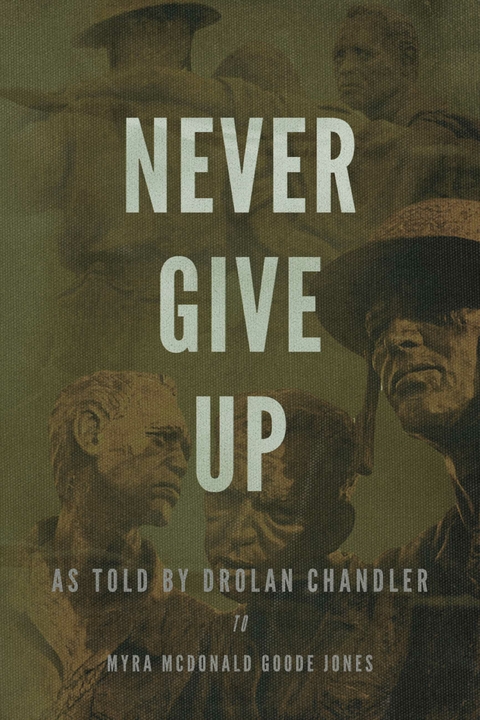
Never Give Up (eBook)
390 Seiten
Bookbaby (Verlag)
978-1-0983-1552-8 (ISBN)
'Never Give Up' is Drolan Chandler's personal story, as told to his niece, Myra Jones, of his combat and prisoner of war experiences during World War II. The story encompasses his childhood background, enlistment, basic training at Savannah Air Base in Georgia where he was assigned to duty in the USAF Headquarters Squadron 27th Bomb Group, Transportation Group, which was sent to Operation: PLUM, at Fort McKinley in the Philippines. After the Japanese invaded the Philippines during December, 1941, he fought in frontline jungle combat until April 9, 1942, when the American generals surrendered. He endured horrific treatment, including the infamous Bataan Death March, Bilibid Prison, Camp O'Donnell and Cabanatuan POW camps, hell ship Clyde Maru transfer to Omuta, Japan, Camp 17, and slave labor in unsafe coal mines. His sheer will to survive through positive attitude, humor, and bulldog determination - which often got him into trouble with his captors and caused some humorous, as well as dangerous, situations - is sure to inspire and entertain readers.
CHAPTER 2
I’m in the Army Now
I managed to stay in school and graduate. My senior year at Sulligent, 1938, was a good year. Weighing in around 185 to 190, height of 5’8”, I played fullback on our football team, which went undefeated.
After graduating in 1939, I drove the school bus in the mornings, worked at Hall’s Chevrolet as a mechanic during the day, and then drove the bus home in the evening. When Dad quit, I picked up his old bus route, which he had driven for twelve years for extra income. Later, in my spare time, I worked alongside him as a mechanic in his garage where he set up shop in the one-horse town of Detroit, Alabama.
One Wednesday, Mother’s brother, Uncle Carly Real,1 came by to visit on the way to Barksdale AFB, Bossier City/Shreveport, Louisiana. He had been in the army for nearly twenty-five years. A bunch of us boys, at Detroit, had already planned to enlist in the army the following Saturday.
“Why don’t you go to Birmingham with me? I’ll get you signed up where I’m going to be stationed in Shreveport for a while,” he suggested.
“I’ve already promised my friends I’d enlist with them,” I said.
He said he was going to spend the night and give me time to think about it. I got out that evening, since there were no phones, and hunted up the other fellows. They decided they would wait to be drafted, which we figured would start soon enough, foreseeing the United States’ involvement in the war in Europe was inevitable.
The next morning, I asked Dad to drive the school bus until I got back. I loaded up with Uncle Carly and went to the Birmingham Post Office, Court House and Federal Building, at 1800 Fifth Avenue North, which was where everyone signed up back then.
Carly informed the recruiting sergeant, “This is my nephew and he’s going to Shreveport with me.” He outranked the Buck Sergeant, so the man obliged and granted his request.
While I was getting my examination, I looked down the line and saw Jim Dyer.2 We had gone to school together and been best friends since we were kids. I thought Jim would be in Corpus Christi, Texas, by then, because Dad and I had worked on his car getting him ready to go.
“Where are you going?” Jim asked.
“Shreveport, Louisiana,” I replied.
“I’m going to Jefferson Barracks, in St. Louis, Missouri. Come on and go with me,” he coaxed.
“No, I’m going to Shreveport. My uncle is out yonder in the café eating lunch and he’s already got it arranged.”
Jim decided he wanted to go to Louisiana with me, so we went to the recruiting sergeant to request the assignment.
“No, I’ve got a quota I’ve got to fill for Jefferson Barracks, St. Louis, Missouri,” he barked.
I left the Post Office and crossed the street to the café. After I told Uncle Carly that Jim wanted to go with me and what the sergeant had told me, he slapped the table and stood up.
“Well, we ought to be able to fix that!” he stated with finality.
He strode over to the recruiting sergeant. “These boys grew up together and they’re going to camp together.”
About the time the sergeant finished taking care of Jim, another guy, Grady Palmatier, came in the office. He had been in the Infantry and lived in Birmingham, and he told the recruiting sergeant, “I’ve decided I’m going to join up again. I aim to join the Air Force in Savannah.”
“No, you’re going to Jefferson Barracks,” the recruiting sergeant snapped, his patience beginning to thin.
Fur flew, but the recruiting sergeant relented and then sent the three of us packing to the hotel to stay, just to keep us away from other recruits. I guess he was tired of messing with Uncle Carly.
*******
October 11, 1940: I was sworn in and joined the U.S. Army Air Corps at age twenty-one. I weighed in at 165 pounds.
Uncle Carly took us to the Savannah Air Base in Georgia. However, the base was not yet set up for recruit training.
While the Air Force was putting up tents and gearing up for the recruits, I went over to Fort Screven, Tybee Island, a coast artillery eighteen miles out of Savannah on the peninsula, and trained with the National Guard who had been called in.
After that training, I went back to Savannah Air Force Base to finish basic recruit training.3 I was officially assigned to duty in the U.S. Air Force Headquarters Squadron 27th Bomb Group, Transportation Group, which furnished trucks for the 27th Bomb Group.
I wore a civilian dress suit when I joined up and drilled in it throughout most of basic. The United States was gearing up for war, and it took time to get enough uniforms for everyone to wear. Later, I got a pair of dungarees and drilled in them until they sent me to duty.
Captain William Hipps graduated from West Point, U.S. Military Academy (USMA), made pilot and joined the Air Force, but was assigned to the recruits because he had Infantry training. He was a tough old geezer and later accompanied us overseas.4
I finished basic in December of 1940.
*******
We were told there wasn’t any need to put in for a furlough for Christmas because all the leave time had been granted.
Five of us slept to a tent. One of the guys in my tent worked as an administration clerk in the orderly room. Being a friend, he applied for leave on my behalf, starting January 3, but didn’t bother mentioning it to me.
My first day of duty, I was issued my dress uniform, and I sent my other clothes to the laundry.
General Lewis H. Brereton5 arrived by plane; his driver didn’t know he was due back that day and was nowhere to be found. They frantically hunted a man in uniform to go to the airport to drive the General’s car and serve as his escort. I was the only one they could find on short notice.
They handed me a trip ticket, stuck a star in the window, and sent me after him. A vehicle is not allowed within a certain distance from the airplane, but being a greenhorn, I didn’t know the rules. I drove under the wing and circled out the other side.
I slid to a halt and saw that the General was talking to someone. I parked the car with the right-hand side toward him and sat there waiting for him to get in. Unaware of military protocol, I didn’t realize I was supposed to go around and open the door for him.
When he finished talking, he opened the car door for himself and got in.
“Where to?” I asked.
“To the new barracks,” he stated. The barracks were being constructed at the other end of the runway.
I drove out from under the plane wing and headed down the middle of the taxiway, also against regulations, straight to the barracks. It seemed to be the logical thing to do since it was the shortest distance from point A to point B. The airport guard thought otherwise and came running out in a panic, then, confused when he saw the star on the jeep, threw up his hand to salute. We bounced off the end of the airstrip onto the street, and I screeched to a stop at his command.
“Let’s get out and inspect these barracks,” General Brereton said. So, he got out on his side and I got out on mine. We walked through inspecting the barracks, with me putting in my two cents worth, and then returned to the jeep.
“Let’s go,” he said, opening the door on his side and sitting, while I sauntered around to mine.
“Let’s go to Camp City,” he ordered.
Dutifully, I wheeled around and drove back down the flight strip, taking the shortest route to reach our tents on the other side. Again, guards ran out attempting to wave us down, but threw up a hand to salute when they saw the General.
At the PX on the other end of the landing strip, the General motioned for me to pull over and said, “Stop there.” I bounded off the landing field and bolted up to the PX.
In the meantime, the regular driver appeared on the scene. Nervous because he had missed his call to duty, he jumped into action when the General came out of the PX. The guy ran up to him, opened the door, and helped him carry his purchases to the vehicle.
“Sir, do you want me to drive for you?” he asked in a sweat.
“No, I’ve got a driver,” General Brereton replied. Then he turned to me and asked, “How long have you been in, soldier?”
“Today is my first day on duty,” I proudly announced. I believe he had figured that one out for himself.
“How long are you going to stay in?”
“Twenty years, I guess.” (Later, after my tour of Japan, needless to say, I changed my career plans.)
I delivered him to his appointed address, where he exited, unassisted, and wished me good luck. I suppose he knew I needed it.
How embarrassing it was to recall the episode when it dawned on me later, after obtaining more training and better sense, how many blunders I had committed during my initiation duty day.
*******
January 3, 1941: Saturday morning, I started to the mess hall to eat breakfast. As I passed the orderly room, Capt. Hipps stepped out. I snapped to attention and saluted him.
“Chandler!” he said.
I froze on the spot, not knowing what to expect.
The first day we were assigned to duty, Capt. Hipps...
| Erscheint lt. Verlag | 12.3.2021 |
|---|---|
| Sprache | englisch |
| Themenwelt | Literatur ► Biografien / Erfahrungsberichte |
| ISBN-10 | 1-0983-1552-9 / 1098315529 |
| ISBN-13 | 978-1-0983-1552-8 / 9781098315528 |
| Informationen gemäß Produktsicherheitsverordnung (GPSR) | |
| Haben Sie eine Frage zum Produkt? |
 EPUB (Adobe DRM)
Größe: 47,5 MB
Kopierschutz: Adobe-DRM
Adobe-DRM ist ein Kopierschutz, der das eBook vor Mißbrauch schützen soll. Dabei wird das eBook bereits beim Download auf Ihre persönliche Adobe-ID autorisiert. Lesen können Sie das eBook dann nur auf den Geräten, welche ebenfalls auf Ihre Adobe-ID registriert sind.
Details zum Adobe-DRM
Dateiformat: EPUB (Electronic Publication)
EPUB ist ein offener Standard für eBooks und eignet sich besonders zur Darstellung von Belletristik und Sachbüchern. Der Fließtext wird dynamisch an die Display- und Schriftgröße angepasst. Auch für mobile Lesegeräte ist EPUB daher gut geeignet.
Systemvoraussetzungen:
PC/Mac: Mit einem PC oder Mac können Sie dieses eBook lesen. Sie benötigen eine
eReader: Dieses eBook kann mit (fast) allen eBook-Readern gelesen werden. Mit dem amazon-Kindle ist es aber nicht kompatibel.
Smartphone/Tablet: Egal ob Apple oder Android, dieses eBook können Sie lesen. Sie benötigen eine
Geräteliste und zusätzliche Hinweise
Buying eBooks from abroad
For tax law reasons we can sell eBooks just within Germany and Switzerland. Regrettably we cannot fulfill eBook-orders from other countries.
aus dem Bereich


