


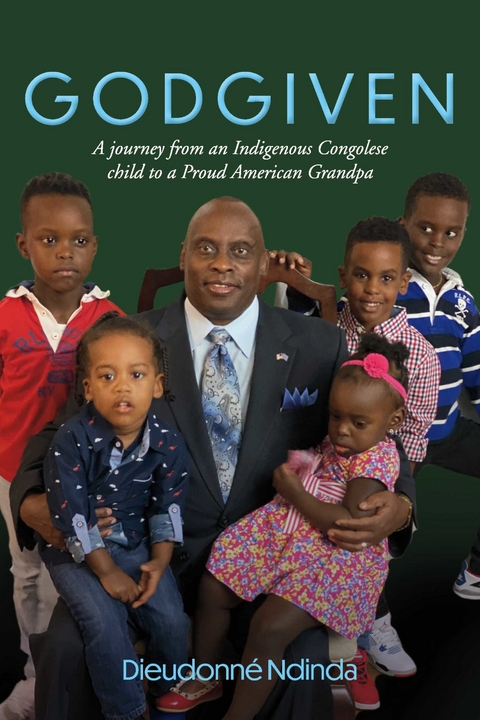
Godgiven (eBook)
494 Seiten
Bookbaby (Verlag)
978-1-0983-4012-4 (ISBN)
"e;Godgiven"e; is a moving autobiography that details the journey of an indigenous Congolese child. Since his birth in 1955 until present day, Dieudonne Ndinda takes us along with him from his youth in his home village through his education at the University of Kinshasa. Readers will discover his fight for opportunities in the workforce in the African Central Great Lakes region and his settlement in the United States of America. From childhood in the Democratic Republic of Congo to becoming an American Grandpa, this enlightening story will inspire and invigorate readers across the world. This unique memoir illustrates life in our increasingly interconnected world.
INTRODUCTION
When I was a little child, I asked my father and my uncles if my grandfather Buhoro had brothers and sisters. They answered that he had no siblings. They also told me that my great-grandfather Mbyayingabo was an only child. And they could not consistently give me the genealogy of their ancestors. Since they were orphaned in their infancy, left alone with their mother, it is understandable that, at the time when oral tradition was the only mode of communication, they couldn’t trace their lineage. Then, several years later when I settled in the USA as a refugee, one of the things that surprised me the most was that a lot of Americans don’t know where Africa is, while others think that Africa is a country. Motivated by those observations, I got the idea of, some time in a near future, writing a book with two objectives: give to my descendants a written reference of my family line and, through my life’s story, give to the American people and others some perspective of Africa in general and of my country of origin, the Democratic Republic of Congo (DRC), in particular. And, in my view, the best way to achieve these two goals was through an autobiography.
I am the first born of a family of seven children, and at my birth my father gave me the first name of Dieudonné, a French name that many Americans have a hard time to pronounce and that means God-given, which inspired the title of this book. After cross-checking the oral information received from relatives and friends of my extended family, I was able to make a genealogical tree of what currently constitutes the “Buhoro Family”.
So far during my life, I have greatly benefited from the solidarity built within this family and the unconditional support of many friends and comrades. So, throughout this book I cite several names of people who marked my life and which, understandably, many readers will find it difficult to read. But these are people I have known and who contributed to make me the man I am today. I remember that, speaking at Aretha Franklin’s funeral on August 31, 2018, former President of the United Sates Bill Clinton referenced to the conversation they had about her book “From These Roots”; when he asked her “why the book was full of those names of unknown people,” she responded that “she knew them and that was what mattered for her.” I totally agree with Aretha. Much more, for me the most important thing is the story behind each name invoked.
The period covering my childhood and adolescence begins with the time the Congo, then called Belgian Congo, was a colony of the Kingdom of Belgium. Since my father was an employee of the colonial administration, my family lived a relatively comfortable life. At my five years of age everything changed when, in 1960, Belgium suddenly decided to grant independence to the Congo. As my father found himself jobless, we were forced to move from my early childhood town to a village where we were reunited with other relatives and where other opportunities of employment were available. Thanks to the relationships built by my uncle and role model Herman Habarugira, my father quickly found a job as a topographer agronomist in a tea production company, while I was adapting to my new environment. Proximity to my grandmother, to my extended family, and especially to my cousin and mentor Jean Népomuscène Muzaribara, allowed me to cultivate a sense of family that would impact the rest of my life.
When, on June 30, 1960, the Congolese independence was proclaimed, I saw people cheering, dancing, and happy, but a kind of anxiety was perceptible due to concern about the unknown.
The Belgians had just left the country in the hands of a group of inexperienced and ill-educated politicians. Mr. Joseph Kasavubu was appointed President of the Democratic Republic of Congo and Mr. Patrice Eméry Lumumba was elected Prime Minister. They had a completely different view of the direction of the country so that, in 1961, the President fired the Prime Minister who, in turn, fired the President. Joseph Désiré Mobutu, who happened to be the Minister of Defense appointed by the Prime Minister, neutralized both the President and the Premier Minister and put in place a transition group formed by what he called “Commissaires Généraux.” Eventually, Mobutu reinstalled President Kasavubu and arrested Patrice Eméry Lumumba who would be killed in bizarre circumstances.
With the death of the latter, his party and its allies started an insurrection. The country was divided in several provinces with a multitude of political parties which looked a lot more like ethnic groups, turning against each other.
It was during this period that I learned that I belonged to the Tutsi ethnic group which, with Hutu and Twa, constituted the “Banyarwanda” or the “Rwandophones” people who, being marginalized and denied their Congolese nationality, found themselves in conflict with other ethnic groups.
Hence, it was in a chaotic climate of threats and fears that I started and pursued my studies at the Catholic Primary School of Birambizo from 1961 through 1967. However, there was some respite when, in 1965, Lieutenant-Colonel Joseph Désiré Mobutu took power by a coup d’état. The coup d’état was generally applauded by all socio-political actors and the international community. For the first time since 1960, my family, my community, and all Congolese in general, could feel safe in their homes.
After the Primary School, I was admitted in the Rugari Middle School “Institut Sainte Marie” where I spent two years - September 1967 through June 1969 – in very challenging conditions.
From Rugari, I moved to the Jomba Institut Saint Jean Bosco, which later became Institut Busimba, where I completed my high school in 1973. My stay at the Jomba secondary school definitively marked my life, having spent my adolescence there with all that implies in terms of perceptible physical, mental, emotional, social and behavioral changes, and assertiveness. The education received at this boarding school, coupled with the mentorship of my cousin Jean Népomuscène Muzaribara during my vacations, helped to shape the man that I have become. And although I was affected by the loss of my father when I was only 17 years old, it was with maturity and in total confidence that I received my High School State Diploma in 1973. And matureness was really needed when came the time to decide whether I would pursue my university education as I had planned, or I would follow the demand of my mom who insisted that I stick with the teaching job so that I could take care of my siblings.
Fortunately, in that deliberation I could benefit from the support of my mentor Jean Népomuscène and my role model, Uncle Herman, whose involvement allowed me to go to the National University of Zaïre – Kinshasa Campus.
At the University, I maintained my high school discipline. I was unimpressed by the guys who spent their time flirting with girls; actually, I was shocked by the extent of fornication that existed at the Campus. For me, there was no way I could even think of having a girlfriend, for several reasons: first, I considered it as a distraction while I should concentrate on my studies; second, it would be a betrayal to my Princess whom I had left in Jomba; third, the State Financial Aid I was receiving was just enough to cover my needs and I didn’t have the means to meet the costs of maintaining that kind of relationship; forth, I knew that proximity might lead to situations with disastrous consequences.
And this focus on studies paid off because on July 2, 1977 I was conferred upon the degree of Bachelor in Economic Sciences with concentration in Financial Management, at only 22 years old.
Then began my long professional career, going from a position of executive in State-owned companies ONACER and ONPV (1977 – 1979) to, successively, a senior manager position in the private company KOMEZA (1980 – 1982), a senior auditor and economist in the Consulting Firm COGEPAR (1982 – 1985), an expatriate senior executive in the holding Group VK (1985 -1990), a Partner in the Accounting and Auditing Firm SAGESS (1991 – 1998), and an Economic Adviser of the Minister of Economy of the Democratic Republic of Congo (1998).
As my career was successfully evolving, I managed to take care of my mother and my siblings, to create strong friendships, and to make up my own family by marrying a gorgeous, elegant, well-educated lady named Caritas Rwigema Rukundo who gave me five wonderful children: Didier, Micheline, Laurien, Carine, and André.
Nevertheless, as there are no roses without thorns, I had to face a lot of disappointments, challenges, and moments of sadness, especially the premature death of many loved ones.
The period after 1998 would start with a descent into the Congolese hell which shelters the demons of the nationality issue, already foregrounded by wicked politicians in the aftermath of the Congolese independence. To make the reader understand the underside of this question of the citizenship of “Banyarwanda” or “Rwandophones” in Congo, I had to dig in the past to give a historic overview of the creation of the Congo as a nation.
First of all, the current geographical space covering 1,430,000 square miles (2,300,000 square km) in the center of Africa, which forms the Democratic Republic of Congo, exists as a State only since 1885. The occupation of this space took place gradually, first by fishermen and hunter-gatherer peoples whose traces of presence go back to approximately 200,000 years B.C., and then by several successive migratory flows as well as conquest expeditions. Already, the desertification...
| Erscheint lt. Verlag | 14.2.2021 |
|---|---|
| Sprache | englisch |
| Themenwelt | Literatur ► Biografien / Erfahrungsberichte |
| ISBN-10 | 1-0983-4012-4 / 1098340124 |
| ISBN-13 | 978-1-0983-4012-4 / 9781098340124 |
| Informationen gemäß Produktsicherheitsverordnung (GPSR) | |
| Haben Sie eine Frage zum Produkt? |
 EPUB (Ohne DRM)
Größe: 6,4 MB
Digital Rights Management: ohne DRM
Dieses eBook enthält kein DRM oder Kopierschutz. Eine Weitergabe an Dritte ist jedoch rechtlich nicht zulässig, weil Sie beim Kauf nur die Rechte an der persönlichen Nutzung erwerben.
Dateiformat: EPUB (Electronic Publication)
EPUB ist ein offener Standard für eBooks und eignet sich besonders zur Darstellung von Belletristik und Sachbüchern. Der Fließtext wird dynamisch an die Display- und Schriftgröße angepasst. Auch für mobile Lesegeräte ist EPUB daher gut geeignet.
Systemvoraussetzungen:
PC/Mac: Mit einem PC oder Mac können Sie dieses eBook lesen. Sie benötigen dafür die kostenlose Software Adobe Digital Editions.
eReader: Dieses eBook kann mit (fast) allen eBook-Readern gelesen werden. Mit dem amazon-Kindle ist es aber nicht kompatibel.
Smartphone/Tablet: Egal ob Apple oder Android, dieses eBook können Sie lesen. Sie benötigen dafür eine kostenlose App.
Geräteliste und zusätzliche Hinweise
Buying eBooks from abroad
For tax law reasons we can sell eBooks just within Germany and Switzerland. Regrettably we cannot fulfill eBook-orders from other countries.
aus dem Bereich


