Introduction
Why Bother Writing a Book on that mashugana?
—Sheldon Leonard
My introduction to Joey Bishop began in the spring of 1996. I was in Los Angeles doing interviews on a planned book about actor Robert Cummings. I was also kicking around the idea of a biography on Joey Bishop that would touch upon the Rat Pack. I thought it was perfect timing. Sammy had died in 1990. Dean had just passed away at Christmas in 1995. Peter Lawford had ceased to exist more than a decade earlier, in 1984. Frank Sinatra gave his last performance in February of 1995 and the rumor was that he was suffering from dementia. Joey was basically the last man standing.
I was enjoying a leisurely lunch at the old-school Valley Inn Restaurant in Sherman Oaks, California, with sitcom writing guru Austin “Rocky” Kalish and the legendary actor/producer/director Sheldon Leonard. Over the years, my greatest pleasure was listening to these accomplished raconteurs. Writers always know the inside scoop on the comics and can expose every gory detail. And the topic of Joey Bishop opened the floodgates.
I asked for their thoughts about my writing a book about Joey Bishop and the Rat Pack.
“Shoot yourself first,” cracked Leonard in his unforgettable side-of-the-mouth, New Yorkese, gangster voice. Leonard was far from being a streetwise hood, however. A graduate of Syracuse University, Sheldon Leonard Bershad was an erudite partner and producer (with Danny Thomas) of some truly classic sitcoms. One of the lesser shows under the Danny Thomas umbrella was The Joey Bishop Show. With Leonard’s help—and despite the hiring and firing of writers, directors, actors and with several format changes—it lasted four seasons on two networks for an astonishing 123 episodes.
“Why bother writing a book on that mashugana?” Leonard continued.
My dear friend Rocky Kalish was my Sensei. Rocky and his wife (and writing partner), Irma (who became a prominent leader at the Writers Guild), spanned decades in television. Rocky had the unfortunate experience of writing for the Bishop show as a favor to Sheldon.
Rocky was never one to mince words. “That son of a bitch isn’t worth a paragraph … talentless motherfucker. He couldn’t score a role on Sunrise Sermon.”
I was hoping that Sheldon could wrangle an interview with the Chairman of the Board as he had been friendly with him and had co-starred (as Harry the Horse) in Guys and Dolls in 1955. Leonard said with a wry grin, “Not a chance.”
Under Rocky’s tutelage, I met countless other great writers, performers, and legends of film and television. A wonderful documentary entitled Lunch (2012), lovingly created by Donna Kanter (daughter of comedy legend Hal Kanter), shows Rocky in his full splendor. As Jannette Catsoulis of the New York Times wrote in her November 8, 2012, review:
It’s all knishes and kibitzing in “Lunch,” Donna Kanter’s charming documentary about a Hollywood institution more enduring than most sitcoms. … Every other Wednesday for 40 years a bunch of legendary comedy writers and directors—whose career highlights alone would fill a showbiz encyclopedia—have been meeting for a prandial catch-up session. The location may change (currently it’s Factor’s Famous Deli), but the diners remain constant, give or take the odd family or medical event. And though the gathering usually kicks off with health updates —the so-called “organ recital”—these guys (and they are all guys) would rather not focus on hip-replacement humor.
These lunches, several of which I attended as Rocky’s guest, featured top comedy writers, directors, and television personalities: Hal Kanter, Irving Brecher, Sid Caesar, Carl Reiner, Gary Owens, director Arthur Hiller, Mel Brooks, Matty Simmons, Arthur Marx, Monty Hall, and writers Ben Starr and John Rappaport. I sat there like the proverbial fly on the wall, soaking up these great stories as they flew, fast and furious, around the table.
Inevitably, at almost every lunch I attended over several years, stories about working with Joey Bishop came up—war stories. It seemed that at one time or another Joey fired virtually every legendary comedy writer. It became a sort of badge of honor, a Purple Heart. Harry Crane, Fred Freeman, Marvin Marx, Bill Persky, Sam Denoff, Irving Ellison, Fred Fox, Danny Simon … the list seemed endless.
After each lunch, I went back to my hotel room and recorded these unforgettable stories, carefully including the anecdotes about the perils of working with Joey Bishop.
Joey’s head writer of his ABC talk show, Trustin Howard (a.k.a. Slick Slavin), told the author, “I believe I was the longest-surviving writer to stick with Joey [nearly three years]. While I was grateful for the job, Regis and I lived through a constant reign of terror.”
It was a call from both Sheldon and Rocky that unlocked the door to Joey. I called him and, at first, he sounded rather old and crotchety.
“I’m not talking about the fucking Rat Pack,” he warned me.
Nonetheless, I wangled an invitation to his home, which was in the Newport Beach area, about an hour from where I was staying in the Valley. I had my eldest son, Matthew, with me as he was on spring break. Matthew had no idea who (or even what) Joey Bishop was. It had been almost thirty years since Joey had walked off his ABC late-night talk show in 1969. For all intents and purposes, when his talk show was canceled, so was he.
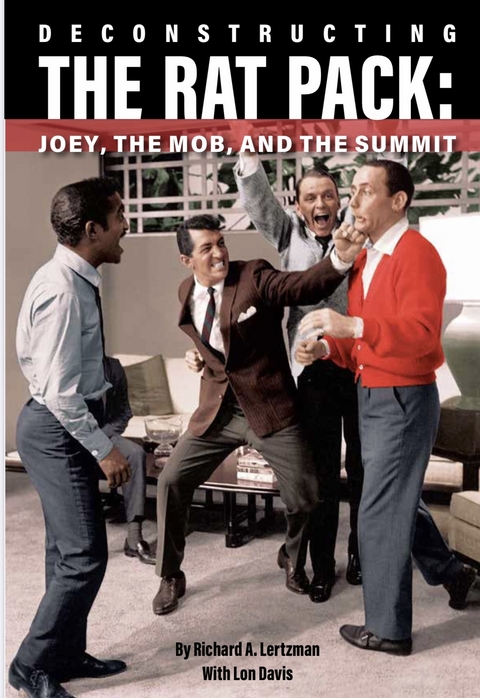
I was hoping that a book about the Rat Pack, fronted by Joey, would be saleable. It wasn’t Joey I was interested in, but a fresh, insider’s glimpse at Frank, Dean, and Sammy (and Peter) by “the hub” (as Joey called himself) of the wheel.
Joey had lived for nearly thirty years in a gated community in Newport Beach. Lido Isle is a man-made island located in the harbor, which is linked to the city by a small bridge. It’s a crowded, residential area with townhouses, condominiums, and small homes. Joey, who loved the water, had also docked his boats (Son of a Gun I, Son of a Gun II, etc.) near the condo. I believe he had sold his last boat just prior to our initial meeting.
I set up the meeting for about 11 A.M. with his assistant, Nora Garibotti. Joey lived in an older condo with Sylvia, his wife of nearly sixty years. Although it was a crowded residential complex with a marina setting, it had a spectacular view of the ocean/harbor. I met Sylvia, and then Joey, who looked much older and far more disheveled than I had expected. He was wearing a sweat suit dotted with food stains. The house was a throwback to the early 1970s “Jewish schmaltz” that I remembered from my youth. Joey took us upstairs to his study, which he called the “trophy room.” It was basically a shrine to himself. There were plaques, framed photographs, statuettes (awards), and books lining the shelves.
As it turns out, my visit was hardly an “exclusive.” A parade of writers and reporters had already made the pilgrimage to Lido Isle after the deaths of the other Rat Pack members, hoping to squeeze out some hitherto-unexplored memories. As our conversation progressed, Joey grew angrier as he began to realize that our interest was clearly in Frank, Dean, and Sammy—and that he was just an afterthought.
What attracted us to this subject was far more complex than just the man’s talent—or lack thereof. In fact, I don’t consider Joey Bishop to be much more than a competent comedian. He was not unlike baseball player Bob Uecker, who made himself the butt of many jokes concerning his mediocre career. “If a guy hits .300 every year, what does he have to look forward to?” Uecker asked. “I always tried to stay around .190 with three or four RBI. And I tried to get them all in September. That way I always had something to talk about that winter.”8
Thus, we compare Joey to that utility player. That guy on the bench—a journeyman. Dependable. Adequate.
So why write a book about an adequate comedian?
Joey took his ordinary skills and landed himself in the middle of the phenomenon known as the Rat Pack. His inclusion, though, had far less to do with his comic skills and more with his neutrality. There is a Yiddish expression, “Ir Nit Shtinken ader schkm,” which translates as “You neither stink nor smell.” In essence, it means you can get along with everybody. You don’t stand out in a loud way. Joey knew how to be liked and blend in. He could kiss ass.
While perfecting his craft as a comic in the 1930s and ’40s, he was also making the right friends—mobsters such as Moe Dalitz, Billy Weinberger, Carl Cohen, Mickey Cohen, Louis Rothkopf, Frank Costello, Benjamin “Bugsy” Siegel, Meyer Lansky. He became the fair-haired boy of Murder, Inc. He worked their joints, kept his nose clean, handled hecklers, looked the other...


 EPUB (Ohne DRM)


