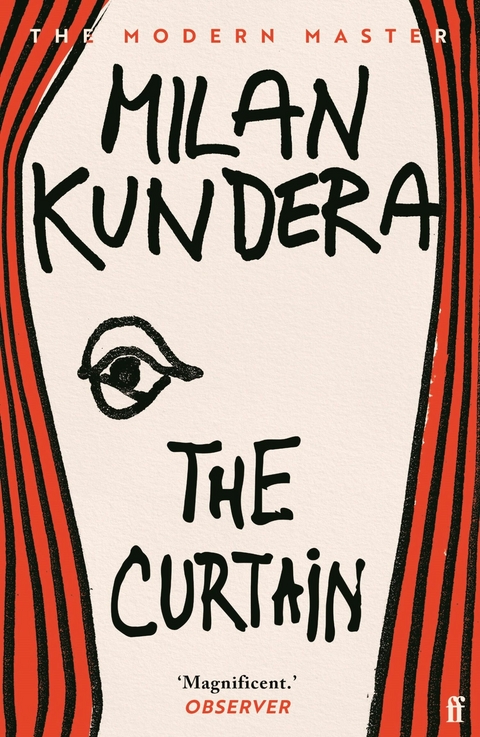
Curtain (eBook)
176 Seiten
Faber & Faber (Verlag)
978-0-571-36743-6 (ISBN)
The French-Czech novelist Milan Kundera was born in the Czech Republic and has lived in France since 1975. He died in Paris in 2023.
A landmark essay about the value of the novel from the superstar author of The Unbearable Lightness of Being. A magic curtain, woven of legends, hung before the world . . . Cervantes sent Don Quixote journeying and tore the curtain. The world opened before the knight errant in all the comical nakedness of its prose.'For Kundera, this curtain represents our individual, ready-made, pre-interpreted perceptions of the world. The job of the novelist, he argues, is to rip through it to reveal what it hides. In this outstanding essay, one of world literature's most distinctive thinkers celebrates the history and value of fiction in Western civilisation. Too often, a novel is thought about only within the confines of the language and nation of its origin, when in fact its development has always occurred across borders: Fielding learned from Cervantes, Joyce from Flaubert, Marquez from Kafka. The real work of a novel transcends locality by revealing a previously unknown aspect of human existence, asking life's biggest questions - and in his extraordinary prose, Kundera describes how the greatest novels do just that. 'Magnificent.' Observer'Thoughtful and thought-provoking. We owe Kundera thanks.'Sunday Times'Full of insights, which show Kundera to be a wonderful critic . . . His tone is seductive, sly and, above all, personal.' Financial Times
The French-Czech novelist Milan Kundera was born in the Czech Republic and has lived in France since 1975.
The Consciousness of Continuity
THEY USED TO TELL A STORY ABOUT MY FATHER, WHO WAS a musician. He is out with friends someplace when, from a radio or a phonograph, they hear the strains of a symphony. The friends, all of them musicians or music buffs, immediately recognize Beethoven’s Ninth. They ask my father, “What’s that playing?” After long thought he says, “It sounds like Beethoven.” They all stifle a laugh: my father doesn’t recognize the Ninth Symphony! “Are you sure?” “Yes,” says my father, “Late Beethoven.” “How do you know it’s late?” He points out a certain harmonic shift that the younger Beethoven could never have used.
The anecdote is probably just a mischievous little invention, but it does illustrate the consciousness of continuity, one of the distinguishing marks of a person belonging to the civilization that is (or was) ours. Everything, in our eyes, took on the quality of a history, seemed a more or less logical sequence of events, of attitudes, of works. From my early youth I knew the exact chronology of my favorite writers’ works. Impossible to think Apollinaire could have written Alcools after Calligrammes, because if that were the case he would have been a different poet, his whole work would have a different meaning. I love each of Picasso’s paintings for itself, but I also love the whole course of his work understood as a long journey whose succession of stages I know by heart. In art, the classic metaphysical questions—Where do we come from? Where are we going?—have a clear, concrete meaning, and are not at all unanswerable.
History and Value
LET US IMAGINE A CONTEMPORARY COMPOSER WRITING A sonata that in its form, its harmonies, its melodies resembles Beethoven’s. Let’s even imagine that this sonata is so masterfully made that, if it had actually been by Beethoven, it would count among his greatest works. And yet no matter how magnificent, signed by a contemporary composer it would be laughable. At best its author would be applauded as a virtuoso of pastiche.
What? We feel aesthetic pleasure at a sonata by Beethoven and not at one with the same style and charm if it comes from one of our own contemporaries? Isn’t that the height of hypocrisy? So then the sensation of beauty is not spontaneous, spurred by our sensibility, but instead is cerebral, conditioned by our knowing a date?
No way around it: historical consciousness is so thoroughly inherent in our perception of art that this anachronism (a Beethoven piece written today) would be spontaneously (that is, without the least hypocrisy) felt to be ridiculous, false, incongruous, even monstrous. Our feeling for continuity is so strong that it enters into the perception of any work of art.
Jan Mukarovsky, the founder of structural aesthetics, wrote in Prague in 1932: “Only the presumption of objective aesthetic value gives meaning to the historical evolution of art.” In other words: in the absence of aesthetic value, the history of art is just an enormous storehouse of works whose chronologic sequence carries no meaning. And conversely: it is only within the context of an art’s historical evolution that aesthetic value can be seen.
But what objective aesthetic value can we speak of if each nation, each historical period, each social group has tastes of its own? From the sociological viewpoint the history of an art has no meaning in itself but is part of a society’s whole history, like the history of its clothing, its funeral and marriage rituals, its sports, or its celebrations. That is roughly how the novel is discussed in the Diderot and d’Alembert Encyclopédie (1751–72). The author of that entry, the Chevalier de Jaucourt, acknowledges that the novel has a broad reach (“nearly everyone reads it”) and a moral influence (sometimes worthwhile, sometimes noxious), but not a specific value in itself; and furthermore, he mentions almost none of the novelists we admire today: not Rabelais, not Cervantes, not Quevedo, nor Grimmelshausen, nor Defoe, nor Swift, nor Smollett, nor Lesage, nor the Abbé Prévost; for the Chevalier de Jaucourt the novel does not stand as autonomous art or history.
Rabelais and Cervantes. That the encyclopedist did not cite either one of them is no shock: Rabelais hardly worried about whether he was a novelist or not, and Cervantes believed he was writing a sarcastic epilogue to the fantastical literature of the previous period; neither saw himself as “a founder.” It was only in retrospect, over time, that the practice of the art of the novel assigned them the role. And it did so not because they were the first to write novels (there were many other novelists before Cervantes), but because their works made clear—better than the others had—the raison d’être of this new epic art; because for their successors the works represented the first great novelistic values; and only when people began to see the novel as having a value—a specific value, an aesthetic value—could novels in their succession be seen as a history.
Theory of the Novel
FIELDING WAS ONE OF THE FIRST NOVELISTS ABLE TO CONCEIVE a poetics of the novel: each of the eighteen books of Tom Jones opens with a chapter devoted to a kind of theory of the novel (a light, playful theory, for that’s how a novelist theorizes—he holds jealously to his own language, flees learned jargon like the plague).
Fielding wrote his novel in 1749, thus two centuries after Gargantua and Pantagruel and a century and a half after Don Quixote, and yet even though he looks back to Rabelais and Cervantes, for him the novel is still a new art, so much so that he calls himself “the founder of a new province of writing …” That “new province” is so new that it has no name yet! Or rather, in English it has two names—novel and romance—but Fielding refuses to use them because no sooner is it discovered than the “new province” is invaded by “a swarm of foolish novels and monstrous romances,” with which he does not want his own books confused. He therefore designates this new art by a rather convoluted but remarkably accurate expression: “prosai-comiepic writing.”
He tries to define the art—that is, to determine its raison d’être, to outline the realm of reality it should illuminate, explore, grasp: “the provision, then, which we have here made is no other than Human Nature.” The assertion only seems banal; readers at the time saw novels as amusing, edifying, entertaining stories, but nothing more; no one would have granted the novel a purpose so general, thus so exacting, so serious, as an inquiry into “human nature”; no one would have elevated it to the rank of a reflection on man as such.
In Tom Jones, Fielding suddenly interrupts himself in mid-narration to declare that he is dumbfounded by one of the characters, whose behavior the writer finds “the most unaccountable of all the absurdities which ever entered into the brain of that strange prodigious creature man”; in fact, astonishment at the “inexplicable” in “that strange … creature man” is for Fielding the prime incitement to writing a novel, the reason for inventing it. “Invention” is the key word for Fielding; he refers to its Latin source—inventio, meaning “discovery, or finding out.” In inventing his novel the novelist discovers an aspect of “human nature” till then unknown, concealed; so a novelistic invention is an act of knowing that Fielding defines as “a quick and sagacious penetration into the true essence of all the objects of our contemplation.” (A remarkable sentence: the adjective “quick” indicates that he is speaking of a particular kind of knowing, in which intuition is fundamental.)
And the form of that “prosai-comi-epic writing”? “As I am the founder of a new province of writing, I am at liberty to make what laws I please therein,” Fielding proclaims, and he rejects out of hand any rules or limits which the literary bureaucrats or “clerks”—his term for critics—would try to dictate to him; in his view the novel is defined (and I see this as essential) by its raison d’être; by the realm of reality it has to “discover”; its form, however, arises in a freedom that no one can delimit and whose evolution will be a perpetual surprise.
Poor Alonzo Quijada
POOR ALONZO QUIJADA MEANT TO ELEVATE HIMSELF INTO THE legendary figure of a knight-errant. Instead, for all of literary history, Cervantes succeeded in doing just the opposite: he cast a legendary figure down: into the world of prose. “Prose”: the word signifies not only a nonversified language; it also signifies the concrete, everyday, corporeal nature of life. So to say that the novel is the art of prose is not to state the obvious; the word defines the deep sense of that art. Homer never wondered whether, after their many hand-to-hand struggles, Achilles or Ajax still had all their teeth. But for Don Quixote and Sancho teeth are a perpetual concern—hurting teeth, missing teeth. “You must know, Sancho, that no diamond is so precious as a tooth.”
But prose is not merely the difficult or vulgar side of life, it is also a certain beauty, till then neglected: the beauty of modest sentiments, for instance the fondness tinged with familiarity that Sancho feels toward Don Quixote. The Don reproaches him for his garrulous...
| Erscheint lt. Verlag | 9.10.2020 |
|---|---|
| Übersetzer | Linda Asher |
| Verlagsort | London |
| Sprache | englisch |
| Themenwelt | Literatur ► Essays / Feuilleton |
| Literatur ► Romane / Erzählungen | |
| Geisteswissenschaften ► Sprach- / Literaturwissenschaft ► Literaturwissenschaft | |
| Schlagworte | Humankind • language |
| ISBN-10 | 0-571-36743-7 / 0571367437 |
| ISBN-13 | 978-0-571-36743-6 / 9780571367436 |
| Informationen gemäß Produktsicherheitsverordnung (GPSR) | |
| Haben Sie eine Frage zum Produkt? |
 EPUB (Adobe DRM)
Kopierschutz: Adobe-DRM
Adobe-DRM ist ein Kopierschutz, der das eBook vor Mißbrauch schützen soll. Dabei wird das eBook bereits beim Download auf Ihre persönliche Adobe-ID autorisiert. Lesen können Sie das eBook dann nur auf den Geräten, welche ebenfalls auf Ihre Adobe-ID registriert sind.
Details zum Adobe-DRM
Dateiformat: EPUB (Electronic Publication)
EPUB ist ein offener Standard für eBooks und eignet sich besonders zur Darstellung von Belletristik und Sachbüchern. Der Fließtext wird dynamisch an die Display- und Schriftgröße angepasst. Auch für mobile Lesegeräte ist EPUB daher gut geeignet.
Systemvoraussetzungen:
PC/Mac: Mit einem PC oder Mac können Sie dieses eBook lesen. Sie benötigen eine
eReader: Dieses eBook kann mit (fast) allen eBook-Readern gelesen werden. Mit dem amazon-Kindle ist es aber nicht kompatibel.
Smartphone/Tablet: Egal ob Apple oder Android, dieses eBook können Sie lesen. Sie benötigen eine
Geräteliste und zusätzliche Hinweise
Buying eBooks from abroad
For tax law reasons we can sell eBooks just within Germany and Switzerland. Regrettably we cannot fulfill eBook-orders from other countries.
aus dem Bereich