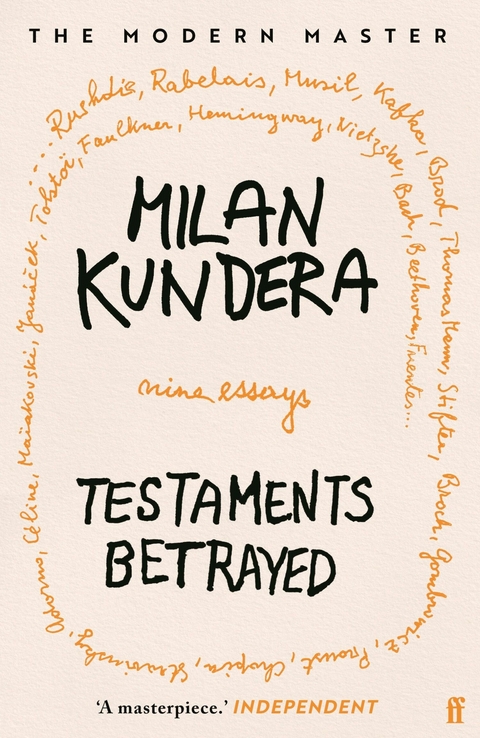
Testaments Betrayed (eBook)
288 Seiten
Faber & Faber (Verlag)
978-0-571-36742-9 (ISBN)
The French-Czech novelist Milan Kundera was born in the Czech Republic and has lived in France since 1975. He died in Paris in 2023.
An invigorating novelistic essay, rich in literary wisdom, from the international superstar author of The Unbearable Lightness of Being. 'A masterpiece.' Independent'Nothing so much as a gauntlet, thrown down by Kundera for both novelists and their readers to pick up - if we dare. ' ObserverStravinsky and Kafka meet with their friends Ansermet and Brod; Hemingway with his biographer; Janacek with his little nation; and Rabelais with his heirs. In Kundera's unique essay written in the form of a novel, our greatest novelists become characters who repeatedly cross paths, shedding light on the great aesthetic questions of our time along the way. Through their wise encounters, we explore the moral trials of twentieth century culture; the boundaries between past and present; the twilight of individualism; and the betrayed testaments of European art. Characteristically rich in revelatory ideas about the time in which we live, eloquently exposing how we have become who we are, this is a landmark work from a legendary writer and critic.
The French-Czech novelist Milan Kundera was born in the Czech Republic and has lived in France since 1975.
1
The image of Kafka that is widely held these days comes originally from a novel. Max Brod wrote it immediately after Kafka’s death and published it in 1926. Savor the title: The Enchanted Kingdom of Love (Zauberreich der Liebe). This key-novel is a roman à clef, a novel with a key. Its protagonist, a German writer in Prague named Nowy, is recognizably a flattering self-portrait of Brod (adored by women, envied by the literati). Nowy/Brod cuckolds a man who, by very elaborate wicked schemes, gets him sent to prison for four years. We are instantly plunged into a story cobbled together by the most improbable coincidences (characters meet by complete chance on a ship out at sea, on a Haifa street, on a street in Vienna), we witness the struggle between the good (Nowy and his mistress) and the evil (the cuckold, so vulgar that he fully deserves his horns, and a literary critic who systematically pans Nowy’s wonderful books), we are pained by melodramatic reversals (the heroine kills herself because she cannot bear life caught between the cuckold and the cuckolder), we admire the sensitive soul of Nowy/Brod, who swoons regularly.
This novel would have been forgotten before it was written if not for the character Garta. Because Garta, Nowy’s close friend, is a portrait of Kafka. Without this key, the character would be the most uninteresting in the entire history of literature; he is described as a “saint of our time,” but even about the ministry of his saintliness we don’t learn much, except that from time to time, when Nowy/Brod is having love troubles, he seeks advice from his friend, which the friend, as a saint with no such experience, is incapable of giving him.
What a marvelous paradox: the whole image of Kafka and the whole posthumous fate of his work were first conceived and laid out in this simpleminded novel, this garbage, this cartoon-novel concoction, which, aesthetically, stands at exactly the opposite pole from Kafka’s art.
2
Some quotations from the novel: Garta “was a saint of our time, a veritable saint.” “Perhaps his best quality was his remaining so independent and free, so saintly rational in the face of all mythologies, even though deep down he was akin to them and nearly a mythological figure himself.” “He wanted to live in perfect purity—rather, he could not do otherwise….’
The words “saint,” “saintly,” “mythological,” “purity,” are not a matter of rhetoric; they are to be taken literally: “Of all the sages and prophets who have walked the earth, he was the quietest…. Perhaps he lacked one thing: self-confidence. With it, he would have become a guide to humanity. No, he was not a guide. He spoke neither to the people nor to disciples, like the Buddha, Jesus, Moses. He did not speak that way. He remained reticent. Was that because he saw more deeply into the great mystery than those three? Because what he undertook was more difficult yet than what the Buddha intended? Because if he succeeded, it would be conclusive?”
And again: “All the founders of religions were sure of themselves. One of them, however—he may well be the most sincere of all—Lao-tze, retreated into the shadows. Garta certainly did the same.”
Garta is presented as someone who writes. Nowy “had agreed to be Garta’s literary executor—Garta had asked him to do this, but with the unusual condition that everything be destroyed.” Nowy “sensed the reason for that last wish. Garta was not announcing a new religion; he wanted only to live his faith…. He required the ultimate effort of himself; as he had not succeeded, his writings (mere rungs to help him climb to the heights) had no value for him.”
Still, Nowy/Brod did not want to obey his friend’s wish, because in his view, Garta’s writings, “even as attempts, as mere sketches, bring to wandering humanity a presentiment of something irreplaceable.”
Yes, it’s all there.
3
Were it not for Brod, we would not even know Kafka’s name today. Right after his friend’s death, Brod saw to the publication of his three novels. No reaction. So he realized that, to establish Kafka’s work, he would have to undertake a real and long war. Establishing a body of work means presenting it, interpreting it. Brod opened a veritable artillery attack: prefaces: for The Trial (1925), for The Castle (1926), for Amerika (1927), for “Description of a Struggle” (1936), for the diaries and letters (1937), for the stories (1946); for the Conversations by Gustav Janouch (1952); then the dramatizations: of The Castle (1953) and Amerika (1957); but above all, four important books of interpretation (take good note of the titles!): Franz Kafka: A Biography (1937), The Faith and Teachings of Franz Kafka (1946), Franz Kafka, He Who Shows the Way (1951), and Despair and Salvation in the Work of Franz Kafka (1959).
Through all of these texts, the image outlined in The Enchanted Kingdom of Love is confirmed and developed: above all, Kafka is primarily the religious thinker, der religiöse Denker. True, he “never systematically set out his philosophy and his religious world view. Nonetheless, we can deduce rather clear fundamentals from his work, from his aphorisms especially but also from his poetry, his letters, his diaries, and then also from his way of life (from that above all)….”
Further on: Kafka’s true importance cannot be understood “unless two currents in his work are distinguished: (1) the aphorisms, (2) the narrative writings (novels, stories, fragments).
“In his aphorisms Kafka expounds the positive word [das positive Wort] that he gives to mankind, a faith, a stern call for each individual to change his own life.”
In his novels and stories, “he describes the horrible punishments in store for those who do not wish to hear the word [das Wort] and do not follow the path of righteousness.”
Note the hierarchy: at the top: Kafka’s life as an example to be followed; in the middle: the aphorisms, that is, all the meditative “philosophical” passages in his diaries; at the bottom: the narrative works.
Brod was a brilliant intellectual with exceptional energy; a generous man willing to do battle for others; his attachment to Kafka was warm and disinterested. The only problem was his artistic orientation: a man of ideas, he knew nothing of the passion for form; his novels (he wrote twenty of them) are sadly conventional; and above all: he understood nothing at all about modern art.
Why, despite all this, was Kafka so fond of him? What about you—do you stop being fond of your best friend because he has a compulsion to write bad verse?
But the man who writes bad verse turns dangerous once he starts to publish the work of his poet friend. Suppose the most influential commentator on Picasso were a painter who could not even manage to understand the impressionists. What would he say about Picasso’s paintings? Probably the same thing Brod said about Kafka’s novels: that they describe “the horrible punishments in store for those who … do not follow the path of righteousness.”
4
Max Brod created the image of Kafka and that of his work; he created Kafkology at the same time. The Kafkologists may distance themselves from their founding father, but they never leave the terrain he mapped out for them. Despite the astronomical number of its texts, Kafkology goes on elaborating infinite variants on the same discussion, the same speculation, which, increasingly unconnected to Kafka’s work, feeds only on itself. Through innumerable prefaces, postfaces, notes, biographies and monographs, university lectures and dissertations, Kafkology produces and sustains its own image of Kafka, to the point where the author whom readers know by the name Kafka is no longer Kafka but the Kafkologized Kafka.
Not everything written on Kafka is Kafkology. How then to define Kafkology? By a tautology: Kafkology is discourse for Kafkologizing Kafka. For replacing Kafka with the Kafkologized Kafka:
1) Following Brod’s example, Kafkology examines Kafka’s books not in the large context of literary history (the history of the European novel) but almost exclusively in the microcontext of biography. In their monograph, Boisdeffre and Albérès cite Proust rejecting biographical explication of art, but only to say that Kafka requires exception to that rule, as his books are “not separable from his person. Whether he is called Josef K., Rohan, Samsa, the Surveyor, Bendemann, Josefine the Singer, the Hunger Artist, or the Trapeze Artist, the hero of his books is none other than Kafka himself.” Biography is the principal key for understanding the meaning of the work. Worse: the only meaning of the work is as a key for understanding the biography.
2) Following Brod’s example, in the hands of the Kafkologists Kafka’s biography ...
| Erscheint lt. Verlag | 9.11.2020 |
|---|---|
| Verlagsort | London |
| Sprache | englisch |
| Themenwelt | Literatur ► Biografien / Erfahrungsberichte |
| Literatur ► Essays / Feuilleton | |
| Literatur ► Romane / Erzählungen | |
| Geisteswissenschaften ► Sprach- / Literaturwissenschaft ► Anglistik / Amerikanistik | |
| Geisteswissenschaften ► Sprach- / Literaturwissenschaft ► Literaturwissenschaft | |
| Schlagworte | ART • Culture • writers |
| ISBN-10 | 0-571-36742-9 / 0571367429 |
| ISBN-13 | 978-0-571-36742-9 / 9780571367429 |
| Informationen gemäß Produktsicherheitsverordnung (GPSR) | |
| Haben Sie eine Frage zum Produkt? |
 EPUB (Adobe DRM)
Kopierschutz: Adobe-DRM
Adobe-DRM ist ein Kopierschutz, der das eBook vor Mißbrauch schützen soll. Dabei wird das eBook bereits beim Download auf Ihre persönliche Adobe-ID autorisiert. Lesen können Sie das eBook dann nur auf den Geräten, welche ebenfalls auf Ihre Adobe-ID registriert sind.
Details zum Adobe-DRM
Dateiformat: EPUB (Electronic Publication)
EPUB ist ein offener Standard für eBooks und eignet sich besonders zur Darstellung von Belletristik und Sachbüchern. Der Fließtext wird dynamisch an die Display- und Schriftgröße angepasst. Auch für mobile Lesegeräte ist EPUB daher gut geeignet.
Systemvoraussetzungen:
PC/Mac: Mit einem PC oder Mac können Sie dieses eBook lesen. Sie benötigen eine
eReader: Dieses eBook kann mit (fast) allen eBook-Readern gelesen werden. Mit dem amazon-Kindle ist es aber nicht kompatibel.
Smartphone/Tablet: Egal ob Apple oder Android, dieses eBook können Sie lesen. Sie benötigen eine
Geräteliste und zusätzliche Hinweise
Buying eBooks from abroad
For tax law reasons we can sell eBooks just within Germany and Switzerland. Regrettably we cannot fulfill eBook-orders from other countries.
aus dem Bereich