


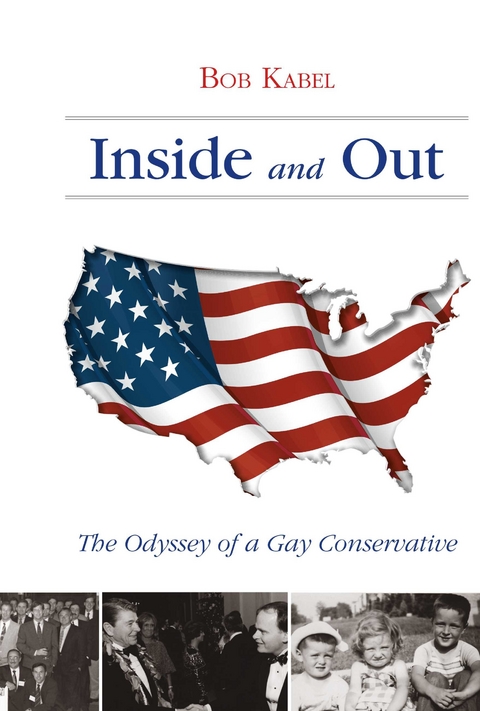
Inside and Out (eBook)
318 Seiten
Bookbaby (Verlag)
978-1-0983-1665-5 (ISBN)
Millions of young men and women all over the country dream of one day walking the corridors of power in the nation's capital. Bob Kabel was one who got to live the dream when he worked on the staff of two U.S. senators and President Ronald Reagan. Some of the obstacles he faced were typical: gaining knowledge and maturity, thriving in hyper competitive arenas, and earning the favor of key mentors. But some obstacles were less common. These days, being gay or lesbian is not widely considered a hindrance to a successful career, but in the 50s, 60s, and 70s, being gay was at the very least awkward and could at times be quite dangerous. That includes Bob's experience of being kidnapped, robbed, and shot by a young hustler in Nashville, Tennessee. Aside from the physical danger, being gay could be the equivalent of the scarlet letter for a young man with designs on making his mark in Republican politics. Somehow, Bob persevered. "e;Inside and Out"e; is his story.
CHAPTER 2
Members Only
Being a gay Republican, especially someone involved in politics, is a tightrope act. No event better summarizes this reality than a meeting of the Republican National Committee (RNC) in the spring of 2013. It was a defining moment in my personal and professional life.
As the RNC meeting was getting underway, LGBT Americans had made considerable progress toward equality, in both public opinion and the law. At the end of 2010, Congress repealed the odious Clinton-era “Don’t Ask Don’t Tell” policy; so now gay men and lesbians could serve openly in the U.S. military. Many states and localities had adopted anti-discrimination laws protecting the LGBT community. The freedom to marry was now legal in several states and the District of Columbia. Plus, the Supreme Court was considering two important cases involving marriage rights for gay and lesbian Americans.
The RNC’s April meeting was held in the heart of Hollywood, at a hotel adjacent to the theatre that annually hosts the Academy Awards. Meeting in L.A. was part of a strategy developed after the 2012 election defeat — called the Growth and Opportunity Project and commissioned by RNC Chairman Reince Priebus — to, among a lengthy list of action items, “reach out” to the liberal-leaning blue states and especially to certain minority constituencies. I have enjoyed these meetings. We all share a love of our country and a desire to serve it by promoting the Republican Party’s core policies and principles. One of my favorite events during this three-day meeting was an awards luncheon for Asian-American Republicans. It was heartwarming to see so many deserving senior Asian-Americans receiving awards for service to their country and party. It was also gratifying to hear their eloquent comments, filled with wisdom derived from a long life and a culture that reveres its seniors. President Ronald Reagan’s son Michael also spoke at this luncheon; he was terrific in warning of the dangers of being overly harsh on social issues. It was a harbinger of things to come.
A few weeks before the spring meeting, I had learned there would be two resolutions addressing the freedom to marry. One resolution highlighted the GOP’s socially conservative principles as stated in the party’s 2012 platform, including the definition of marriage as being between one man and one woman. The other resolution specifically outlined the party’s opposition to gay marriage. From my perspective, and that of many other RNC members, these resolutions were unnecessary, if for no other reason than the 2012 GOP platform that had been adopted the previous August already included those items. There was no need to accentuate them. Let me be clear: I opposed having these references in the party platform at all, but I understood they were there to placate social conservatives. I also knew the Herculean effort that would be required to remove them. Proposing these two resolutions was a combination of power play and publicity stunt by the party’s far-right wing to bring extra attention to the issue ahead of the Supreme Court’s pending decision on gay marriage. As a gay man and a committed member of the Republican Party, I could not just let these two resolutions pass without some effort to stop them. It was unlikely I could stop them because resolutions, even those offensive or embarrassing to certain constituency groups, are typically passed without much debate by the RNC Resolutions Committee and then brought up as a package to be considered during a voice vote at the general session, which is open to the public. So, I decided to raise my concerns at the members-only session, which is held at every RNC meeting. As the name suggests, this session was for RNC members only. No staff or journalists allowed, so I knew I could say what was in my heart and on my mind, and not be accused of public grandstanding. The Republican National Committee has 168 members; three members from each U.S. state, territory, and the District of Columbia. The three members include a state party chairman, a national committeeman, and a national committeewoman.
The members-only session was scheduled for breakfast on Thursday morning. I told Reince Priebus, the RNC Chairman, the evening before that I was going to do two things at the breakfast. First, I would come out as a gay man. Second, I would express my concerns about the two marriage resolutions. I considered Reince a friend with a very difficult job, so I owed him a heads-up. He urged me to get to the microphone early in the meeting so there would be time for discussion. That night, I wrote and re-wrote the talking points for my statement. To be effective I had to make my points as thoroughly and as succinctly as possible. My training as an attorney and advocate served me well as I crafted my “case.” This work helped keep my mind off the potential ramifications of my speech. Eventually, I settled on the appropriate phrases and tone I would use. Then I had some red wine before going to bed for some much-needed sleep.
The next morning at the members-only session, I followed Reince’s advice. As soon as he was finished speaking, I quickly stood up to speak, but I was beat to the microphone by Dr. Ada Fisher, a retired medical doctor who was the Republican national committeewoman from North Carolina. Ada is one of a handful of African American members in the party’s national leadership. A larger-than-life figure in every sense of the word, she always makes very pointed, challenging comments but with a down-home sense of humor that usually gets a laugh from her audience.
As Ada was speaking, I had extra time to think more about what I was going to say, and how my comments would be received. The room was filled with men and women from all over the country, some of whom I had known for years and other newer members I was just getting to know. I had built a career, a reputation, and a life with service to the GOP as its foundation. I had always lived my life with a sense of dignity and with an eye on earning other’s respect. I had no doubt I had earned the respect of many people in that room. Some of them knew I was gay, but many more didn’t. I hadn’t made a special effort to hide my sexual orientation, but I didn’t need to. Nothing about my manner suggested the stereotypical “tells” of a gay man. I had always been rather quiet and reserved, and not given to talking about my personal life with professional colleagues in any setting. But I knew that once I broke the seal and talked about my sexuality and placed it in the arena of politics, my standing in that community would be permanently impacted. I didn’t know if the reaction would be positive or negative. But I was committed, in that place and at that moment, to step outside my comfort zone to stand up for my beliefs.
After Ada Fisher finished speaking, I walked to the microphone. My hand had a slight tremor that belied my nervousness, but my voice was steady. I told the assembled RNC members that while many of them knew me others did not, so I asked for their indulgence to give them some of my background. I told them that I had grown up in the 1960s in Ohio when being a Republican meant being a fiscal conservative, strong on defense and foreign affairs. People’s personal lives were considered private and the GOP stayed out of that sphere until some years later. I scanned the room, looking at the faces watching me speak, knowing that what I was about to say would change the expressions on many of those faces. I described myself as a “hard-wired” Republican and a “hard-wired” gay man. A few jaws dropped; I also noted a few smiles.
I went on to say I had been elected four times as Chairman of the DCGOP as an openly gay man and city wide in Washington, D.C. as the Republican national committeeman. I felt I had some standing to discuss LGBT issues. I raised my concerns about the two resolutions on marriage that had been voted on the previous day by the Resolutions Committee, noting that the resolutions had been drafted by social conservative members and backed by a large group of social conservative organizations led by ultra-conservative Phyllis Schlafly in response to the Supreme Court cases on gay marriage. I discussed recent polls showing most younger voters in support of same-sex marriage. And I mentioned other polls dispelling the assumption that African Americans and Hispanics strongly opposed the freedom to marry. I added that the margin by which voters aged 18 to 29 supported Barack Obama (60% for Obama versus 36% for Republican candidate Mitt Romney) was the largest advantage for the President of any voting group other than African Americans. I concluded by saying that if we lost them again in the 2016 Presidential contest, we would probably lose them forever. I then sat down and waited for reactions to my speech.
I didn’t have to wait long. The reactions rolled across the room like a like a summer storm. There are certain states where the election process for Republican national committeeman and Republican national committeewoman is structured in such a way that social conservatives almost always win; the representatives from those states had the most visceral reaction to my speech. The member who was waiting his turn behind me at the microphone was one of the most socially conservative members in the entire GOP, a somewhat bitter man with a countenance that made me think of someone who had eaten nails for breakfast. After hearing me say “hard-wired gay man,” he moaned. After I sat down, he took the microphone and proceeded to ask in a very angry tone why the RNC was reaching out to homosexuals; that they were an infinitesimal percentage of the population who didn’t count. I was...
| Erscheint lt. Verlag | 14.9.2020 |
|---|---|
| Sprache | englisch |
| Themenwelt | Literatur ► Biografien / Erfahrungsberichte |
| ISBN-10 | 1-0983-1665-7 / 1098316657 |
| ISBN-13 | 978-1-0983-1665-5 / 9781098316655 |
| Informationen gemäß Produktsicherheitsverordnung (GPSR) | |
| Haben Sie eine Frage zum Produkt? |
 EPUB (Adobe DRM)
Größe: 16,6 MB
Kopierschutz: Adobe-DRM
Adobe-DRM ist ein Kopierschutz, der das eBook vor Mißbrauch schützen soll. Dabei wird das eBook bereits beim Download auf Ihre persönliche Adobe-ID autorisiert. Lesen können Sie das eBook dann nur auf den Geräten, welche ebenfalls auf Ihre Adobe-ID registriert sind.
Details zum Adobe-DRM
Dateiformat: EPUB (Electronic Publication)
EPUB ist ein offener Standard für eBooks und eignet sich besonders zur Darstellung von Belletristik und Sachbüchern. Der Fließtext wird dynamisch an die Display- und Schriftgröße angepasst. Auch für mobile Lesegeräte ist EPUB daher gut geeignet.
Systemvoraussetzungen:
PC/Mac: Mit einem PC oder Mac können Sie dieses eBook lesen. Sie benötigen eine
eReader: Dieses eBook kann mit (fast) allen eBook-Readern gelesen werden. Mit dem amazon-Kindle ist es aber nicht kompatibel.
Smartphone/Tablet: Egal ob Apple oder Android, dieses eBook können Sie lesen. Sie benötigen eine
Geräteliste und zusätzliche Hinweise
Buying eBooks from abroad
For tax law reasons we can sell eBooks just within Germany and Switzerland. Regrettably we cannot fulfill eBook-orders from other countries.
aus dem Bereich


