


East Clifton Avenue (eBook)
274 Seiten
Bookbaby (Verlag)
978-1-0983-2300-4 (ISBN)
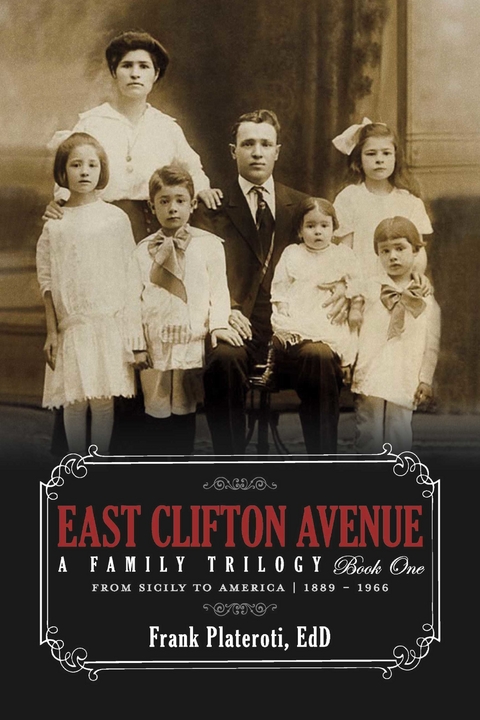
I am introducing you to the Buonofortes: A family similar to my mother's family and the millions of other families who immigrated to this great country at the beginning of the last century. The Italian immigrants took their place among the other immigrants who came before them and who were already acclimated and settled in their new country. Similar to all the new immigrants, regardless of nationality, they all shared the same passion: to make a better life for themselves, their children, and generations to come. This is a fictional/non-fictional account of the Buonforte family. A family that came from Sicily, Italy in the early 1900's to make a better life for the children and finally settle on East Clifton Avenue, New Jersey. Non fictional events are inter-weaved with fictional events and people. The Buonoforte family lived in Clifton, New Jersey, a town similar to thousands of small towns in the northeastern part of the United States. Within the story of the Buonoforte family, the sacrifices, potential rewards, and heartbreak of unconditional love are the main message: Rethink behaviors as to not repeat the same mistakes that eventually destroy families. A message that I hope millions of other families may be able to relate to, understand, and be moved by. You will see within the Buonoforte family that there are those who are emotional and affectionate, and those who may be emotional and not affectionate. Although brothers and sisters may share the same genetics, it is a puzzle why if brought up by the same parents they can be so different. It creates much confusion and potential hurt. Perhaps if that is understood, we can let go of old vendettas and hurt feelings, reconnect, and grow.
Chapter 1:
A Home on East Clifton Avenue
I am introducing you to the Buonofortes: A family similar to my mother’s family and the millions of other families who immigrated to this great country at the beginning of the last century. The Italian immigrants took their place among the other immigrants who came before them and who were already acclimated and settled in their new country. Similar to all the new immigrants, regardless of nationality, they all shared the same passion: to make a better life for themselves, their children, and generations to come. The Buonoforte family lived in Clifton, New Jersey, a town similar to thousands of small towns in the northeastern part of the United States.
It was many years ago that the second-floor master bedroom of the Buonoforte house on East Clifton Avenue was the family living room. The front entrance that leads onto an open porch offers a broad view of East Clifton Avenue, which ends at Lexington to the west and Randolph to the east. On both sides of East Clifton Avenue there are rows of different-size houses built in different architectural designs. As with other houses in the neighborhood, the renovations of the Buonoforte house were built for “function and not form” in order to accommodate a growing family.
The eat-in kitchen is in the basement, which is the original section of the house. When the Buonoforte family moved into their small house there wasn’t a bathroom inside the house, but only an “outhouse” in the backyard referred to in broken English as the “backous.” Years later, when more children were born, a bigger living space was added to make room for a half bathroom downstairs, a full bathroom upstairs, and two additional bedrooms. The basement was also extended to include a bigger dining and living room area.
It is January. At this point there is really no need to know when, but let’s just say the early 1960s. It’s also important to note that the neighborhood is changing. On this winter day the view from the large master bedroom window is somewhat obstructed due to the condensation. However, one could still see smoke billowing against the gray winter sky out of the chimneys of the houses that have been renovated and added to in a confusing mix of carelessly configured design. Like the Buonoforte house, “necessity and function” replaced architectural integrity in lieu of the need of additional living space. Rooms were built onto houses where rooms should never have been built. Where once large ceiling-to-floor windows let in warm summer breezes through a Florida-style sunroom, it later became a small additional bedroom for an unexpected newly born son or daughter. An oddly placed outside door leads into small partitioned rooms that were hastily created to make an apartment for a widowed mother or father whose married son or daughter now live in the main part of the house. Eventually, when grown children left their parent’s house or were killed in one of the world wars, some of these rooms were turned back into sunrooms and porches; but instead of rebuilding them according to their original design, the exteriors were covered with asbestos or aluminum siding to minimize cost and maintenance.
This mad mix of designs has become the architectural hodgepodge that makes up the small neighborhood of East Clifton Avenue. And as the houses are different architecturally, the perception on the outside is different from the reality of the families who live in each of the houses on the inside. But like the many other neighborhoods in Clifton and surrounding towns, it’s about the families that created a “home.” And these homes were created by the sweat of hundreds of immigrants who traveled from Europe at the beginning of the twentieth century. They entered the United States at Ellis Island and moved into neighborhoods like East Clifton Avenue, which became their “street of dreams” and for some their nightmares.
America had two things that the immigrants didn’t have from where they came from: hope and opportunity. In America, with hard work, those who came here would be able to take advantage of all the opportunities that America offered in order to create a better life for themselves and the generations to come. Just as with thousands of neighborhoods all over the country, many of the people who lived on East Clifton Avenue were able to achieve their goals and dreams. Many worked at any job they could get, while others started businesses from their garages, if they were so lucky to have a garage, selling fruits and vegetables from horse-drawn carts, or taking in wash, or whatever else could supplement the household income. Hundreds of Clifton residents were employed at factories that sprang up like the one in Botany Village on the other side of Clifton that produced textiles. And because of the hard-working immigrants who worked in the factories or wherever they could get a job, many of their children got an education and became doctors, lawyers, and engineers and as well as achieving success in other professional fields. Many of the children also fought and died in the wars that came and went, which further ingrained the immigrants into the fabric of the country.
There was the determination to work hard and sacrifice in order to achieve the American Dream: owning a home and being part of this great country. But the American Dream was hard to hang onto, because hard work wasn’t enough. This was a time when there was no unemployment insurance or Social Security. Families had to make it on their own or they didn’t eat. It was made even more difficult because immigrants had to endure bigotry and prejudice. Some were able to endure the bigotry, while some went back to their countries of origin and endured the “we told you so” from the families who remained there.
With the influx of immigrants, East Clifton Avenue became a blend of cultures. People from Italy, Germany, Poland, Hungary, and other countries throughout Europe and throughout the world tried hard to hold onto and share their ethnic heritage, while at the same time acclimating to their new country. Many residents formed social and cultural clubs so they would be able to continue their ethnic culture and pass it onto their children. But at the same time, they embraced the American culture and formed new traditions that were a blend of the new and the old.
One tradition for most Italian families takes place each Sunday before and after going to church. Early in the morning, husbands leave their homes to buy newspapers and groceries and to gossip in lines while waiting for the fresh bread to come out of the hot bakery ovens. Everything would have to be fresh, including the gossip they shared as they waited. It had been pointed out on more than one occasion by the wives of the neighborhood that the men gossiped more than the woman because the woman were too busy keeping house and attending to the many children. While the men shopped, the women were already preparing things for the afternoon meals. Some were making fresh raviolis or pasta that they dried on their beds when they ran out of room in the kitchen. They attended to the “sauce” or “gravy,” depending on how each family refers to their tomato concoction. While mothers scream in Italian and “broken English” to their children to get ready for church, they also run around the kitchen toasting bread or heating leftover pizza for a fast breakfast to give to their children. After a couple of hours, the husbands return with the Sunday paper and groceries and hang up their heavy wool coats smelling of cigarette or cigar smoke. As they yell for their wives, they head for the kitchen carrying the bags of cold cuts, fresh bread, and groceries for the Sunday night meal, give the bags into the hands of their anxious wives, and yell for an expresso, “Per favore, prende il caffe subito!”
After a quick trip to the bathroom to relieve themselves of all the espresso or coffee they already drank, they then share all the gossip they heard while shopping in order to distract their wife as they break off the end of the freshly baked crusty Italian bread they just bought and dip it into the hot tomato sauce simmering on the sparkling white stove. Their wife screams and pushes them away from the pot while asking what took him so long, and the husband continues to blabber about this and that. The wives don’t even fully hear or care about what is being said unless it is about someone who is sick or has, God forbid, died. Perhaps it’s some “juicy” new neighborhood scandal.
After fully interrogating the husband, the wife then shuts the gas burner under the sauce, covers the steaming pot, throws off her apron onto the chair, and then leaves the kitchen to help get the kids get ready for mass, while the husband sits and reads the paper, perhaps chewing on what is left of a little cigar he had smoked earlier. After all, the husband knows that getting the kids ready and taking care of the household chores is a wife’s job. It is a well-orchestrated symphony of confusion, which can take years of practice and a lot of yelling. But not everyone can handle so many things at once. People still talk about Mrs. Nudio, who was in such a panic to get to her family ready for church that she forgot to put her skirt on and left the house wearing just her slip. It was fortunate that it was winter and her heavy coat covered most of it, but it made for some teasing and laughs over cold cuts and homemade wine that Sunday evening sharing the story with her relatives.
The Buonoforte Family
Like many of the other...
| Erscheint lt. Verlag | 7.9.2020 |
|---|---|
| Sprache | englisch |
| Themenwelt | Literatur ► Biografien / Erfahrungsberichte |
| ISBN-10 | 1-0983-2300-9 / 1098323009 |
| ISBN-13 | 978-1-0983-2300-4 / 9781098323004 |
| Informationen gemäß Produktsicherheitsverordnung (GPSR) | |
| Haben Sie eine Frage zum Produkt? |
 EPUB (Adobe DRM)
Kopierschutz: Adobe-DRM
Adobe-DRM ist ein Kopierschutz, der das eBook vor Mißbrauch schützen soll. Dabei wird das eBook bereits beim Download auf Ihre persönliche Adobe-ID autorisiert. Lesen können Sie das eBook dann nur auf den Geräten, welche ebenfalls auf Ihre Adobe-ID registriert sind.
Details zum Adobe-DRM
Dateiformat: EPUB (Electronic Publication)
EPUB ist ein offener Standard für eBooks und eignet sich besonders zur Darstellung von Belletristik und Sachbüchern. Der Fließtext wird dynamisch an die Display- und Schriftgröße angepasst. Auch für mobile Lesegeräte ist EPUB daher gut geeignet.
Systemvoraussetzungen:
PC/Mac: Mit einem PC oder Mac können Sie dieses eBook lesen. Sie benötigen eine
eReader: Dieses eBook kann mit (fast) allen eBook-Readern gelesen werden. Mit dem amazon-Kindle ist es aber nicht kompatibel.
Smartphone/Tablet: Egal ob Apple oder Android, dieses eBook können Sie lesen. Sie benötigen eine
Geräteliste und zusätzliche Hinweise
Buying eBooks from abroad
For tax law reasons we can sell eBooks just within Germany and Switzerland. Regrettably we cannot fulfill eBook-orders from other countries.
aus dem Bereich


