


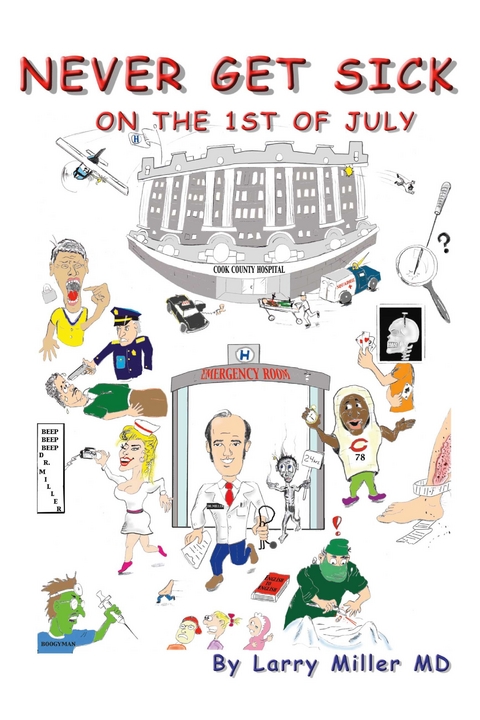
Never Get Sick on the First of July (eBook)
386 Seiten
Bookbaby (Verlag)
978-1-0983-2034-8 (ISBN)
Never Get Sick on the First of July includes more than 100 of the most human, outrageous, memorable, and, yes, weirdest and funniest incidents of Doctor Miller's medical training at Chicago's Cook County Hospital, where he earned the Intern of the Year Award. While each is a story unto itself, the episodes trace his development as a physician and are woven together by his underlying philosophy emphasizing a personalized, and empathetic approach to patient care. The stories are enriched by illustrating his thought processes and reveal tightly held secrets that until now only medical "e;insiders"e; knew. Readers will not only be entertained by the situation, but will also gain a rare understanding of the dynamics that give emergency medicine such powerful appeal. Readers will learn how a mysterious headache was caused by a nail some "e;friends"e; had pounded into the victim's head, and find out how a patient got "e;lost"e; for three months on a surgical ward. Every story is a grabber; every one is true. With the tremendous popularity of the television series "e;ER"e; (which took place at Cook County Hospital), you will be surprised to know what it was really like inside the nation's favorite emergency room. Doctor Miller's book illustrates what everyone should know before going to any ER, especially on the first of July.
DEDICATION
Over the years I have worked with hundreds of nurses, most of whom were friends as well as mentors. They have been my eyes, ears, hands, and feet, and my confidantes. Many times they saved me from an error in medication, pointed out an oversight of an obvious diagnosis or alerted me to problems I was unaware of. Although performing a different role than theirs, I have always viewed nurses as equals in the professional care of emergency patients. Their years of experience and sensitivity to patients have given nurses a sixth sense that is far more valuable than any laboratory analysis.
Most emergency nurses are highly motivated, dedicated, competent, and caring. They reinforce my instructions, prepare patients for treatments I have to render, and assist with procedures I could not accomplish alone. Without them, I could not possibly provide the level of medical care patients have come to expect.
These nurses often work under adverse conditions. On swing shifts, they switch from days to nights with little time to readjust their biological clocks. Theirs is one of the highest-stress occupations, where their decisions and accuracy often mean the difference between life and death. They deal constantly with patients who are agitated, frightened, and often on their worst behavior. Nurses competently handle throngs of demanding patients, all wanting to be seen first. Not only do nurses triage patients, identifying the most acutely ill, but they must also prioritize their work. Keeping one’s sanity in such a chaotic environment is a monumental task.
Compounding their problems, nurses must deal with doctors, many of whom have ego problems (the “God” complex), are rude and tend to treat nurses like subhuman servants; not exactly what you’d expect from the individuals who should most appreciate their competence and indispensable function. Besides the disrespect shown by some doctors, nurses are treated like fast food employees by hospital administrators who have historically underpaid and undervalued their essential services. The immense gap between nurses’ and doctors’ incomes is a national disgrace.
The ultimate insult too many times originates from nursing supervisors, who seem to ignore their own experiences as staff nurses. Instead of making their subordinates’ jobs easier and more productive, these nurse managers often burden their staffs with irrelevant, inflexible policy requirements and bureaucratic charting nightmares. No wonder we have a crisis caused by a shortage of experienced nurses.
Nurses who have survived such difficult working conditions have earned my utmost respect and admiration. For those who have shared with me many of life’s most precious and rewarding moments, as well as some of the most devastating and shattering experiences, I feel a tremendous debt of gratitude and deep affection.
To these valiant women and men, I dedicate this book.
I.
INTERNSHIP AT COOK
COUNTY HOSPITAL
EMERGENCY ROOM
Patient Nailed for Cheating at Cards
The young man stumbled into the ER holding his head, moaning and complaining of a horrible headache. He looked sick. (Over the years, I have learned to trust this “look”: dull eyes with droopy eyelids, an inanimate expression, gray skin tone, cold sweat, listless movements of the head and extremities, and an almost monotone voice. You can’t really document medical problems based on appearance, but over all, this “look” always spelled trouble to me.) After searching my memory for diagnoses of headaches, I proceeded to “work up” this patient (complete a medical history, conduct a physical exam, and initiate a battery of lab and diagnostic tests to determine what caused his problem). I asked him what happened.
“It all began about three days ago when I was playing cards with my friends at a party. I had some extra cards up my sleeve so I’d be sure to win. When they caught me cheating, they were really mad. They said I’d never cheat again and they started beating me up and pounding me on my head. The next thing I remember was waking up in the alley the next day and I had this horrible headache and it’s getting worse. Doc, everything looks blurry, it’s hard to walk. I’ve been throwing up.”
Good grief, I thought, these are all signs of a skull fracture or a subdural hematoma (bleeding into the brain). Something serious is going on with this fellow. I examined him very carefully like the eager intern I was. When I checked his pupils they reacted normally, so I performed a neurological exam, checking his balance and coordination, examined his scalp for bruises, looked in his ear for possible bleeding and found nothing. His physical exam checked out fine except he felt awful, was vomiting, and he had a terrible headache.
Still baffled, I sent him to radiology for skull x-rays. X-ray orders had to be handled cleverly at Cook County. If you wanted a patient processed quickly, you tied a red tag to the patient’s toe (or somewhere). “Red-tag x-ray” patients would probably be back in a few hours. That was considered fast. No red-tag and they might be gone for 12 hours or more just waiting their turn because there were so many patients. Several times I sent a patient for a routine x-ray just before getting off my shift, only to find the patient had not returned yet the following day when I started my next shift. I knew my headache patient needed a skull series fast, so I tied a red tag to his toe.
An hour or so later, Head ER Nurse McKernan called me, alarmed. “Miller, come here quick.” I ran to the view box. A 3-inch nail was clearly visible, driven straight into the top of my patient’s head. On the AP (anterior/posterior or front-to-back) view, you could see where this guy’s “friends” had struck him dead center and the nail penetrated right between the two sides of his brain.
I raced back to the patient, totally amazed he was still alive, and examined his scalp more carefully. I gingerly picked through his thick Afro hair and, sure enough, spotted a tiny scab. When I scraped it off, I saw the shiny head of the nail! I explained what had happened to my patient, but he could not believe his friends would pound a nail into his head. To convince him, I had to show him the x-rays.
“No wonder I have such a bad headache, Doc,” he groaned.
I called a skeptical neurosurgery resident who, after taking one glance at the x-ray, rushed the man into surgery, opened his skull, pulled out the nail, and placed him on antibiotics. To everyone’s amazement, the fellow survived and went home 10 days later. Of the thousands of headaches I have treated over the years, this one was the most bizarre, caused by cheating at cards.
You Better Know What to Do
From day one, my University of Michigan Medical School professors repeated this imprecation: “Remember this lecture because on the first day of your internship you might be assigned to the emergency room and you might be faced with this situation and you’d better know what to do.” That always got my attention. I took that advice to heart.
When I checked in at Cook County Hospital for my internship on The 1st of July, 1965, I could have been assigned to any one of twelve different departments. Sure enough, just as my professors had predicted, my first assignment was the emergency room, and not just any emergency room. This was one of the largest and busiest trauma centers in the world, treating more than 1,000 patients every day.
The emergency room at Cook County was a huge, sprawling facility encompassing an entire city block. It was divided down the center into female and male sections, necessary because of the total lack of privacy in this high-volume ER. When I walked into the first floor of the hospital, following arrows pointing to the emergency room, I saw throngs of people colliding with each other, stampeding through the doors and swarming the information desk. It was like Christmas Eve at Marshall Fields, except these people were not in a holiday mood. Many were bleeding or crying and they all seemed desperate. Nurses, doctors, orderlies, and aides worked their way through the crowd, running in every direction, ignoring pleas for help. Police were dragging in thugs in handcuffs. Stretchers transporting the critically injured were being pushed to treatment areas, knocking people out of the way. Blood was everywhere. People were screaming and dying. It was a war zone. Seeing my crisp white uniform, patients tugged on my shirt to ask for help. I was no help. I couldn’t even find my way to where I was supposed to report.
Finally, I saw a nurse who looked as if she knew where she was going. I followed her through a door that said NO ADMITTANCE. Whenever you’re trying to gain access to something, these warning signs usually lead the way. For example, if you need to get inside a TV cabinet, just open the panel that says “do not remove these screws.” When she reached her desk and picked up some charts, I caught up with her. “Excuse me Nurse. Do you know where the new interns are supposed to report?”
“Yep, right here,” she said, handing me the stack of charts in her hand. “Go see these patients.”
What have I gotten myself into? I thought. Who are these patients? What am I supposed to do...
| Erscheint lt. Verlag | 8.8.2020 |
|---|---|
| Sprache | englisch |
| Themenwelt | Literatur ► Biografien / Erfahrungsberichte |
| ISBN-10 | 1-0983-2034-4 / 1098320344 |
| ISBN-13 | 978-1-0983-2034-8 / 9781098320348 |
| Informationen gemäß Produktsicherheitsverordnung (GPSR) | |
| Haben Sie eine Frage zum Produkt? |
 EPUB (Ohne DRM)
Größe: 7,9 MB
Digital Rights Management: ohne DRM
Dieses eBook enthält kein DRM oder Kopierschutz. Eine Weitergabe an Dritte ist jedoch rechtlich nicht zulässig, weil Sie beim Kauf nur die Rechte an der persönlichen Nutzung erwerben.
Dateiformat: EPUB (Electronic Publication)
EPUB ist ein offener Standard für eBooks und eignet sich besonders zur Darstellung von Belletristik und Sachbüchern. Der Fließtext wird dynamisch an die Display- und Schriftgröße angepasst. Auch für mobile Lesegeräte ist EPUB daher gut geeignet.
Systemvoraussetzungen:
PC/Mac: Mit einem PC oder Mac können Sie dieses eBook lesen. Sie benötigen dafür die kostenlose Software Adobe Digital Editions.
eReader: Dieses eBook kann mit (fast) allen eBook-Readern gelesen werden. Mit dem amazon-Kindle ist es aber nicht kompatibel.
Smartphone/Tablet: Egal ob Apple oder Android, dieses eBook können Sie lesen. Sie benötigen dafür eine kostenlose App.
Geräteliste und zusätzliche Hinweise
Buying eBooks from abroad
For tax law reasons we can sell eBooks just within Germany and Switzerland. Regrettably we cannot fulfill eBook-orders from other countries.
aus dem Bereich


