


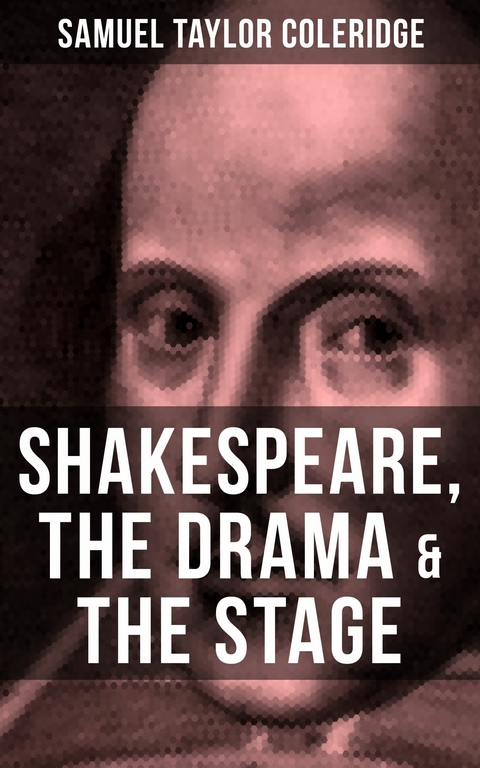
SHAKESPEARE, THE DRAMA & THE STAGE (eBook)
434 Seiten
Musaicum Books (Verlag)
978-80-272-0245-4 (ISBN)
Twelfth Night.
In the third, as indicating a greater energy — not merely of poetry, but of all the world of thought, yet still with some of the growing pains, and the awkwardness of growth — I place —
Troilus and Cressida.
Cymbeline.
Merchant of Venice.
Much Ado about Nothing.
Taming of the Shrew.
In the fourth, I place the plays containing the greatest characters —
Macbeth.
Lear.
Hamlet.
Othello.
And lastly, the historic dramas, in order to be able to show my reasons for rejecting some whole plays, and very many scenes in others.
CLASSIFICATION ATTEMPTED, 1819.
I think Shakespeare’s earliest dramatic attempt — perhaps even prior in conception to the Venus and Adonis, and planned before he left Stratford — was Love’s Labour’s Lost. Shortly afterwards I suppose Pericles and certain scenes in Jeronymo to have been produced; and in the same epoch, I place the Winter’s Tale and Cymbeline, differing from the Pericles by the entire rifacimento of it, when Shakespeare’s celebrity as poet, and his interest, no less than his influence, as manager, enabled him to bring forward the laid-by labours of his youth. The example of Titus Andronicus, which, as well as Jeronymo, was most popular in Shakespeare’s first epoch, had led the young dramatist to the lawless mixture of dates and manners. In this same epoch I should place the Comedy of Errors, remarkable as being the only specimen of poetical farce in our language, that is, intentionally such; so that all the distinct kinds of drama, which might be educed a priori, have their representatives in Shakespeare’s works. I say intentionally such; for many of Beaumont and Fletcher’s plays, and the greater part of Ben Jonson’s comedies, are farce plots. I add All’s Well that Ends Well, originally intended as the counterpart of Love’s Labour’s Lost, Taming of the Shrew, Midsummer Night’s Dream, Much Ado about Nothing, and Romeo and Juliet.
SECOND EPOCH.
Richard II.
King John.
Henry VI., — rifacimento only.
Richard III.
THIRD EPOCH.
Henry IV.
Henry V.
Merry Wives of Windsor.
Henry VIII., — a sort of historical masque, or show play.
FOURTH EPOCH
gives all the graces and facilities of a genius in full possession and habitual exercise of power, and peculiarly of the feminine, the lady’s character.
Tempest.
As You Like It
Merchant of Venice.
Twelfth Night.
And, finally, at its very point of culmination —
Lear.
Hamlet.
Macbeth.
Othello.
LAST EPOCH.
when the energies of intellect in the cycle of genius were, though in a rich and more potentiated form, becoming predominant over passion and creative self-manifestation —
Measure for Measure,
Timon of Athens.
Coriolanus.
Julius Cæsar.
Antony and Cleopatra.
Troilus and Cressida.
Merciful, wonder-making Heaven! what a man was this Shakespeare! Myriad-minded, indeed, he was.
Notes On The “Tempest.”
There is a sort of improbability with which we are shocked in dramatic representation, not less than in a narrative of real life. Consequently, there must be rules respecting it; and as rules are nothing but means to an end previously ascertained — (inattention to which simple truth has been the occasion of all the pedantry of the French school), — we must first determine what the immediate end or object of the drama is. And here, as I have previously remarked, I find two extremes of critical decision; — the French, which evidently presupposes that a perfect delusion is to be aimed at, — an opinion which needs no fresh confutation; and the exact opposite to it, brought forward by Dr. Johnson, who supposes the auditors throughout in the full reflective knowledge of the contrary. In evincing the impossibility of delusion, he makes no sufficient allowance for an intermediate state, which I have before distinguished by the term illusion, and have attempted to illustrate its quality and character by reference to our mental state when dreaming. In both cases we simply do not judge the imagery to be unreal; there is a negative reality, and no more. Whatever, therefore, tends to prevent the mind from placing itself, or being placed, gradually in that state in which the images have such negative reality for the auditor, destroys this illusion, and is dramatically improbable.
Now, the production of this effect — a sense of improbability — will depend on the degree of excitement in which the mind is supposed to be. Many things would be intolerable in the first scene of a play, that would not at all interrupt our enjoyment in the height of the interest, when the narrow cockpit may be made to hold
“The vasty field of France, or we may cram
Within its wooden O, the very casques,
That did affright the air at Agincourt.”
Again, on the other hand, many obvious improbabilities will be endured, as belonging to the groundwork of the story rather than to the drama itself, in the first scenes, which would disturb or disentrance us from all illusion in the acme of our excitement; as for instance, Lear’s division of his kingdom, and the banishment of Cordelia.
But, although the other excellences of the drama besides this dramatic probability, as unity of interest, with distinctness and subordination of the characters, and appropriateness of style, are all, so far as they tend to increase the inward excitement, means towards accomplishing the chief end, that of producing and supporting this willing illusion, — yet they do not on that account cease to be ends themselves; and we must remember that, as such, they carry their own justification with them, as long as they do not contravene or interrupt the total illusion. It is not even always, or of necessity, an objection to them, that they prevent the illusion from rising to as great a height as it might otherwise have attained; — it is enough that they are simply compatible with as high a degree of it as is requisite for the purpose. Nay, upon particular occasions, a palpable improbability may be hazarded by a great genius for the express purpose of keeping down the interest of a merely instrumental scene, which would otherwise make too great an impression for the harmony of the entire illusion. Had the panorama been invented in the time of Pope Leo X., Raffael would still, I doubt not, have smiled in contempt at the regret, that the broom twigs and scrubby bushes at the back of some of his grand pictures were not as probable trees as those in the exhibition.
The Tempest is a specimen of the purely romantic drama, in which the interest is not historical, or dependent upon fidelity of portraiture, or the natural connection of events, but is a birth of the imagination, and rests only upon the coaptation and union of the elements granted to, or assumed by, the poet. It is a species of drama which owes no allegiance to time or space, and in which, therefore, errors of chronology and geography — no mortal sins in any species — are venial faults, and count for nothing. It addresses itself entirely to the imaginative faculty; and although the illusion may be assisted by the effect on the senses of the complicated scenery and decorations of modern times, yet this sort of assistance is dangerous. For the principal and only genuine excitement ought to come from within — from the moved and sympathetic imagination; whereas, where so much is addressed to the mere external senses of seeing and bearing, the spiritual vision is apt to languish, and the attraction from without will withdraw the mind from the proper and only legitimate interest which is intended to spring from within.
The romance opens with a busy scene admirably appropriate to the kind of drama, and giving, as it were, the key-note to the whole harmony. It prepares and initiates the excitement required for the entire piece, and yet does not demand anything from the spectators, which their previous habits had not fitted them to understand. It is the bustle of a tempest, from which the real horrors are abstracted; — therefore it is poetical, though...
| Erscheint lt. Verlag | 7.8.2017 |
|---|---|
| Verlagsort | Prague |
| Sprache | englisch |
| Themenwelt | Literatur ► Essays / Feuilleton |
| Geisteswissenschaften ► Sprach- / Literaturwissenschaft ► Anglistik / Amerikanistik | |
| Schlagworte | Alexander Pope • Classic English Literature Study • Coleridge's Shakespeare Lectures • Dante • Drama and Theater Exploration • Edmund Burke • Elizabethan Drama Interpretation • English Poetry Critique • John Milton • Jonathan Swift • literary criticism collection • literary philosophy • Lord Byron • Mary Shelley • Romantic Era Criticism • Romantic Movement Insights • Shakespearean analysis • Thomas Paine • William Blake • William Wordsworth |
| ISBN-10 | 80-272-0245-0 / 8027202450 |
| ISBN-13 | 978-80-272-0245-4 / 9788027202454 |
| Informationen gemäß Produktsicherheitsverordnung (GPSR) | |
| Haben Sie eine Frage zum Produkt? |
 EPUB (Wasserzeichen)
DRM: Digitales Wasserzeichen
Dieses eBook enthält ein digitales Wasserzeichen und ist damit für Sie personalisiert. Bei einer missbräuchlichen Weitergabe des eBooks an Dritte ist eine Rückverfolgung an die Quelle möglich.
Dateiformat: EPUB (Electronic Publication)
EPUB ist ein offener Standard für eBooks und eignet sich besonders zur Darstellung von Belletristik und Sachbüchern. Der Fließtext wird dynamisch an die Display- und Schriftgröße angepasst. Auch für mobile Lesegeräte ist EPUB daher gut geeignet.
Systemvoraussetzungen:
PC/Mac: Mit einem PC oder Mac können Sie dieses eBook lesen. Sie benötigen dafür die kostenlose Software Adobe Digital Editions.
eReader: Dieses eBook kann mit (fast) allen eBook-Readern gelesen werden. Mit dem amazon-Kindle ist es aber nicht kompatibel.
Smartphone/Tablet: Egal ob Apple oder Android, dieses eBook können Sie lesen. Sie benötigen dafür eine kostenlose App.
Geräteliste und zusätzliche Hinweise
Buying eBooks from abroad
For tax law reasons we can sell eBooks just within Germany and Switzerland. Regrettably we cannot fulfill eBook-orders from other countries.
aus dem Bereich


