


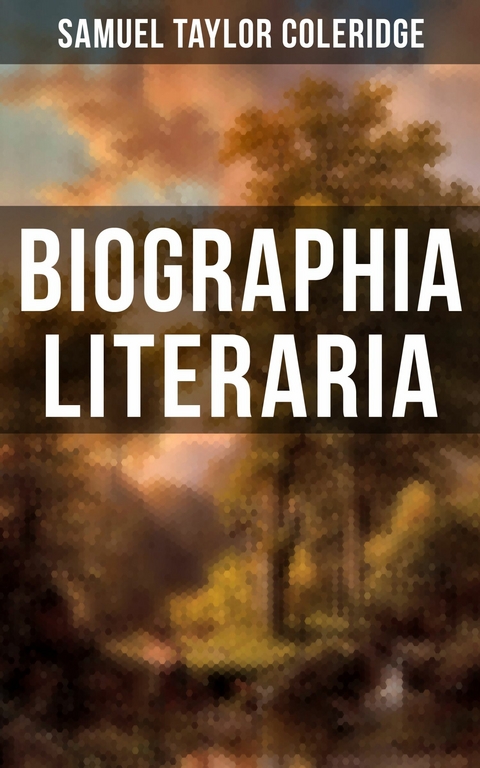
BIOGRAPHIA LITERARIA (eBook)
352 Seiten
Musaicum Books (Verlag)
978-80-272-0244-7 (ISBN)
CHAPTER IV
The Lyrical Ballads with the Preface — Mr. Wordsworth’s earlier poems — On fancy and imagination — The investigation of the distinction important to the Fine Arts.
I have wandered far from the object in view, but as I fancied to myself readers who would respect the feelings that had tempted me from the main road; so I dare calculate on not a few, who will warmly sympathize with them. At present it will be sufficient for my purpose, if I have proved, that Mr. Southey’s writings no more than my own furnished the original occasion to this fiction of a new school of poetry, and to the clamours against its supposed founders and proselytes.
As little do I believe that Mr. Wordsworth’s Lyrical Ballads were in themselves the cause. I speak exclusively of the two volumes so entitled. A careful and repeated examination of these confirms me in the belief, that the omission of less than a hundred lines would have precluded nine-tenths of the criticism on this work. I hazard this declaration, however, on the supposition, that the reader has taken it up, as he would have done any other collection of poems purporting to derive their subjects or interests from the incidents of domestic or ordinary life, intermingled with higher strains of meditation which the poet utters in his own person and character; with the proviso, that these poems were perused without knowledge of, or reference to, the author’s peculiar opinions, and that the reader had not had his attention previously directed to those peculiarities. In that case, as actually happened with Mr. Southey’s earlier works, the lines and passages which might have offended the general taste, would have been considered as mere inequalities, and attributed to inattention, not to perversity of judgment. The men of business who had passed their lives chiefly in cities, and who might therefore be expected to derive the highest pleasure from acute notices of men and manners conveyed in easy, yet correct and pointed language; and all those who, reading but little poetry, are most stimulated with that species of it, which seems most distant from prose, would probably have passed by the volumes altogether. Others more catholic in their taste, and yet habituated to be most pleased when most excited, would have contented themselves with deciding, that the author had been successful in proportion to the elevation of his style and subject. Not a few, perhaps, might, by their admiration of the Lines written near Tintern Abbey, on revisiting the Wye, those Left upon a Yew Tree Seat, The Old Cumberland Beggar, and Ruth, have been gradually led to peruse with kindred feeling The Brothers, the Hart-leap Well, and whatever other poems in that collection may be described as holding a middle place between those written in the highest and those in the humblest style; as for instance between the Tintern Abbey, and The Thorn, or Simon Lee. Should their taste submit to no further change, and still remain unreconciled to the colloquial phrases, or the imitations of them, that are, more or less, scattered through the class last mentioned; yet even from the small number of the latter, they would have deemed them but an inconsiderable subtraction from the merit of the whole work; or, what is sometimes not unpleasing in the publication of a new writer, as serving to ascertain the natural tendency, and consequently the proper direction of the author’s genius.
In the critical remarks, therefore, prefixed and annexed to the Lyrical Ballads, I believe, we may safely rest, as the true origin of the unexampled opposition which Mr. Wordsworth’s writings have been since doomed to encounter. The humbler passages in the poems themselves were dwelt on and cited to justify the rejection of the theory. What in and for themselves would have been either forgotten or forgiven as imperfections, or at least comparative failures, provoked direct hostility when announced as intentional, as the result of choice after full deliberation. Thus the poems, admitted by all as excellent, joined with those which had pleased the far greater number, though they formed two-thirds of the whole work, instead of being deemed (as in all right they should have been, even if we take for granted that the reader judged aright) an atonement for the few exceptions, gave wind and fuel to the animosity against both the poems and the poet. In all perplexity there is a portion of fear, which predisposes the mind to anger. Not able to deny that the author possessed both genius and a powerful intellect, they felt very positive, — but yet were not quite certain that he might not be in the right, and they themselves in the wrong; an unquiet state of mind, which seeks alleviation by quarrelling with the occasion of it, and by wondering at the perverseness of the man, who had written a long and argumentative essay to persuade them, that
Fair is foul, and foul is fair;
in other words, that they had been all their lives admiring without judgment, and were now about to censure without reason.
That this conjecture is not wide from the mark, I am induced to believe from the noticeable fact, which I can state on my own knowledge, that the same general censure has been grounded by almost every different person on some different poem. Among those, whose candour and judgment I estimate highly, I distinctly remember six who expressed their objections to the Lyrical Ballads almost in the same words, and altogether to the same purport, at the same time admitting, that several of the poems had given them great pleasure; and, strange as it might seem, the composition which one cited as execrable, another quoted as his favourite. I am indeed convinced in my own mind, that could the same experiment have been tried with these volumes, as was made in the well known story of the picture, the result would have been the same; the parts which had been covered by black spots on the one day, would be found equally albo lapide notatae on the succeeding.
However this may be, it was assuredly hard and unjust to fix the attention on a few separate and insulated poems with as much aversion, as if they had been so many plague-spots on the whole work, instead of passing them over in silence, as so much blank paper, or leaves of a bookseller’s catalogue; especially, as no one pretended to have found in them any immorality or indelicacy; and the poems, therefore, at the worst, could only be regarded as so many light or inferior coins in a rouleau of gold, not as so much alloy in a weight of bullion. A friend whose talents I hold in the highest respect, but whose judgment and strong sound sense I have had almost continued occasion to revere, making the usual complaints to me concerning both the style and subjects of Mr. Wordsworth’s minor poems; I admitted that there were some few of the tales and incidents, in which I could not myself find a sufficient cause for their having been recorded in metre. I mentioned Alice Fell as an instance; “Nay,” replied my friend with more than usual quickness of manner, “I cannot agree with you there! — that, I own, does seem to me a remarkably pleasing poem.” In the Lyrical Ballads, (for my experience does not enable me to extend the remark equally unqualified to the two subsequent volumes,) I have heard at different times, and from different individuals, every single poem extolled and reprobated, with the exception of those of loftier kind, which as was before observed, seem to have won universal praise. This fact of itself would have made me diffident in my censures, had not a still stronger ground been furnished by the strange contrast of the heat and long continuance of the opposition, with the nature of the faults stated as justifying it. The seductive faults, the dulcia vitia of Cowley, Marine, or Darwin might reasonably be thought capable of corrupting the public judgment for half a century, and require a twenty years war, campaign after campaign, in order to dethrone the usurper and reestablish the legitimate taste. But that a downright simpleness, under the affectation of simplicity, prosaic words in feeble metre, silly thoughts in childish phrases, and a preference of mean, degrading, or at best trivial associations and characters, should succeed in forming a school of imitators, a company of almost religious admirers, and this too among young men of ardent minds, liberal education, and not
—— — with academic laurels unbestowed;
and that this bare and bald counterfeit of poetry, which is characterized as below criticism, should for nearly twenty years have well-nigh engrossed criticism, as the main, if not the only, butt of review, magazine, pamphlet, poem, and paragraph; this is indeed matter of wonder. Of yet greater is it, that the contest should still continue as undecided as that between Bacchus and the frogs in Aristophanes; when the former descended to the realms of the departed to bring back the spirit of old and genuine poesy; —
CH. Brekekekex, koax, koax.
D. All’ exoloisth’ auto koax.
Ouden gar est’ all’, hae koax.
Oimozet’ ou gar moi melei.
CH. Alla maen kekraxomestha
g’, oposon hae pharynx an haemon
chandanae di’ haemeras,
brekekekex, koax, koax!
D. Touto gar ou nikaesete.
CH. Oude men haemas su pantos.
D. Oude maen humeis ge dae m’
...| Erscheint lt. Verlag | 7.8.2017 |
|---|---|
| Verlagsort | Prague |
| Sprache | englisch |
| Themenwelt | Literatur ► Essays / Feuilleton |
| Geisteswissenschaften ► Sprach- / Literaturwissenschaft ► Anglistik / Amerikanistik | |
| Schlagworte | Alexander Pope • Aristotle • Coleridge Influence • Dante • English Criticism • English Romanticism • John Milton • Jonathan Swift • Lake Poets • Literary Analysis • literary philosophy • Mary Shelley • metaphysical principles • philosophical critique • Romantic Era Criticism • Thomas Paine • Transcendentalism Influence • William Blake • William Shakespeare • William Wordsworth |
| ISBN-10 | 80-272-0244-2 / 8027202442 |
| ISBN-13 | 978-80-272-0244-7 / 9788027202447 |
| Informationen gemäß Produktsicherheitsverordnung (GPSR) | |
| Haben Sie eine Frage zum Produkt? |
 EPUB (Wasserzeichen)
DRM: Digitales Wasserzeichen
Dieses eBook enthält ein digitales Wasserzeichen und ist damit für Sie personalisiert. Bei einer missbräuchlichen Weitergabe des eBooks an Dritte ist eine Rückverfolgung an die Quelle möglich.
Dateiformat: EPUB (Electronic Publication)
EPUB ist ein offener Standard für eBooks und eignet sich besonders zur Darstellung von Belletristik und Sachbüchern. Der Fließtext wird dynamisch an die Display- und Schriftgröße angepasst. Auch für mobile Lesegeräte ist EPUB daher gut geeignet.
Systemvoraussetzungen:
PC/Mac: Mit einem PC oder Mac können Sie dieses eBook lesen. Sie benötigen dafür die kostenlose Software Adobe Digital Editions.
eReader: Dieses eBook kann mit (fast) allen eBook-Readern gelesen werden. Mit dem amazon-Kindle ist es aber nicht kompatibel.
Smartphone/Tablet: Egal ob Apple oder Android, dieses eBook können Sie lesen. Sie benötigen dafür eine kostenlose App.
Geräteliste und zusätzliche Hinweise
Buying eBooks from abroad
For tax law reasons we can sell eBooks just within Germany and Switzerland. Regrettably we cannot fulfill eBook-orders from other countries.
aus dem Bereich


