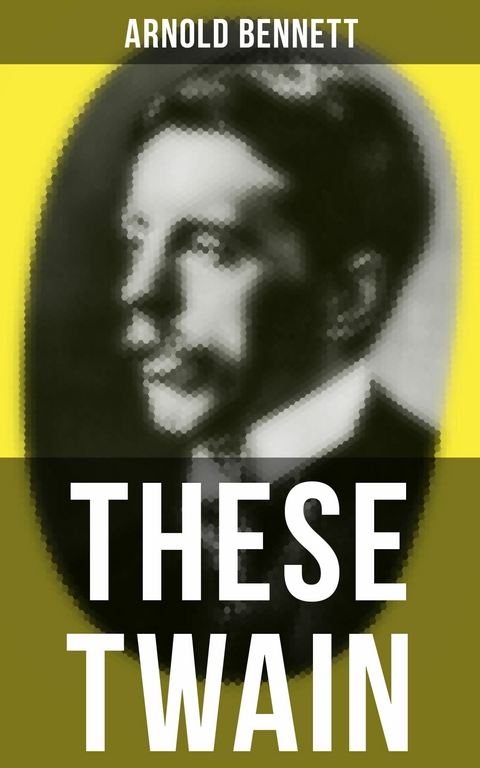
THESE TWAIN (eBook)
430 Seiten
Musaicum Books (Verlag)
978-80-272-3151-5 (ISBN)
Chapter II
Hilda on the Stairs
i
Ada descended the stairs, young, slim, very neat. Ada was one of Hilda’s two new servants. Before taking charge of the house Hilda had ordained the operation called “a clean sweep,” and Edwin had approved. The elder of Maggie’s two servants had been a good one, but Hilda had shown no interest in the catalogue of her excellences. She wanted fresh servants. Maggie, like Edwin, approved, but only as a general principle. In the particular case she had hinted that her prospective sister-in-law was perhaps unwise to let slip a tested servant. Hilda wanted not merely fresh servants, but young servants agreeable to behold. “I will not have a lot of middle-aged scowling women about my house,” Hilda had said. Maggie was reserved, but her glance was meant to remind Hilda that in those end-of-the-century days mistresses had to be content with what they could get. Young and comely servants were all very well—if you could drop on them, but supposing you couldn’t? The fact was that Maggie could not understand Hilda’s insistence on youth and comeliness in a servant, and she foresaw trouble for Hilda. Hilda, however, obtained her desire. She was outspoken with her servants. If Edwin after his manner implied that she was dangerously ignoring the touchiness of the modern servant, she would say indifferently: “It’s always open to them to go if they don’t like it.” They did not go. It is notorious that foolhardy mistresses are often very lucky.
As soon as Ada caught sight of her master in the hall she became self-conscious; all the joints of her body seemed to be hung on very resilient springs, and,—reddening slightly,—she lowered her gaze and looked at her tripping toes. Edwin seldom spoke to her more than once a day, and not always that. He had one day visited the large attic into which, with her colleague, she disappeared late at night and from which she emerged early in the morning, and he had seen two small tin trunks and some clothes behind the door, and an alarm-clock and a portrait of a fireman on the mantelpiece. (The fireman, he seemed to recollect, was her brother.) But she was a stranger in his house, and he had no sustained curiosity about her. The days were gone when he used to be the intimate of servants—of Mrs. Nixon, for example, sole prop of the Clayhanger family for many years, and an entirely human being to Edwin. Mrs. Nixon had never been either young, slim, or neat. She was dead. The last servant whom he could be said to have known was a pert niece of Mrs. Nixon’s—now somebody’s prolific wife and much changed. And he was now somebody’s husband, and bearded, and perhaps occasionally pompous, and much changed in other ways. So that enigmatic Adas bridled at sight of him and became intensely aware of themselves. Still, this Ada in her smartness was a pretty sight for his eyes as like an aspen she trembled down the stairs, though the coarseness of her big red hands, and the vulgarity of her accent were a surprising contrast to her waist and her fine carriage.
He knew she had been hooking her mistress’s dress, and that therefore the hooking must be finished. He liked to think of Hilda being attired thus in the bedroom by a natty deferential wench. The process gave to Hilda a luxurious, even an oriental quality, which charmed him. He liked the suddenly impressive tone in which the haughty Hilda would say to Ada, “Your master,” as if mentioning a sultan. He was more and more anxious lest Hilda should be late, and he wanted to ask Ada: “Is Mrs. Clayhanger coming down?”
But he discreetly forbore. He might have run up to the bedroom and burst in on the toilette—Hilda would have welcomed him. But he preferred to remain with his anxiety where he was, and meditate upon Hilda bedecking herself up there in the bedroom—to please him; to please not the guests, but him.
Ada disappeared down the narrow passage leading to the kitchen, and a moment later he heard a crude giggle, almost a scream, and some echo of the rough tones in which the servants spoke to each other when they were alone in the kitchen. There were in fact two Adas; one was as timid as a fawn with a voice like a delicate invalid’s; the other a loud-mouthed hoity-toity girl such as rushed out of potbanks in flannel apron at one o’clock. The Clayhanger servants were satisfactory, more than satisfactory, the subject of favourable comment for their neatness among the mistresses of other servants. He liked them to be about; their presence and their official demeanour flattered him; they perfected the complex superiority of his house,—that island. But when he overheard them alone together, or when he set himself to imagine what their soul’s life was, he was more than ever amazed at the unnoticed profound differences between modes of thought that in apparently the most natural manner could exist so close together without producing a cataclysm. Auntie Hamps’s theory was that they were all—he, she, the servants—equal in the sight of God!
ii
Hilda’s son, George Edwin, sidled surprisingly into the hall. He was wearing a sailor suit, very new, and he had probably been invisible somewhere against the blue curtains of the drawing-room window—an example of nature’s protective mimicry. George was rather small for his ten years. Dark, like his mother, he had her eyes and her thick eyebrows that almost met in the middle, and her pale skin. As for his mind, he seemed to be sometimes alarmingly precocious and sometimes a case of arrested development. In this and many other respects he greatly resembled other boys. The son of a bigamist can have no name, unless it be his mother’s maiden name, but George knew nothing of that. He had borne his father’s name, and when at the exciting and puzzling period of his mother’s marriage he had learnt that his surname would in future be Clayhanger he had a little resented the affront to his egoism. Edwin’s explanation, however, that the change was for the convenience of people in general had caused him to shrug his shoulders in concession and to murmur casually: “Oh, well then—!” He seemed to be assenting with loftiness: “If it’s any particular use to the whole world, I don’t really mind.”
“I say, uncle,” he began.
Edwin had chosen this form of address. “Stepfather” was preposterous, and “father” somehow offended him; so he constituted himself an uncle.
“Hello, kid!” said he. “Can you find room to keep anything else in your pockets besides your hands?”
George snatched his hands out of his pockets. Then he smiled confidently up. These two were friends. Edwin was as proud as the boy of the friendship, and perhaps more flattered. At first he had not cared for George, being repelled by George’s loud, positive tones, his brusque and often violent gestures, and his intense absorption in himself. But gradually he had been won by the boy’s boyishness, his smile, his little, soft body, his unspoken invocations, his resentment of injustice (except when strict justice appeared to clash with his own interests), his absolute impotence against adult decrees, his touching fatalism, his recondite personal distinction that flashed and was gone, and his occasional cleverness and wit. He admitted that George charmed him. But he well knew that he also charmed George. He had a way of treating George as an equal that few children (save possibly Clara’s) could have resisted. True, he would quiz the child, but he did not forbid the child to quiz. The mother was profoundly relieved and rejoiced by this friendship. She luxuriated in it. Edwin might well have been inimical to the child; he might through the child have shown a jealousy of the child’s father. But, somewhat to the astonishment of even Edwin himself, he never saw the father in the child, nor thought of the father, nor resented the parenthood that was not his. For him the child was an individual. And in spite of his stern determination not to fall into the delusions of conceited parents, he could not help thinking that George was a remarkable child.
“Have you seen my horse?” asked George.
“Have I seen your horse? ... Oh! ... I’ve seen that you’ve left it lying about on the hall-table.”
“I put it there so that you’d see it,” George persuasively excused himself for the untidiness.
“Well, let’s inspect it,” Edwin forgave him, and picked up from the table a piece of cartridge-paper on which was a drawing of a great cart-horse with shaggy feet. It was a vivacious sketch.
“You’re improving,” said Edwin, judicially, but in fact much impressed. Surely few boys of ten could draw as well as that! The design was strangely more mature than certain quite infantile watercolours that Edwin had seen scarcely a year earlier.
“It’s rather good, isn’t it?” George suggested, lifting up his head so that he could just see over the edge of the paper which Edwin held at the level of his watch-chain.
“I’ve met worse. Where did you see this particular animal?”
“I saw him down near the Brewery this morning. But when I’m doing a horse, I see him on the paper before I begin to draw, and I just draw round him.”
Edwin thought:
“This kid is no ordinary kid.”
He said:
“Well, we’ll pin it up here. We’ll have a Royal Academy and hear what the public has to say.” He took a pin from under his waistcoat.
...| Erscheint lt. Verlag | 15.11.2017 |
|---|---|
| Verlagsort | Prague |
| Sprache | englisch |
| Themenwelt | Literatur ► Essays / Feuilleton |
| Literatur ► Historische Romane | |
| Schlagworte | Arnold Bennett legacy • British realism trilogy • Charles Dickens • Clayhanger trilogy finale • Critical essays influence • Edwardian era characters • Ernest Hemingway • European Realist Tradition • Ezra Pound • Family drama conclusion • industrial England setting • Jack Kerouac • James Joyce • Joseph Conrad • Literary confrontation climax • Mark Twain • Oscar Wilde • Salinger • T. S. Eliot • Turn-of-the-century England |
| ISBN-10 | 80-272-3151-5 / 8027231515 |
| ISBN-13 | 978-80-272-3151-5 / 9788027231515 |
| Informationen gemäß Produktsicherheitsverordnung (GPSR) | |
| Haben Sie eine Frage zum Produkt? |
 EPUB (Wasserzeichen)
DRM: Digitales Wasserzeichen
Dieses eBook enthält ein digitales Wasserzeichen und ist damit für Sie personalisiert. Bei einer missbräuchlichen Weitergabe des eBooks an Dritte ist eine Rückverfolgung an die Quelle möglich.
Dateiformat: EPUB (Electronic Publication)
EPUB ist ein offener Standard für eBooks und eignet sich besonders zur Darstellung von Belletristik und Sachbüchern. Der Fließtext wird dynamisch an die Display- und Schriftgröße angepasst. Auch für mobile Lesegeräte ist EPUB daher gut geeignet.
Systemvoraussetzungen:
PC/Mac: Mit einem PC oder Mac können Sie dieses eBook lesen. Sie benötigen dafür die kostenlose Software Adobe Digital Editions.
eReader: Dieses eBook kann mit (fast) allen eBook-Readern gelesen werden. Mit dem amazon-Kindle ist es aber nicht kompatibel.
Smartphone/Tablet: Egal ob Apple oder Android, dieses eBook können Sie lesen. Sie benötigen dafür eine kostenlose App.
Geräteliste und zusätzliche Hinweise
Buying eBooks from abroad
For tax law reasons we can sell eBooks just within Germany and Switzerland. Regrettably we cannot fulfill eBook-orders from other countries.