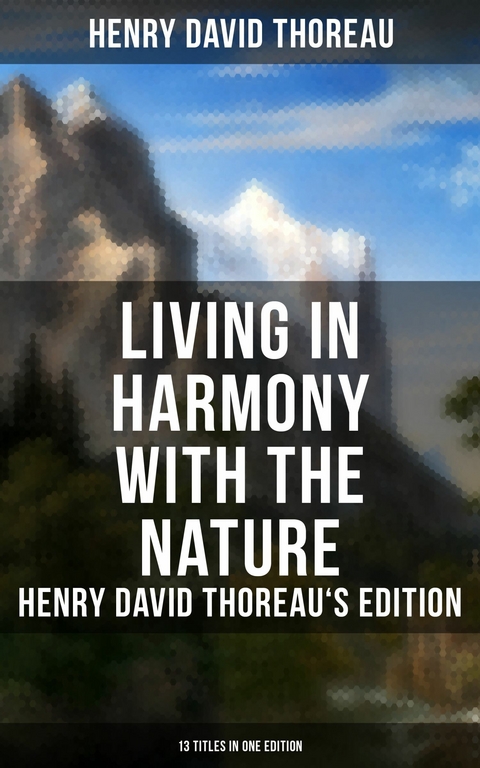
Living in Harmony with the Nature: Henry David Thoreau's Edition (13 Titles in One Edition) (eBook)
957 Seiten
Musaicum Books (Verlag)
978-80-272-2495-1 (ISBN)
Economy
When I wrote the following pages, or rather the bulk of them, I lived alone, in the woods, a mile from any neighbor, in a house which I had built myself, on the shore of Walden Pond, in Concord, Massachusetts, and earned my living by the labor of my hands only. I lived there two years and two months. At present I am a sojourner in civilized life again.
I should not obtrude my affairs so much on the notice of my readers if very particular inquiries had not been made by my townsmen concerning my mode of life, which some would call impertinent, though they do not appear to me at all impertinent, but, considering the circumstances, very natural and pertinent. Some have asked what I got to eat; if I did not feel lonesome; if I was not afraid; and the like. Others have been curious to learn what portion of my income I devoted to charitable purposes; and some, who have large families, how many poor children I maintained. I will therefore ask those of my readers who feel no particular interest in me to pardon me if I undertake to answer some of these questions in this book. In most books, the I, or first person, is omitted; in this it will be retained; that, in respect to egotism, is the main difference. We commonly do not remember that it is, after all, always the first person that is speaking. I should not talk so much about myself if there were anybody else whom I knew as well. Unfortunately, I am confined to this theme by the narrowness of my experience. Moreover, I, on my side, require of every writer, first or last, a simple and sincere account of his own life, and not merely what he has heard of other men’s lives; some such account as he would send to his kindred from a distant land; for if he has lived sincerely, it must have been in a distant land to me. Perhaps these pages are more particularly addressed to poor students. As for the rest of my readers, they will accept such portions as apply to them. I trust that none will stretch the seams in putting on the coat, for it may do good service to him whom it fits.
I would fain say something, not so much concerning the Chinese and Sandwich Islanders as you who read these pages, who are said to live in New England; something about your condition, especially your outward condition or circumstances in this world, in this town, what it is, whether it is necessary that it be as bad as it is, whether it cannot be improved as well as not. I have travelled a good deal in Concord; and everywhere, in shops, and offices, and fields, the inhabitants have appeared to me to be doing penance in a thousand remarkable ways. What I have heard of Bramins sitting exposed to four fires and looking in the face of the sun; or hanging suspended, with their heads downward, over flames; or looking at the heavens over their shoulders “until it becomes impossible for them to resume their natural position, while from the twist of the neck nothing but liquids can pass into the stomach”; or dwelling, chained for life, at the foot of a tree; or measuring with their bodies, like caterpillars, the breadth of vast empires; or standing on one leg on the tops of pillars — even these forms of conscious penance are hardly more incredible and astonishing than the scenes which I daily witness. The twelve labors of Hercules were trifling in comparison with those which my neighbors have undertaken; for they were only twelve, and had an end; but I could never see that these men slew or captured any monster or finished any labor. They have no friend Iolaus to burn with a hot iron the root of the hydra’s head, but as soon as one head is crushed, two spring up.
I see young men, my townsmen, whose misfortune it is to have inherited farms, houses, barns, cattle, and farming tools; for these are more easily acquired than got rid of. Better if they had been born in the open pasture and suckled by a wolf, that they might have seen with clearer eyes what field they were called to labor in. Who made them serfs of the soil? Why should they eat their sixty acres, when man is condemned to eat only his peck of dirt? Why should they begin digging their graves as soon as they are born? They have got to live a man’s life, pushing all these things before them, and get on as well as they can. How many a poor immortal soul have I met well-nigh crushed and smothered under its load, creeping down the road of life, pushing before it a barn seventy-five feet by forty, its Augean stables never cleansed, and one hundred acres of land, tillage, mowing, pasture, and woodlot! The portionless, who struggle with no such unnecessary inherited encumbrances, find it labor enough to subdue and cultivate a few cubic feet of flesh.
But men labor under a mistake. The better part of the man is soon plowed into the soil for compost. By a seeming fate, commonly called necessity, they are employed, as it says in an old book, laying up treasures which moth and rust will corrupt and thieves break through and steal. It is a fool’s life, as they will find when they get to the end of it, if not before. It is said that Deucalion and Pyrrha created men by throwing stones over their heads behind them:—
Inde genus durum sumus, experiensque laborum,
Et documenta damus qua simus origine nati.
Or, as Raleigh rhymes it in his sonorous way —
“From thence our kind hard-hearted is, enduring pain and care,
Approving that our bodies of a stony nature are.”
So much for a blind obedience to a blundering oracle, throwing the stones over their heads behind them, and not seeing where they fell.
Most men, even in this comparatively free country, through mere ignorance and mistake, are so occupied with the factitious cares and superfluously coarse labors of life that its finer fruits cannot be plucked by them. Their fingers, from excessive toil, are too clumsy and tremble too much for that. Actually, the laboring man has not leisure for a true integrity day by day; he cannot afford to sustain the manliest relations to men; his labor would be depreciated in the market. He has no time to be anything but a machine. How can he remember well his ignorance — which his growth requires — who has so often to use his knowledge? We should feed and clothe him gratuitously sometimes, and recruit him with our cordials, before we judge of him. The finest qualities of our nature, like the bloom on fruits, can be preserved only by the most delicate handling. Yet we do not treat ourselves nor one another thus tenderly.
Some of you, we all know, are poor, find it hard to live, are sometimes, as it were, gasping for breath. I have no doubt that some of you who read this book are unable to pay for all the dinners which you have actually eaten, or for the coats and shoes which are fast wearing or are already worn out, and have come to this page to spend borrowed or stolen time, robbing your creditors of an hour. It is very evident what mean and sneaking lives many of you live, for my sight has been whetted by experience; always on the limits, trying to get into business and trying to get out of debt, a very ancient slough, called by the Latins aes alienum, another’s brass, for some of their coins were made of brass; still living, and dying, and buried by this other’s brass; always promising to pay, promising to pay, tomorrow, and dying today, insolvent; seeking to curry favor, to get custom, by how many modes, only not state-prison offenses; lying, flattering, voting, contracting yourselves into a nutshell of civility or dilating into an atmosphere of thin and vaporous generosity, that you may persuade your neighbor to let you make his shoes, or his hat, or his coat, or his carriage, or import his groceries for him; making yourselves sick, that you may lay up something against a sick day, something to be tucked away in an old chest, or in a stocking behind the plastering, or, more safely, in the brick bank; no matter where, no matter how much or how little.
I sometimes wonder that we can be so frivolous, I may almost say, as to attend to the gross but somewhat foreign form of servitude called Negro Slavery, there are so many keen and subtle masters that enslave both North and South. It is hard to have a Southern overseer; it is worse to have a Northern one; but worst of all when you are the slave-driver of yourself. Talk of a divinity in man! Look at the teamster on the highway, wending to market by day or night; does any divinity stir within him? His highest duty to fodder and water his horses! What is his destiny to him compared with the shipping interests? Does not he drive for Squire Make-a-stir? How godlike, how immortal, is he? See how he cowers and sneaks, how vaguely all the day he fears, not being immortal nor divine, but the slave and prisoner of his own opinion of himself, a fame won by his own deeds. Public opinion is a weak tyrant compared with our own private opinion. What a man thinks of himself, that it is which determines, or rather indicates, his fate. Self-emancipation even in the West Indian provinces of the fancy and imagination — what Wilberforce is there to bring that about? Think, also, of the ladies of the land weaving toilet cushions against the last day, not to betray too green an interest in their fates! As if you could kill time without injuring eternity.
The mass of men lead lives of quiet desperation. What is called resignation is confirmed desperation. From the desperate city you go into the desperate country, and have to console yourself with the bravery of minks and muskrats. A stereotyped but unconscious despair is concealed even under what are called the games and amusements of mankind. There is no play in them, for this comes after work. But it is a characteristic of wisdom...
| Erscheint lt. Verlag | 16.10.2017 |
|---|---|
| Verlagsort | Prague |
| Sprache | englisch |
| Themenwelt | Literatur ► Essays / Feuilleton |
| Geisteswissenschaften ► Philosophie | |
| Schlagworte | 19th-Century Literature • Albert Camus • American naturalist • American Transcendentalism • Civil Disobedience essay • Environmentalism • Into the wild • Jack London • Leaves of Grass • Nathaniel Hawthorne • Nature exploration • new england setting • Nietzsche • philosophical essays • Plato • Ralph Waldo Emerson • simple living • Tolstoy • Transcendentalist philosophy • Voltaire |
| ISBN-10 | 80-272-2495-0 / 8027224950 |
| ISBN-13 | 978-80-272-2495-1 / 9788027224951 |
| Informationen gemäß Produktsicherheitsverordnung (GPSR) | |
| Haben Sie eine Frage zum Produkt? |
 EPUB (Wasserzeichen)
DRM: Digitales Wasserzeichen
Dieses eBook enthält ein digitales Wasserzeichen und ist damit für Sie personalisiert. Bei einer missbräuchlichen Weitergabe des eBooks an Dritte ist eine Rückverfolgung an die Quelle möglich.
Dateiformat: EPUB (Electronic Publication)
EPUB ist ein offener Standard für eBooks und eignet sich besonders zur Darstellung von Belletristik und Sachbüchern. Der Fließtext wird dynamisch an die Display- und Schriftgröße angepasst. Auch für mobile Lesegeräte ist EPUB daher gut geeignet.
Systemvoraussetzungen:
PC/Mac: Mit einem PC oder Mac können Sie dieses eBook lesen. Sie benötigen dafür die kostenlose Software Adobe Digital Editions.
eReader: Dieses eBook kann mit (fast) allen eBook-Readern gelesen werden. Mit dem amazon-Kindle ist es aber nicht kompatibel.
Smartphone/Tablet: Egal ob Apple oder Android, dieses eBook können Sie lesen. Sie benötigen dafür eine kostenlose App.
Geräteliste und zusätzliche Hinweise
Buying eBooks from abroad
For tax law reasons we can sell eBooks just within Germany and Switzerland. Regrettably we cannot fulfill eBook-orders from other countries.
aus dem Bereich