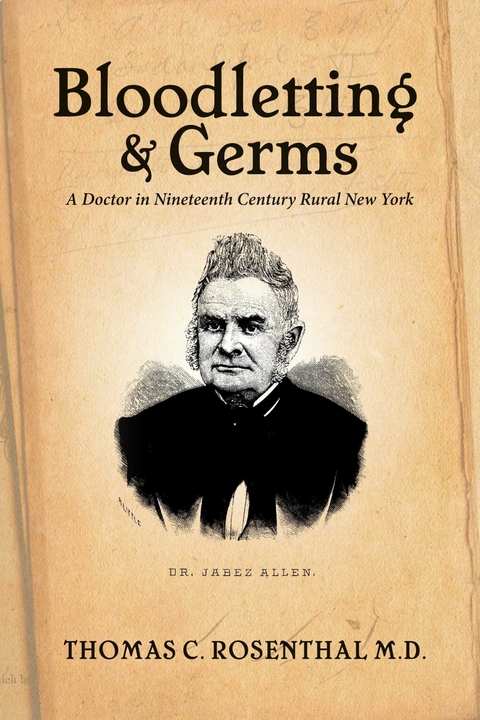
Bloodletting and Germs (eBook)
348 Seiten
Bookbaby (Verlag)
978-1-0983-1539-9 (ISBN)
Thomas C. Rosenthal M.D. practiced family medicine and geriatrics in both rural and urban Western New York for 40 years. He chaired the Department of Family Medicine at the Jacobs School of Medicine and Biomedical Science, University at Buffalo, edited the Journal of Rural Health and FP Audio, authored numerous peer reviewed scientific papers, edited a textbook of geriatric medicine and received teaching awards from the National Rural Health Association and the New York State Academy of Family Medicine. This is his first historical novel.
Bloodletting and Germs will change the way you think about medical practice. Imagine you are a patient in 1840. You're sick and your village doctor has little more to offer than letting blood and purging your bowels. Or think of being the doctor, repeatedly staring at death, seeking cures, and holding the hand of a feverish child. On his way to America's frontier in 1834 the newly graduated doctor, Jabez Allen MD, stops for one night in an upstate New York village. He meets a teacher, a sick child, a young socialite abolitionist, and stays a lifetime. Millicent, the abolitionist, becomes Dr. Allen's wife. When they later employ Civia, a runaway slave, as a wet nurse they discover a woman of ever hopeful outlook and unexplored talents who becomes indispensable to Dr. Allen's medical practice. Millicent and Civia and force Dr. Allen to confront nineteenth century medical theories labeling Negros as physiologically inferior. When the 1850 Fugitive Slave Act results the arrest of Civia and her family, the local Underground Railroad arranges their escape to Canada as the nation yields to Civil War. Through it all, patients force Dr. Allen to deal with the contagions of his day, including the cholera that drains life from President Millard Fillmore's daughter, the very man who signed the Fugitive Slave Act. Dr. Allen is drawn to investigate a typhoid outbreak in a nearby village. Joined by Dr. Austin Flint, their discoveries result in three scientific papers used as an investigative model by John Snow and referenced in Snow's 1855 treatise on London Cholera. Dr. Allen remains dedicated to his village, is elected President of his county's Medical Society, makes the acquaintance of nationally known medical scientists, and participates in the 1878 AMA meeting where organized medicine argues the scientific foundation for the germ theory. Bloodletting and Germs is a historical novel written as Dr. Allen's memoir. Citing over four hundred sources, it is true to the events of Dr. Allen's life and the forces that changed medical care in the nineteenth century. The characters come alive as you're embraced by this well-paced story. Dr. Allen teaches us about managing the unknown and being a small-town hero. It puts humanity's face on a period of profound scientific and social transformation.
1. Discovering Aurora, 1834
Accident plays a role in deciding our path.
Vermont had an early spring in 1834 allowing a timely start for America’s frontier, which I determined to be Cincinnati, Ohio. On my horse Parsley, I traveled the Mohawk Valley, crossed the northern limits of the Finger Lakes, and near the Genesee River headed southwest on Big Tree Road. With only Parsley to listen, I planned my new life as a graduate medical doctor.
In many places our route was little more than a cleared path, easy for a horse, but many days I helped some family push their overloaded ox cart out of the mud that lingered in the valleys. Occasional clusters of cabins interrupted the mostly mature forest, and, often as not, at least one cabin declared itself a tavern. Mercifully, good weather allowed me to take comfort in a bedroll under the stars.
My first day on Big Tree Road I took a noon meal at an establishment calling itself the National Hotel. The proprietor was an older gentleman who served a hearty meal with generous helpings of conversation. When I introduced myself as Dr. Jabez Allen, he told me the only other Jabez he knew was Jabez Warren who surveyed and clear-cut Big Tree Road. “It goes back a way, 1803 I believe, Warren farmed land not far from here. He was an ambitious fellow. Took on the Holland Company’s contract to survey and clear a one-rod wide road along an old Indian foot path past a huge ceremonial tree all the way to Lake Erie. At the time, some called it the Middle Road because the idea was to open up settlement through the middle of land the company had purchased from Indian tribes. The twelve dollars a mile Warren was paid secured him a damn comfortable future.”
Two hours at the National was a welcomed respite. I’m not saying that two weeks traveling with only a horse to talk to didn’t encourage many a witty thought, but Parsley was no great conversationalist. I already missed Vermont, especially my father Obadiah, my older brother James and his wife Rebecca, and my younger sister Phoebe. My mother, also named Phoebe, passed away in a typhoid outbreak last summer, and I missed her the most. The family farm was now in the capable hands of Phoebe’s husband who reckoned the farm could support but one family.
I returned to Big Tree Road recharged by the notion that another Jabez had blazed my trail. Parsley, also fed and watered, seemed happy to resume our travel. She was a good, healthy mare who had weaned her second filly a couple months before our departure. I had come across the word parsley in a book, liked it, and gave it to my horse.
In my saddle bags, I carried a clean suit and enough medical supplies to assure a modest start in my profession. My father and mother, the former Phoebe Fargo, had done well in East Dorset, Vermont. Dad was a farmer and a merchant who knew how to manage a dollar. He acquired land, and with my mother’s help, they made Vermont’s hard scratch productive. He also cultivated connections, becoming what might be called a mercantile trader. He made most of his money brokering, selling, and trading farm equipment, like horse drawn rakes and mowers. Father also knew a good horse when he saw one. His honesty gained the trust of farmers throughout Vermont and for each transaction he took only a fair share.
Every summer typhoid menaced our Vermont neighbors and last summer it took my mother. After her death, father lost his ambition for the farm, but fortunately Phoebe’s husband, a natural born farmer, took over. Father now holds the mortgage for Phoebe and her husband.
James, four years my elder and always more determined and adventuresome, had decided to try his hand at physic. After graduating from Castleton Medical College in 1828, James returned to East Dorset and became the first doctor with a medical degree to practice in Bennington County.
Being the middle child, I suppose I never was as adventuresome as James, nor as settled as Phoebe. I did like to read and Castleton was a short day’s ride from East Dorset. With my brother’s encouragement, I became his apprentice and attended the required two terms of lectures at Castleton. I enjoyed the book study and took naturally to seeing patients. After graduation James allowed me to retain half of all the income I generated, but competition with Thomsonian herbalists and Homeopathic dilutions meant there wasn’t enough paying work to support both James and me in East Dorset, or anywhere in New England. So, my late blooming, twenty-six-year-old energies pushed me west. I figured a growing city like Cincinnati needed doctors and sister Phoebe thought the move would cure what she called my “shiftless determination.” I had just enough confidence, and naivety, to strike out for the great State of Ohio.
Two days from the National Hotel, the Big Tree Road entered the upper village of Aurora. After passing a few cabins and a couple of sturdy plank houses, I came upon the first three-story building since Syracuse. It was the Globe Hotel where I purchased a bath, a meal, and a soft bed for the night. The Globe proprietor, Mr. Charles P. Persons, greeted me with a generous handshake, a smile and led Parsley off to his stables. A cold bath and clean towel were soon delivered to my room. In medical college, they said a cold-water bath relieves nervous afflictions and reduces flatulency. Besides, the Globe charged 25 cents for a cold bath, half that of a hot bath. I then downed my one clean suit and collar for dinner. With so many irregular, poorly trained men calling themselves doctors, Castleton professors said it was important for a graduate physician to appear the part of a gentleman.
I found myself dinning with two other westward travelers and a local gentleman who was boarding at the Globe. One traveler was also heading to Cincinnati where his brother-in-law’s harness business was buried in work. The other was on his way to Indiana where he had secured a section of federal land on which he had to establish a farm within the year, then send for his wife and child. The boarder, a Mr. Hiram Barney, had arrived from Springville that winter to teach Greek philosophy and Latin as the live-in assistant to Mr. Daniel Howard, principal of the Aurora Academy. The Academy attracted eighty students from prominent families in Buffalo and Aurora, half of whom boarded with village families. Mr. Barney, Hiram, was waiting for his rooms to be prepared in the Academy’s newest expansion. Besides lecturing, his responsibilities included discipline and student refinement. Being the bookish sort, I asked about the Academy’s library, which Hiram bragged was the most extensive collection outside of Buffalo or New York City. It had recently acquired an anthology of Waldo Emerson’s essays.
Our after-dinner brandy was interrupted by Colonel Calvin Fillmore. Col. Fillmore ran another tavern less than a mile further west on Big Tree Road, but was clearly on good terms with Mr. Persons. The Colonel was inquiring after Dr. Johnathan Hoyt who commonly left word at the Globe when he was out on a house call. That night Hoyt was attending the confinement of a woman in Wales Center, about six miles distant.
Sensing some urgency in Col. Fillmore’s inquiry, I introduced myself as a graduate physician and asked the nature of the problem. His eighteen-month-old grandson had been ill for several days with recurrent, painful episodes of diarrhea. They had tried everything in their medical book, but tonight the child had grown weaker.
It is a poor habit to attend to a patient of another doctor, none-the-less, I offered my services until Dr. Hoyt could return. In short order, I was following the Colonel further west along Big Tree road. The night was cold, clear and the stars shone brightly. Daytime muddy wagon ruts now sparkled in a frozen moonlight. The Colonel ushered me to his tavern’s second floor where his daughter-in-law, the young Abiatha Fillmore, sat at the bedside of her pale listless son.
I immediately commenced my examination. The child scarcely responded to my touch. His tongue was parched and his skin easily tented. He was warm but did not feel feverish. His pulse was hard, and during bouts of pain it quickened, though he barely woke. The child’s abdomen was tender and the stool I examined seemed a mixture of blood and mucous that appeared like jam made of currants. As I took out my stethoscope the child’s mother gasped. I encouraged her to hold it and see that it was simply a wooden tube with a flange on one end. Her fears abated. I found the child’s breaths to be shallow but clear. Abiatha showed me her copy of Gunn’s Domestic Medicine saying that she tried every remedy listed.
These many years later it seems easy to confess that I was perplexed. The child’s condition was extreme and the presentation did not match anything I had seen. After nearly three years working with my brother and two semesters of lectures at Castleton, I was embarrassed and uncertain. My mind raced as I considered how seriously ill the child appeared. I was compelled to act, to do something that would afford comfort, and bring some hope to his mother.
The child had red, sore gums and was at the typical age for molars to emerge. Lacking any strategy for dealing with the child’s real problem, I absurdly lanced the child’s swollen gums hoping to ease any systemic symptoms teething is known to ignite. Then, to hide my ignorance, I explained that I...
| Erscheint lt. Verlag | 29.6.2020 |
|---|---|
| Sprache | englisch |
| Themenwelt | Literatur ► Historische Romane |
| ISBN-10 | 1-0983-1539-1 / 1098315391 |
| ISBN-13 | 978-1-0983-1539-9 / 9781098315399 |
| Informationen gemäß Produktsicherheitsverordnung (GPSR) | |
| Haben Sie eine Frage zum Produkt? |
 EPUB (Ohne DRM)
Größe: 2,7 MB
Digital Rights Management: ohne DRM
Dieses eBook enthält kein DRM oder Kopierschutz. Eine Weitergabe an Dritte ist jedoch rechtlich nicht zulässig, weil Sie beim Kauf nur die Rechte an der persönlichen Nutzung erwerben.
Dateiformat: EPUB (Electronic Publication)
EPUB ist ein offener Standard für eBooks und eignet sich besonders zur Darstellung von Belletristik und Sachbüchern. Der Fließtext wird dynamisch an die Display- und Schriftgröße angepasst. Auch für mobile Lesegeräte ist EPUB daher gut geeignet.
Systemvoraussetzungen:
PC/Mac: Mit einem PC oder Mac können Sie dieses eBook lesen. Sie benötigen dafür die kostenlose Software Adobe Digital Editions.
eReader: Dieses eBook kann mit (fast) allen eBook-Readern gelesen werden. Mit dem amazon-Kindle ist es aber nicht kompatibel.
Smartphone/Tablet: Egal ob Apple oder Android, dieses eBook können Sie lesen. Sie benötigen dafür eine kostenlose App.
Geräteliste und zusätzliche Hinweise
Buying eBooks from abroad
For tax law reasons we can sell eBooks just within Germany and Switzerland. Regrettably we cannot fulfill eBook-orders from other countries.
aus dem Bereich