


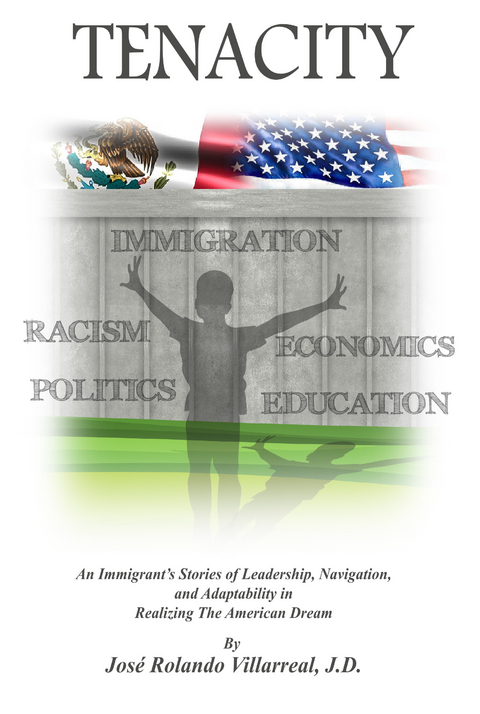
Tenacity (eBook)
200 Seiten
Bookbaby (Verlag)
978-1-0983-0183-5 (ISBN)
TENACITY is the story about the life experiences of the author, Jose Rolando Villarreal, J.D. It is an American immigration story that reflects the life stories of many immigrants who came, and continue to come from all parts of the world, to the United States of America seeking to realize the American Dream. What do present-day immigrants confront when they reach the USA and commence to navigate their journey in seeking the American dream as they define it? How can present-day immigrants to the USA confront a complex cultural system that causes bewilderment, confusion, and perplexity that on occasion hinders and impedes progress towards success? Jos Rolando Villarreal answers these challenging questions by presenting his own immigration story. American immigration life stories are basically about individuals who came or were brought to the United States out of economic necessity, hunger for better opportunities, or even worse, seeking asylum due to oppression in their country. The author's story is no different. While his life story reflects an unpleasantly rough, and at times severely cruel reality that most immigrants have confronted for centuries, it is also a story of resilience. It is a story about immigration, migration, navigation, and adaptation to change in order to realize the American dream. The author was terco (determined) and he had the tenacity to confront and overcome the myriad harsh realities and barriers faced by immigrants in order to navigate successfully toward the American dream. He feels content that he realized the American dream, as he defines it, while striving to be successful as a son, husband, father, grandfather, attorney, administrator, adjunct college professor, city mayor, staff training consultant, and best of all, as an American citizen. The author gives specific historical references to his experiences facing adversity in the areas of institutional racism in education, the criminal justice system, economics, and politics. The author gives special attention to the area of leadership development tools, such as conflict resolution and synergy, which can be used to enhance one's capacity to navigate the aforementioned adversarial situations. Being an American immigrant is a state of mind, a tangle of conundrums and contradictions, but with the end goal of becoming an American in the most transparent and purest sense. From the various identity labels of a documented immigrant, Mexican, Mexican-American, Chicano, Latino, or Hispanic, the author emerges as a quintessential American, proud of his Mexican heritage. His primary intent in writing this book is to inspire immigrants, documented and undocumented, and by extension to anyone who is related to immigrants or works with immigrants. The secondary purpose of this book is to leave a valuable legacy to his family, children, grandchildren. Through the use of memoirs of leadership and cultural competence, the author shows others how to successfully navigate the journey in the USA as immigrants. This book culminates in the author's presentation of highly effective leadership tools which can be utilized by the reader in the pursuit of the American dream, however that dream is defined.
Chapter 3
Remembering the Border Town of Piedras Negras
My parents, José María and Elisa, my sisters María del Socorro, Lidia Elisa, Tomasita, and I were all born in the Mexican border city of Piedras Negras, in the State of Coahuila, Mexico. Piedras Negras was founded in 1849 as a military post, prompted by the American border side military establishment of Fort Duncan (later Eagle Pass, Texas) in 1849 as a protective measure against the Native Americans (Apaches). Piedras Negras (Black Rocks) was so named for the coal deposits in the local area. It became a prosperous city due to coal mining and was subsequently elevated from a villa (village) to a ciudad (city). In 1888, the city was named Ciudad Porfirio Díaz, in honor of then President of Mexico, Porfirio Díaz. The name was said to have been changed back to Piedras Negras after the 1911 political uprising that resulted in the Mexican Revolution. Piedras Negras continued to prosper after the years of the Revolution due to the economic connection the city provided between the United States and Mexico; coal mining, railroad, and political evolvement were large factors in the city’s proliferation. But just as Piedras Negras had its economic prosperity, it also had its problems that affected economically strapped families who were barely making ends meet. It was under this setting that I was born. Recently I was told by my mother that my father was living and working in the USA as an undocumented worker when I was born. The only reason why my father was working in the USA was the almost universal reason - economic necessity.
I remember Piedras Negras as a vibrant Mexican city where its residents were constantly moving in the early hours of the day, engaging in daily activities with an attitude full of vigor. My family was economically poor but we as children hardly knew it.
In the early 1950’s, a typical day in Piedras (as we used to call Piedras Negras) would start with street vendors loudly selling milk, firewood, sweet bread, tamales, ice (in the summer), and many other house goods. The downtown main streets of Zaragoza and Allende were bustling with cars and horse buggy taxis transporting USA tourists. The block long enclosed Mercado Zaragoza (marketplace with many vendors) was the place to buy and sell daily fresh meat, fruits and vegetables, as well as clothing and other items such as Mexican artisan souvenirs. Workers in restaurants and nightclubs such as La Fortuna, El México Moderno, Las Trancas, El Golfito, Las Cabañitas, El Club Victoria, El Campestre, and Terraza América were getting ready for the daily business of offering traditional Mexican dishes and entertainment. La Plaza de Armas (the main plaza), La Catedral, (the main church), and La Presidencia (the Civic Presidential Building) were all located next to the international bridge by which the two countries were connected. The main plaza area drew the usual crowds from the colonias (neighborhoods) such as El Mundo Nuevo, La Gonzalez, La Colonia Americana, and many others. Movie theaters like El Cinelandia, El Rodriguez, and El Teatro Acuña were setting up for movie presentations. Sundays were typical. Devout Catholics greeted the early morning sun by attending mass. Midday Sunday activities included a trip to La Villa de Fuente, known as La Villita, for a día de campo (picnic) by the Río Escondido. Sunday nights consisted of a family walk at the main plaza where vendors sold paletas (ice cream bars), gardenias, and suegras (sling shot toys). Young ladies and young men would walk in a pathway within the plaza in an opposite circular way in order to face each other in a ritual of courting and socializing with members of the opposite sex, while mothers, fathers, older brothers, and grandmothers of the young ladies kept a watchful eye from a distance to ensure respect for the young maidens. Sunday nights were always festive, full of social activities that included conversation, music, dance, and food shared with family and friends.
The dark side of Piedras reared its ugly head in cantinas (bar saloons). La Zona Roja (zone of tolerance) was wrought with ficheras (ladies of the night), practicing the oldest profession in the world.
Special occasions, such as fiestas (festivals), public events, carnivals, and parades displayed all the joy in Piedras Negras in the early 1950’s, boosting the citizens’ spirits. What would liven up the spirit of Piedras the most was the festive attitude of the resident population. Although stratified by class, the Nigropetenses (residents of Piedras Negras) found common ground in working and celebrating life together. Whether it was through sporting events, festivals, dances, or flooding disasters, the residents of Piedras always showed unity.
Piedras Negras had its local unique characters that roamed the streets of the city as free spirits. I remember Lolo, a mentally ill individual, who was always singing, talking to himself, or acting belligerent, but never harming anyone. I also remember Cuco walking the streets wearing a number of hats at the same time, and Pacitos, who literally walked taking little steps at a time. All these mentally ill characters were certainly reflective of a local cultural fabric that included true diversity and tolerance. And then there was Chalío, the local street clown, who brought joy and laughter to both children and parents at street corners, while trying to sell a product as part of the act.
I also remember watching a public funeral in which thousands of residents lined the streets of Piedras Negras to pay tribute to a local young man known as El Sabio (The Wise One). He was so smart as a young student that at times he substituted for his professor at the local school. El Sabio joined the American military service as a volunteer to fight in the Korean war. The practice of Mexican citizens volunteering for military service in the USA was not as common then as it is today. El Sabio had been promised citizenship by the USA upon finishing his tour of military service. Unfortunately, he was killed in combat. He was buried in Piedras Negras with all USA military honors, including draping his casket with the American flag.
Lastly, there was Doña Virginia, who lived in our neighborhood, and was known as a curandera (healer), a bruja (witch), and a fortune teller, all rolled into one. Doña Virginia was the aunt and guardian of three kids that my cousins and I played with daily. She lived next door to the house where our family lived with our grandmother.
Doña Virginia was a stern looking lady, and I describe her as such because, although she was always gentle and polite to us, she was somewhat cruel and abusive with her nephews. Doña Virginia was truly a clever business woman who provided business services in a variety of areas. She had clients that came from far-away places to consult with her regarding their fortune, their future, their health, and the health of others. Doña Virginia used a traditional Spanish deck of cards and provided a decorative environment to give flavor to the service of fortune telling. Doña Virginia cured the young and the elderly through the use of folk pagan medicine, including plants and oraciones (prayers). We always knew when Doña Virginia was ‘curing’ someone because of the strong smell of rotten eggs that permeated the entire house. We would gladly go outside to play. Doña Virginia was also involved in brujeria (witchcraft) for the good or bad of whoever requested the service, for a reasonable fee, of course. Certain rooms of Doña Virginia’s house were decorated appropriately with tools of the profession, such as plants, cards, embalmed owls and dead cats. This was not the scary part. The scary part was at nighttime when Doña Virginia decided that it was time for us visitors to go home. She suggested that it was time for a cuentito (a short story), that she told us, in essence, to kick us out of her home. But because she wanted to appear to be nice and kind to us, she made up or used her repetitive stories of la bruja (the witch). Although we were fascinated by the stories, by the end of ten minutes or so, the bruja tale was so scary that we pleaded with her to stop telling it as we started to run to our house.
Doña Virginia was a character that certainly reflected a fascinating cultural aspect of Piedras Negras in the early 1950’s. As destiny would have it, about a year after we crossed to the USA, the big flood of June 1954 devastated Piedras Negras and the house where Doña Virginia lived. We never saw nor heard of her or her nephews again.
On the family front, my father soon became politically involved in Piedras Negras and consequently was appointed to be alcaide (warden) in charge of the local jail. During his tenure as the warden, his leadership abilities were challenged, resulting in the escape of three prisoners. Although this happened at night when he was home sleeping during off duty hours, my father was incarcerated on charges of criminal misconduct. Back then, you could be incarcerated without a hearing or trial and without bail for months.
Since my father was the only wage earner in our family, his six months stay in jail...
| Erscheint lt. Verlag | 28.1.2020 |
|---|---|
| Sprache | englisch |
| Themenwelt | Literatur ► Biografien / Erfahrungsberichte |
| ISBN-10 | 1-0983-0183-8 / 1098301838 |
| ISBN-13 | 978-1-0983-0183-5 / 9781098301835 |
| Informationen gemäß Produktsicherheitsverordnung (GPSR) | |
| Haben Sie eine Frage zum Produkt? |
 EPUB (Adobe DRM)
Größe: 97,6 MB
Kopierschutz: Adobe-DRM
Adobe-DRM ist ein Kopierschutz, der das eBook vor Mißbrauch schützen soll. Dabei wird das eBook bereits beim Download auf Ihre persönliche Adobe-ID autorisiert. Lesen können Sie das eBook dann nur auf den Geräten, welche ebenfalls auf Ihre Adobe-ID registriert sind.
Details zum Adobe-DRM
Dateiformat: EPUB (Electronic Publication)
EPUB ist ein offener Standard für eBooks und eignet sich besonders zur Darstellung von Belletristik und Sachbüchern. Der Fließtext wird dynamisch an die Display- und Schriftgröße angepasst. Auch für mobile Lesegeräte ist EPUB daher gut geeignet.
Systemvoraussetzungen:
PC/Mac: Mit einem PC oder Mac können Sie dieses eBook lesen. Sie benötigen eine
eReader: Dieses eBook kann mit (fast) allen eBook-Readern gelesen werden. Mit dem amazon-Kindle ist es aber nicht kompatibel.
Smartphone/Tablet: Egal ob Apple oder Android, dieses eBook können Sie lesen. Sie benötigen eine
Geräteliste und zusätzliche Hinweise
Buying eBooks from abroad
For tax law reasons we can sell eBooks just within Germany and Switzerland. Regrettably we cannot fulfill eBook-orders from other countries.
aus dem Bereich


