


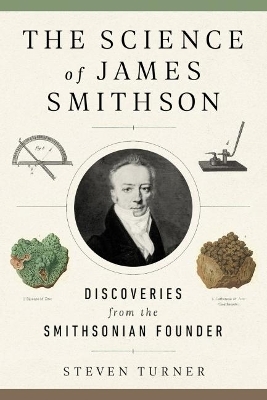
The Science of James Smithson
Discoveries from the Smithsonian Founder
Seiten
2020
Smithsonian Books (Verlag)
978-1-58834-690-2 (ISBN)
Smithsonian Books (Verlag)
978-1-58834-690-2 (ISBN)
"An exploration of the scientific career of James Smithson, who left his fortune to establish the Smithsonian Institution"--
James Smithson is best known as the founder of the Smithsonian Institution, but few people know his full and fascinating story. He was a widely respected chemist and mineralogist and a member of the Royal Society, but in 1865, his letters, collection of 10,000 minerals and more than 200 unpublished papers were lost to a fire in the Smithsonian Castle. His scientific legacy was further written off as insignificant in an 1879 essay published through the Smithsonian fifty years after his death - a claim that author, Steven Turner, demonstrates is far from the truth.
By providing scientific and intellectual context to his work, THE SCIENCE OF JAMES SMITHSON is a comprehensive tribute to Smithson's contributions to his fields, including chemistry, mineralogy and more. This detailed narrative illuminates Smithson and his quest for knowledge at a time when chemists still debated things as basic as the nature of fire and struggled to maintain their networks amid the ever-changing conditions of the French Revolution and the Napoleonic Wars.
James Smithson (c. 1765 - 27 June 1829) was an English chemist and mineralogist. He published numerous scientific papers for the Royal Society during the late 1700s. He attended university at Pembroke College, Oxford in 1782, eventually graduating with an honorary Master of Arts in 1786. As a student he participated in a geological expedition to Scotland and studied chemistry and mineralogy. Smithson never married and had no children; therefore, when he wrote his will, he left his estate to his nephew or his nephew's family if his nephew died before Smithson. However, Smithson's will stipulated that, in the event of there being no heir, his estate be used "to found in Washington, under the name of the Smithsonian Institution, an establishment for the increase and diffusion of knowledge among men". His nephew died without heir, setting in motion the bequest to the United States. In this way Smithson became the patron of the Smithsonian Institution in Washington, D.C. despite having never visited the United States.
James Smithson is best known as the founder of the Smithsonian Institution, but few people know his full and fascinating story. He was a widely respected chemist and mineralogist and a member of the Royal Society, but in 1865, his letters, collection of 10,000 minerals and more than 200 unpublished papers were lost to a fire in the Smithsonian Castle. His scientific legacy was further written off as insignificant in an 1879 essay published through the Smithsonian fifty years after his death - a claim that author, Steven Turner, demonstrates is far from the truth.
By providing scientific and intellectual context to his work, THE SCIENCE OF JAMES SMITHSON is a comprehensive tribute to Smithson's contributions to his fields, including chemistry, mineralogy and more. This detailed narrative illuminates Smithson and his quest for knowledge at a time when chemists still debated things as basic as the nature of fire and struggled to maintain their networks amid the ever-changing conditions of the French Revolution and the Napoleonic Wars.
James Smithson (c. 1765 - 27 June 1829) was an English chemist and mineralogist. He published numerous scientific papers for the Royal Society during the late 1700s. He attended university at Pembroke College, Oxford in 1782, eventually graduating with an honorary Master of Arts in 1786. As a student he participated in a geological expedition to Scotland and studied chemistry and mineralogy. Smithson never married and had no children; therefore, when he wrote his will, he left his estate to his nephew or his nephew's family if his nephew died before Smithson. However, Smithson's will stipulated that, in the event of there being no heir, his estate be used "to found in Washington, under the name of the Smithsonian Institution, an establishment for the increase and diffusion of knowledge among men". His nephew died without heir, setting in motion the bequest to the United States. In this way Smithson became the patron of the Smithsonian Institution in Washington, D.C. despite having never visited the United States.
Steven Turner is a historian of science and curator emeritus of physical sciences at the Smithsonian National Museum of American History. He has written broadly about the history of American science and scientific instruments. He, also, developed a deep interest in the Smithsonian's founder and has recreated most of his chemical experiments
| Erscheinungsdatum | 29.10.2020 |
|---|---|
| Sprache | englisch |
| Maße | 152 x 229 mm |
| Gewicht | 1 g |
| Themenwelt | Literatur ► Biografien / Erfahrungsberichte |
| Sachbuch/Ratgeber ► Natur / Technik ► Natur / Ökologie | |
| Naturwissenschaften | |
| ISBN-10 | 1-58834-690-0 / 1588346900 |
| ISBN-13 | 978-1-58834-690-2 / 9781588346902 |
| Zustand | Neuware |
| Informationen gemäß Produktsicherheitsverordnung (GPSR) | |
| Haben Sie eine Frage zum Produkt? |
Mehr entdecken
aus dem Bereich



aus dem Bereich
die Geschichte einer außergewöhnlichen Begegnung
Buch | Hardcover (2025)
Klett-Cotta (Verlag)
CHF 34,90
eine Geschichte der letzten 500 Jahre
Buch | Hardcover (2025)
C.H.Beck (Verlag)
CHF 47,60
die Corona-Protokolle des Robert-Koch-Instituts
Buch | Softcover (2025)
massel Verlag
CHF 31,95


