


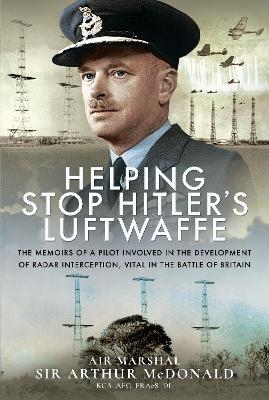
Helping Stop Hitler's Luftwaffe
The Memoirs of a Pilot Involved in the Development of Radar Interception, Vital in the Battle of Britain
Seiten
2020
Air World (Verlag)
978-1-5267-6478-2 (ISBN)
Air World (Verlag)
978-1-5267-6478-2 (ISBN)
Read of how the first ever radar set, not invented in Britain, was thrown into the sea on the orders of an irate ship's captain. Learn of how the radar defence of the UK was developed from its earliest days. Discover the little-known Dowding Experiment'.
‘The bomber will always get through’ was the oft-repeated mantra, first coined by Stanley Baldwin in 1932, which emphasised that the only realistic form of defence was offence. This belief determined the UK’s military strategy, with more attention, and resources, being devoted to bomber production rather than fighters. With bombers able to fly at hundreds of miles an hour, by the time the incoming aircraft had been detected, it would be too late to scramble fighters to intercept them. That was until Sir Henry Tizard and his colleagues first demonstrated that radar (or Radio Direction Finding as it was then called), could detect an aircraft approaching Britain at a considerable distance, allowing fighters to take to the air before the intruders reached British soil.
This was shown in the ‘Biggin Hill Experiment’ when a young Arthur McDonald led three biplanes from RAF Biggin Hill, and which were directed by radar sets on the ground to intercept incoming aircraft. At the time McDonald was told, ‘that the whole future of this country depends on the results which you obtain’. McDonald succeeded and, having demonstrated that bombers could be stopped, Britain turned its attention to building fast, modern fighters, and to developing a radar network – just in time for the Battle of Britain. For this work McDonald received the Air Force Cross.
Essex Class Aircraft Carriers, 1943–1991
In his subsequent career, McDonald became Air Defence Commander in Ceylon in 1942, Air Officer Training at Headquarters Air Command of South East Asia Command in 1943 and Air Officer Commanding No.106 Group in April 1945. He was the last commanding officer of the Royal Pakistan Air Force and held many senior posts in the RAF until his retirement in 1962. But it his part in the development of Britain’s air defence at the most crucial time in its history, for which he will always be remembered.
‘The bomber will always get through’ was the oft-repeated mantra, first coined by Stanley Baldwin in 1932, which emphasised that the only realistic form of defence was offence. This belief determined the UK’s military strategy, with more attention, and resources, being devoted to bomber production rather than fighters. With bombers able to fly at hundreds of miles an hour, by the time the incoming aircraft had been detected, it would be too late to scramble fighters to intercept them. That was until Sir Henry Tizard and his colleagues first demonstrated that radar (or Radio Direction Finding as it was then called), could detect an aircraft approaching Britain at a considerable distance, allowing fighters to take to the air before the intruders reached British soil.
This was shown in the ‘Biggin Hill Experiment’ when a young Arthur McDonald led three biplanes from RAF Biggin Hill, and which were directed by radar sets on the ground to intercept incoming aircraft. At the time McDonald was told, ‘that the whole future of this country depends on the results which you obtain’. McDonald succeeded and, having demonstrated that bombers could be stopped, Britain turned its attention to building fast, modern fighters, and to developing a radar network – just in time for the Battle of Britain. For this work McDonald received the Air Force Cross.
Essex Class Aircraft Carriers, 1943–1991
In his subsequent career, McDonald became Air Defence Commander in Ceylon in 1942, Air Officer Training at Headquarters Air Command of South East Asia Command in 1943 and Air Officer Commanding No.106 Group in April 1945. He was the last commanding officer of the Royal Pakistan Air Force and held many senior posts in the RAF until his retirement in 1962. But it his part in the development of Britain’s air defence at the most crucial time in its history, for which he will always be remembered.
Born in June 1903, as a boy Air Marshal Sir ARTHUR McDONALD KCB, AFC, FRAeS, DL grew up in Antigua, his engineering career beginning in the Antigua Sugar Factory, earning him wages of just £1 a week. He joined the RAF in 1924, remaining in the service until his retirement in 1961. Besides a distinguished RAF career, Sir Arthur was a keen sailor and there are informative accounts of his sailing exploits; including yacht racing in Singapore in the 1930s, winning the Burton Cup in 1937 and being the oldest competitor in single handed sailing in the 1948 Olympic Games in Torbay.
| Erscheinungsdatum | 21.08.2020 |
|---|---|
| Zusatzinfo | 32 black and white illustrations |
| Verlagsort | Barnsley |
| Sprache | englisch |
| Maße | 156 x 234 mm |
| Themenwelt | Literatur ► Biografien / Erfahrungsberichte |
| Geschichte ► Allgemeine Geschichte ► 1918 bis 1945 | |
| Geschichte ► Teilgebiete der Geschichte ► Militärgeschichte | |
| Sozialwissenschaften ► Politik / Verwaltung | |
| ISBN-10 | 1-5267-6478-4 / 1526764784 |
| ISBN-13 | 978-1-5267-6478-2 / 9781526764782 |
| Zustand | Neuware |
| Informationen gemäß Produktsicherheitsverordnung (GPSR) | |
| Haben Sie eine Frage zum Produkt? |
Mehr entdecken
aus dem Bereich

aus dem Bereich
Deutschland 1933 bis 1945
Buch | Hardcover (2025)
S. Fischer (Verlag)
CHF 47,60
ein Psychologe erlebt das Konzentrationslager
Buch | Hardcover (2024)
Kösel (Verlag)
CHF 30,80


