


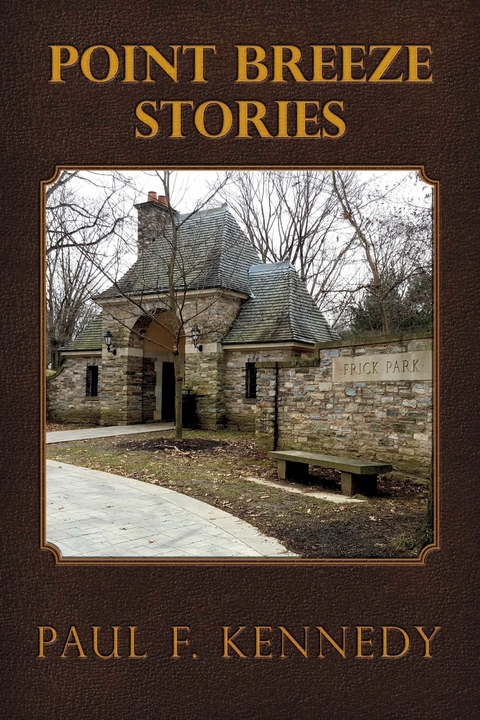
Point Breeze Stories (eBook)
188 Seiten
Bookbaby (Verlag)
978-1-5439-8335-7 (ISBN)
This collection of fourteen fictional short stories and two memoirs spans the time period from America's frontier days to the 21st century. All are set, at least in part, in the small neighborhood of Point Breeze, in the East End of Pittsburgh. Baptism of Desire follows an Irish settler family in the 1700s caught in the struggle between the British, French, and native people for western Pennsylvania. They ultimately settle in what is now Point Breeze. Subsequent stories unfold during the disastrous 1877 railroad strike, the violent Prohibition era, and the Vietnam War. But most of the stories occur in the 1950s and 1960s Baby Boom, when the author grew up in the neighborhood. Many colorful characters populate these pages, but the real star is the neighborhood itself. Anyone who has ever lived or "e;loafed"e; in Point Breeze in the latter half of the twentieth century can relate well to these stories, but they are for all readers. The rich history of the past morphs into the raucous kid-crowded mid-twentieth century and beyond. Tears of grief, joy, and nostalgia drip from the pages. The collection concludes with two tender, poignant, and funny "e;coming of age"e; memoirs. It is the author's hymn to his home, his history, his people. An Introduction entitled "e;Memories Are a Breeze"e; describes the neighborhood's history and literary legacy, as well as the author's memories as he walks the neighborhood.
Memories Are A Breeze
A walk through Point Breeze, the neighborhood that formed me and still grips me, stirs memories with every step. It’s much quieter now, unlike the Baby Boom era with its scores of large families. In those days the shouts of children were incessant, playing wiffle ball, Release, Kick the Can, or just running about looking for fun or trouble. It’s a small patch, barely more than a half mile in any direction, yet its history and celebrity surpass much larger areas.
First, the history: Judge William Wilkins, U.S. Senator and Ambassador to Russia under President Andrew Jackson, built his mansion in 1836 on his estate that covered most of what is now Point Breeze. As Pittsburgh became an industrial powerhouse, many of the wealthy built mansions on Penn Avenue, which became known as “Millionaires Row.” Internationally known tycoons H.J. Heinz, Henry Clay Frick, Andrew and Thomas Carnegie, Thomas Mellon, and George Westinghouse lived there. Other lesser known aristocrats lived nearby, escaping the smoke and grit of the factories along the rivers. At around the time the nineteenth century turned into the twentieth, residents of Pittsburgh’s East End possessed about 40% of the world’s wealth, most of them living in what is now Point Breeze. A residential neighborhood of both upscale and modest homes grew around the mansions, and still thrives today.
The “Breeze,” as it’s been known since the 1960’s, has spawned a list of notables that is remarkable, almost unbelievable, for its size. You want a tour of renowned writers’ homes? Let’s start with the four Pulitzer Prize winners. A five minute walk takes you past the childhood homes of David McCullough (1982, 1993, 2002) Norman Miller (1964) Annie Dillard (1975) and Mary Pat Flaherty (1986, 1995). That’s seven Pulitzers. On the way you would pass the childhood homes of award-winning poets Peter Blair, Nancy Kennedy, and Bill Diskin. Other notable writers include novelists Stewart O’Nan, Albert French, Mark Best, and Jesse Andrews, and national political reporter Kathy Kiely. All lived within a few blocks of each other.
In the second half of the twentieth century it was a haven for Steeler brass. Vice President Jack McGinley, his wife Rita Rooney McGinley (sister of Art), publicist Ed Kiely, and business manager Fran Fogarty were residents. A few celebrity athletes made their homes there. Pirate Hall of Famer Willie Stargell, Steeler great L.C Greenwood, and NBA All-Star Connie Hawkins lived there for decades, from their playing days until their deaths.
Pittsburgh Mayor Joseph Barr (1959-1970) made his home there, as did Dick Thornburg, Governor of Pennsylvania (1979-1987) and U.S. Attorney General (1988-1991), along with many judges and state and local elected officials. Current Pittsburgh Mayor Bill Peduto (2014-) lives there now.
Point Breeze, like other Pittsburgh neighborhoods, has no official boundaries. It’s all under the city of Pittsburgh government, which is divided into wards. The city has tried to establish neighborhood boundaries on maps, but it’s still fuzzy, ultimately the judgment of current and former residents. Traditionally, Catholic parish boundaries were considered indicative. For instance, anyone who attended St. Bede Church or School was considered a “Breezer.” A small expansion of city-imposed mythical boundaries (I’m talking one or two blocks) would give us PBS legend Fred Rogers and former Iowa governor Tom Vilsack.
A few more notables: Federated Investors founder John Donahue raised his thirteen children there. KDKA and WPXI newscaster Pat Kiely lived there during her days on the air, and lectored at St. Bede Church. Frank Dileo, who was Michael Jackson’s manager and appeared in the movie Goodfellas, grew up there, as did jazz musician siblings David and Maureen Budway, and rapper Mac Miller.
The heart and soul of twentieth century Point Breeze was not the celebrities, but the everyday people – the characters – who made it memorable. The neighborhood was considered upscale by outsiders, with many doctors, lawyers, and business owners. But it also included lots of police officers, firefighters, factory workers, and skilled laborers. It had an Irish Catholic flavor, and that group was the most numerous, but lots of German Catholics, Italian Catholics, Jews, and Protestants lived there.
Most of the Catholic kids went to St. Bede. Protestants, Jews, and some Catholics went to Sterrett or Linden of the Pittsburgh Public Schools system. For high school most went to Central Catholic, Sacred Heart, or Allderdice. A few higher income kids attended Mount Mercy or Shadyside Academy. All of the schools were known for academic excellence.
As I walk, I think of the many nicknames. I mean real nicknames, not temporary or derogatory ones, but ones by which a person was normally called, with only family members and close friends knowing the real names. Besides common ones like Butch, Skip, or Buddy, or ones based on a surname like Fitz, Pik, Huffy, or Wags, there were Skinny and Pudgy, Beans and Tubby, Duke, Tank, Hot Dog, Bunky, Jocko, Jiggs, Tubs, Duck, Kiffer, Crusher, Chickie, Donk, and Bammer. Some of the girls also had colorful nicknames, like Bunchie, Muggsy, Howdy, Mimi, Trinkle, and Footsie. (Do kids have nicknames like that today?)
Point Breeze produced an impressive number of athletes of its own, especially in football, baseball, and girls’ softball. Many prominent players at Central Catholic, Allderdice, and Sacred Heart came from a few adjacent blocks in the Breeze. From 1967 to 1975 four starting quarterbacks at Central and two at Allderdice came from those same few blocks. Three outstanding running backs played at Division One college programs, and scores of other football players from the 1960s and 1970s started for high school teams, many some receiving college scholarships and All-America mentions. Most went to top academic universities. Point Breeze spawned several prominent longtime high school coaches, and one NFL coach, Danny Smith, currently with the Steelers. Opportunities for girls were sparse in those days, but some of the quality female softball and basketball players of that era would receive college scholarships today. They earned the respect of their male counterparts on the fields and playgrounds.
From Millionaires Row I pass Clayton, the home of Henry Clay Frick, now part of Frick Museum and Historical Center. When I was a kid, his daughter, Helen Clay Frick, lived there. We called her “Miss Frick.” Next to Clayton, where the museums and parking lot are now, was a beautiful grass field we called “the Greens.” We played football and baseball games there with up to 25 or 30 kids, sometimes interrupted by Miss Frick’s landscapers chasing us away. Across Reynolds Street begins massive and multi-faceted Frick Park, with its Lawn Bowling greens, Waterhouse, woods, athletic fields, playgrounds, and nature center extending well into Squirrel Hill and Regent Square. As kids we explored in the woods, often swinging out over a 40 to 50 foot drop on “Tarzan vines,” an extremely dangerous practice that seemed routine at the time. We ventured down to Nine Mile Creek, which we only knew as “Shit Creek” because of its raw sewage and used condoms.
I pass the Frick Park entrance at the circle of Reynolds and South Homewood, with its quaint arched stone walls and shingled roof. A friend and I once blew off a few shingles with a cherry bomb. A few steps and I’m at Homewood Cemetery’s Homewood Gate. Just inside are steep hills that provided great sled riding. Venturing farther into the “cemmey” could bring an adrenalin rush from being chased by Frank, the cemetery cop. Crossing the street brings me to Sterrett School. Its dirt field was saturated with black oil in the spring to keep the dust from blowing. We played pickup baseball there in the summer with full teams, nine on a side and latecomers waiting to get in. In the late summer and fall, St. Bede football practiced there. The ground was hard, almost like being tackled in the street, except that you got dirt and grease all over you. We threw the bigger pieces of broken glass to the sidelines before playing. Legend has it that Bill Mazeroski’s home run ball from the 1960 World Series, caught by Point Breeze native Andy Jerpe, was lost in the tall weeds at the edge of Sterrett Field.
Like most Pittsburgh neighborhoods, Point Breeze is hilly. Three more blocks brings me to 527 South Murtland, the house where I grew up. Eleven of us lived there in three bedrooms and an attic. We had a garage and basketball court in the back, now a patio. How could it be so quiet? The noise never stopped back then. It was the center of neighborhood activity, with my mother a smiling, welcoming host. The fecundity of the Point Breeze mothers of the Baby Boom era was staggering, unimaginable by today’s standards. Large families were common in many places, but more so in the Breeze. Three or four kids – a large family now – was small then. I can recall sixteen families with nine or more children, and even more in the five to eight range, all within the same small area. I am not exaggerating.
For many years my father was a fixture on our porch, smoking his cigar and accepting waves and honks from pedestrians and cars passing by. He was a gatekeeper to the neighborhood, watching who came and went. Speeders heard a scornful “Hope ya make it Buddy!” from his booming voice. He often drank Iron City beer with his cigar and...
| Erscheint lt. Verlag | 30.8.2019 |
|---|---|
| Sprache | englisch |
| Themenwelt | Literatur ► Historische Romane |
| ISBN-10 | 1-5439-8335-9 / 1543983359 |
| ISBN-13 | 978-1-5439-8335-7 / 9781543983357 |
| Informationen gemäß Produktsicherheitsverordnung (GPSR) | |
| Haben Sie eine Frage zum Produkt? |
 EPUB (Adobe DRM)
Größe: 5,2 MB
Kopierschutz: Adobe-DRM
Adobe-DRM ist ein Kopierschutz, der das eBook vor Mißbrauch schützen soll. Dabei wird das eBook bereits beim Download auf Ihre persönliche Adobe-ID autorisiert. Lesen können Sie das eBook dann nur auf den Geräten, welche ebenfalls auf Ihre Adobe-ID registriert sind.
Details zum Adobe-DRM
Dateiformat: EPUB (Electronic Publication)
EPUB ist ein offener Standard für eBooks und eignet sich besonders zur Darstellung von Belletristik und Sachbüchern. Der Fließtext wird dynamisch an die Display- und Schriftgröße angepasst. Auch für mobile Lesegeräte ist EPUB daher gut geeignet.
Systemvoraussetzungen:
PC/Mac: Mit einem PC oder Mac können Sie dieses eBook lesen. Sie benötigen eine
eReader: Dieses eBook kann mit (fast) allen eBook-Readern gelesen werden. Mit dem amazon-Kindle ist es aber nicht kompatibel.
Smartphone/Tablet: Egal ob Apple oder Android, dieses eBook können Sie lesen. Sie benötigen eine
Geräteliste und zusätzliche Hinweise
Buying eBooks from abroad
For tax law reasons we can sell eBooks just within Germany and Switzerland. Regrettably we cannot fulfill eBook-orders from other countries.
aus dem Bereich


