


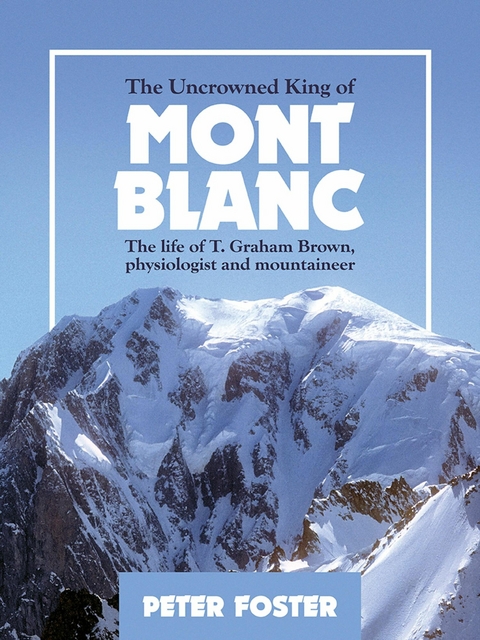
Uncrowned King of Mont Blanc (eBook)
Vertebrate Digital (Verlag)
978-1-898573-83-8 (ISBN)
Peter Foster is a retired consultant physician. Educated at Westminster and Christ Church, Oxford, he qualified in medicine at St Thomas's Hospital Medical School. After junior posts in Stoke, Nottingham and Leeds he was appointed consultant gastroenterologist in Macclesfield. His climbing career followed a similarly conventional route, from Harrison's Rocks, where his father held the rope, via North Wales and Ben Nevis in winter to the Alps, where ambition was not always matched by ability and resulted in a more than usual number of unplanned bivouacs. While still a medical student he was one of a two-man trip to the Himalaya; little was achieved but it provided a memorable experience. He has been a member of the Alpine Club since 1975 and still climbs in the Alps most summers but his long-held ambition to climb Mont Blanc by one of Graham Brown's routes up the Brenva Face remains unfulfilled. His interest in mountaineering history goes back to schooldays when he first started book collecting. He has contributed articles to the Alpine Journal, and The Uncrowned King of Mont Blanc is his first book. He is married to Kate, and has three grown-up children and two grandchildren. He lives on the edge of the Peak District.
The Uncrowned King ofMont Blanc by Peter Foster is the story of Thomas Graham Brown: scientist, mountaineer and psychological paradox, most famous for his groundbreaking routes on the Brenva Face of Mont Blanc and his turbulent relationship with Frank Smythe.
Thomas Graham Brown was born on 27 March 1882 at 63 Castle Street, in the original New Town of Edinburgh, into the comfortable and respectable circumstances of an established and quietly distinguished family from the city’s professional class.
For a man who never showed much enthusiasm for his siblings, Graham Brown was always keenly interested in his own ancestry. His father, John, had been born in Edinburgh in September 1853, ‘the son and grandson of Presbyterian ministers of a family that sent its sons into medicine, or the church or to India’.1 John was one of two boys and always styled himself John Graham Browna to distinguish himself from his brother James Wood Brown. After qualifying in medicine in 1875, he succeeded to the practice established by his Wood grandfather and uncle.b He married Jane Thorburn, another product of Free Church Presbyterianism, and they had four children. Thomas’s birth was followed by that of two more boys, David Thorburn and Alexander Wood, and a daughter called Jane. When Thomas was only nine, his mother died from bowel cancer. His chief memory of her is that she encouraged him to draw, but her death inevitably meant that his formidable father was his greatest influence.
By the time Thomas reached school age, his father was already on the path that would take him to the pinnacle of his profession, the presidency of the Royal College of Physicians of Edinburgh. A photographic family portrait provides a defining image of the late Victorian paterfamilias: grey-haired and bearded, an unruly full-set, pince-nez dangling on a cord. John is seated, surrounded by a chubby, fourteen-year-old Tom in knickerbockers; David, known as Thor, smartly dressed in a naval cadet’s uniform; Alex wearing an Eton collar and a forced smile; a demure Janey, and the pet dog.
John Graham Brown can never have been the easiest of fathers. The son of a distinguished churchman and scientistc himself, he was not the man to expect less of his eldest son. Seventy-odd letters to Thomas written during the period 1898–1920 are extant, their tone humourless and almost invariably admonitory. ‘Your letters are delightful reading but you do make a lot of mistakes in spelling,’ he wrote to his sixteen-year-old son, and it was a tone he never lost.2 ‘You must stick hard into it,’ he would tell him when he was a medical student learning anatomy, ‘for it means a lot of very careful reading and memory work as well as the mere dissecting … I hope you have been working hard at your bones.’3 Even when Graham Brown was appointed to the chair of physiology at Cardiff, his father’s congratulations were qualified by the hope that the post was ‘only a stepping stone’ to a more prestigious position.
From the first, Graham Brown had been inculcated with the need to succeed, but his schooldays were unexceptional and gave no hint of his abilities. In 1889, aged seven, he entered the recently established preparatory school of the Edinburgh Academy. Here he would have encountered the formidable Miss Wood, one of the original three dames engaged to teach at the school. She had arrived at the Academy from the Clergy Daughters’ School at Casterton in Westmoreland where Charlotte Brontë had been a pupil, and which had been the model for Lowood School in Jane Eyre. She was a strict disciplinarian; silence reigned in her class and ‘woe betide the offender who did not on every occasion come up to her high standard of neatness and accuracy’, for he would receive ‘such a torrent of rebuke as many an older person would have flinched under’.4
Three years later he proceeded to the upper school and, like the majority of pupils, attended as a day boy, his home in Chester Street in the city’s West End being just a mile distant. The Edinburgh Academy had been founded in 1824 to provide an alternative to the high school, a sixteenth-century foundation, which was overcrowded and failing its pupils:
[G]reat mobs of boys sat in long rows that rose upwards in tiers, with the cleverest at the top and the slower boys ‘sitting boobie’ on the lowest benches. They droned their Latin verbs and declensions en masse with ‘ushers’ (monitors paid by the masters out of their own pockets) ‘hearkening’ each row and helping to dispense punishment to the slow or inattentive.5
At the Academy, by way of contrast, class sizes were controlled and emphasis was placed on raising the standards of teaching, especially of Greek. From the outset, at the urging of Sir Walter Scott, one of the founder directors of the school, English was compulsory. However, study of the classics remained central to the curriculum until in 1866 it was organised into two separate schools: classical and modern. The modern side learned more English, French, German and Maths, less Latin and no Greek.
Graham Brown’s time at the Academy coincided with the rectorship of R.J. Mackenzie (1888–1901). On assuming charge, Mackenzie had found the Academy in a parlous state with the school roll falling, morale ‘low’, ‘discipline ragged, debts high and prospects poor’.6 Espousing the principles of ‘strict discipline, moral rectitude, and cleanliness of soul’ that were dear to the heart of every Victorian parent and ‘with a blend of determination, charm, enthusiasm and sheer hard work that inspired an extraordinary degree of loyalty and devotion in everyone connected with the school’, he turned the school’s fortunes around.7 By 1895 the number of pupils had more than doubled.
Mackenzie put the teaching of science on a proper footing, building a science laboratory and appointing J. Tudor Cundall, who was only twenty-five but had already built a record as an able chemist, as special science master to organise the laboratory and devise a course of study. Cundall founded the school’s Scientific Society. Its earnest meetings included guest lectures by distinguished scientists, demonstrations and papers given by the boys on topics that ranged from ‘colour photography’ to ‘ants and their habits’; Graham Brown read one on ‘Aluminium’. In addition, there were worthy educational visits to ‘factories, power stations and other establishments of scientific interest’, surely only of interest to an unusual species of teenage boy.8
Mackenzie also believed strongly in the educational value of sport, stating that ‘vigorous exercise of some kind is, I think, a necessity for boys’. He considered that participation in organised games could ‘develop physique, endurance, presence of mind, qualities of the highest value in practical life … [and] afford an education in public spirit’, adding, ‘if I were asked what was the most dangerous occupation for a boy’s hours of leisure, I should at once name loafing’.9 He introduced compulsory games on three afternoons a week; almost the whole of the upper school opted to play cricket and rugby rather than take the special course in gymnastics. Perhaps due to his short stature and difficulties with his eyesight, Graham Brown exhibited no sporting prowess, even failing to show in the sixty-yard sack race at the annual sports day. But like most schoolboys faced with the dreary task of letter writing, the results of matches provided ready subject matter: ‘The Academy beat Fettes yesterday much to their disgust. I suppose they will get no jam for tea for at least a fortnight.’10
Outside school his enthusiasms were for ‘old castles, the quest for secret chambers and underground passages; the “greyhounds” of the Atlantic; prehistoric forts; the yachts of the America’s Cup race; fossil hunting; egg collecting; armour’.11 Amongst his favourite books were Robert Louis Stevenson’s Kidnapped and S.R. Crockett’s The Raiders, a tale of outlaws and smugglers in Galloway in the early eighteenth century. He delighted in tracing and marking the heroes’ routes on a map, a habit which ‘taught me early the valuable art of map-reading’.12 As an older boy:
A phase of golfing holidays merged with the more serious business of fishing – bicycle, rod, and a .380 revolver, which was merciful to the rabbits. Spey, Tweed and Clyde were fished, and the small streams of the Lammermuirs and Lothians, Loch Leven and Loch Ard.13
There were family seaside holidays at Largo on the Fife coast, when he scrambled on the sea cliffs at nearby Elie, and, memorably, ‘two long summers … in my father’s schooner amongst the Hebrides and along the Western coast’.14
In 1898 Graham Brown was removed from the Academy to spend four months in Germany. He was having trouble with his eyesight – the nature of the problem is unclear but his microscopic handwriting may have been a manifestation – and his father arranged for him to travel to Wiesbaden to consult an oculist whose prescription was to avoid reading. The visit also provided an opportunity for him to improve his German, in accordance with his father’s wishes. Graham Brown was dutiful but unenthusiastic; his daily entries in the diary of his stay start with ‘lessons as usual’ and were soon replaced by a single, monotonous...
| Erscheint lt. Verlag | 11.7.2019 |
|---|---|
| Vorwort | Lindsay Griffin |
| Verlagsort | London |
| Sprache | englisch |
| Themenwelt | Literatur ► Biografien / Erfahrungsberichte |
| Literatur ► Romane / Erzählungen | |
| Sachbuch/Ratgeber ► Natur / Technik | |
| Sachbuch/Ratgeber ► Sport | |
| Schlagworte | ALPINE • Alpine Club • Alpine Journal • Alps • Bill Tilman • bouldering • Brenva • Climb • climbing book • Eric Shipton • Frank Smythe • Locomotion • Mountaineering • nervous system • Physician • Physiology |
| ISBN-10 | 1-898573-83-2 / 1898573832 |
| ISBN-13 | 978-1-898573-83-8 / 9781898573838 |
| Informationen gemäß Produktsicherheitsverordnung (GPSR) | |
| Haben Sie eine Frage zum Produkt? |
 EPUB (Adobe DRM)
Kopierschutz: Adobe-DRM
Adobe-DRM ist ein Kopierschutz, der das eBook vor Mißbrauch schützen soll. Dabei wird das eBook bereits beim Download auf Ihre persönliche Adobe-ID autorisiert. Lesen können Sie das eBook dann nur auf den Geräten, welche ebenfalls auf Ihre Adobe-ID registriert sind.
Details zum Adobe-DRM
Dateiformat: EPUB (Electronic Publication)
EPUB ist ein offener Standard für eBooks und eignet sich besonders zur Darstellung von Belletristik und Sachbüchern. Der Fließtext wird dynamisch an die Display- und Schriftgröße angepasst. Auch für mobile Lesegeräte ist EPUB daher gut geeignet.
Systemvoraussetzungen:
PC/Mac: Mit einem PC oder Mac können Sie dieses eBook lesen. Sie benötigen eine
eReader: Dieses eBook kann mit (fast) allen eBook-Readern gelesen werden. Mit dem amazon-Kindle ist es aber nicht kompatibel.
Smartphone/Tablet: Egal ob Apple oder Android, dieses eBook können Sie lesen. Sie benötigen eine
Geräteliste und zusätzliche Hinweise
Buying eBooks from abroad
For tax law reasons we can sell eBooks just within Germany and Switzerland. Regrettably we cannot fulfill eBook-orders from other countries.
aus dem Bereich


