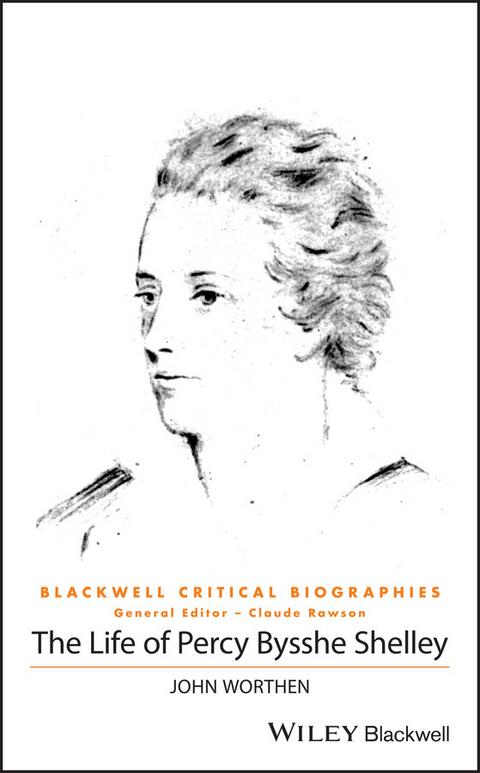
The Life of Percy Bysshe Shelley (eBook)
John Wiley & Sons (Verlag)
978-1-118-53403-8 (ISBN)
Drawing especially on the many scholarly discoveries of recent years, this biography examines the life - and death - of one of the greatest Romantic poets. Based on sceptical historical investigation and featuring an in-depth look at Shelley's personal, financial and familial situation, it builds a compelling narrative about a controversial writer and thinker whose personal and philosophical convictions caused much turmoil during his short yet extraordinarily influential life.
The Life of Percy Bysshe Shelley reveals sides of the author not often studied. It looks at Shelley as an intensely loving, thoughtful and responsible man and father, who (except in one case) took exemplary care of the women he loved and who fell in love with him. It shows how significant his status as a gentleman was; it examines his poetry, letters, notebooks and discursive prose so that readers can comprehend the most important concerns of his life; it explores the financial and medical grounds for his years of exile; it is also the first biography to take account of his recently discovered early long poem the Poetical Essay on the Existing State of Things.
This biography offers readers a unique look at a famous poet, scholar, gentleman, democrat, atheist and tragic icon of English Romanticism.
JOHN WORTHEN is Emeritus Professor at the University of Nottingham, UK. His books include The Life of William Wordsworth: A Critical Biography (2014); The Cambridge Introduction to Samuel Taylor Coleridge (2010); T. S. Eliot: A Short Biography (2009); Robert Schumann: Life and Death of a Musician (2007); and D. H. Lawrence: The Life of an Outsider (2005).
Drawing especially on the many scholarly discoveries of recent years, this biography examines the life and death of one of the greatest Romantic poets. Based on sceptical historical investigation and featuring an in-depth look at Shelley s personal, financial and familial situation, it builds a compelling narrative about a controversial writer and thinker whose personal and philosophical convictions caused much turmoil during his short yet extraordinarily influential life. The Life of Percy Bysshe Shelley reveals sides of the author not often studied. It looks at Shelley as an intensely loving, thoughtful and responsible man and father, who (except in one case) took exemplary care of the women he loved and who fell in love with him. It shows how significant his status as a gentleman was; it examines his poetry, letters, notebooks and discursive prose so that readers can comprehend the most important concerns of his life; it explores the financial and medical grounds for his years of exile; it is also the first biography to take account of his recently discovered early long poem the Poetical Essay on the Existing State of Things. This biography offers readers a unique look at a famous poet, scholar, gentleman, democrat, atheist and tragic icon of English Romanticism.
JOHN WORTHEN is Emeritus Professor at the University of Nottingham, UK. His books include The Life of William Wordsworth: A Critical Biography (2014); The Cambridge Introduction to Samuel Taylor Coleridge (2010); T. S. Eliot: A Short Biography (2009); Robert Schumann: Life and Death of a Musician (2007); and D. H. Lawrence: The Life of an Outsider (2005).
List of Illustrations ix
Acknowledgements xi
Abbreviations and Texts xiii
Foreword xvii
Part I Background, Foreground 1792-1811 1
1 A Scholar, a Gentleman, and a Poet 1792 -1810 3
2 'Bit' 1796 -1811 12
3 Panting to Seize the Wings of Morn 1810 -1811 21
4 Printing Freaks 1810 -1811 32
5 The Necessity of Atheism, Expulsion & Debt 1811 43
Part II Lover of Mankind, Democrat & Atheist 1811-1818 55
6 A Shelley Business! 1811 57
7 My New Sister 1811 -1813 67
8 Tan-yr-allt 1813 78
9 Queen Mab: Shadows of the Dream 1812 -1813 83
10 A Rash & Heartless Union 1813 -1814 96
11 Mary Godwin 1814 103
12 This is a Vampire 1814 -1815 113
13 Alastor 1815 -1816 124
14 Geneva and Byron 1816 135
15 A Series of Pain 1816 149
16 Drowned, Frozen, Dead 1816 158
17 Laon and Cythna: Writing against Death 1817 167
18 My Country Dear to Me Forever 1817 -1818 180
Part III Expatriation 1818-1821 191
19 Italy: As Light in the Sun, Throned 1818 193
20 Flowering Islands 1818 207
21 A Birth in Naples 1818 -1819 222
22 Exceeding Grief: The Cenci 1819 230
23 Prometheus Unbound 1819 240
24 Satiric Reality 1819 248
25 Beam-Anatomising Prism 1819 -1820 258
26 Harmonious Madness 1820 268
27 Swellfoot the Tyrant 1820 280
28 Epipsychidion v. Flesh & Blood 1820-1821 291
29 Defending Poetry 1821 302
30 This Latest of my Orphans 1821 313
Part IV No Rest or Respite 1821-1822 321
31 Ariel to Miranda 1821 -1822 323
32 To the Villa Magni 1822 335
33 'The Triumph of Life' 1822 342
34 Enchanted Heart 1822 349
35 Upon a Precipice 1822 362
36 Going to Join Friend Plato 1822 370
37 Beyond this Life 379
Notes 393
Bibliography 448
Index 457
Foreword
‘Ah, did you once see Shelley plain,
And did he stop and speak to you?
And did you speak to him again?
How strange it seems, and new!’1
Robert Browning (1812–1889)
Seeing Shelley ‘plain’, as Browning put it in 1851, is harder than one might imagine. The best‐known portrait of him, painted in 1819 by Amelia Curran, was – the artist herself admitted – ‘so ill done’ that she nearly destroyed it (it was never finished).2 There exist, however, life‐drawings by Shelley’s friend Edward Williams, including a profile confirming just how ‘boyish looking’ he appeared, together with a ghostly back view (see Figure 1). His brown hair was always wild, his face freckled when he caught the sun; he grew tall but, as the pictures suggest, remained slight, with something of a stoop: small head, narrow shoulders, long legs.3
Figure 1 Percy Bysshe Shelley, pencil drawing (Pisa 27 November 1821) by Edward Ellerker Williams (Newman Ivey White, Shelley, New York: Knopf, 1940, Volume II, facing page 524)
Readers of this book will find a concentration upon the actual: pistols fired in enclosed spaces, books printed in signatures, pieces of paper tightly folded. Shelley has so often been seen as an evanescent, barely human soul – his wife Mary remarked after his death that ‘I do not in any degree believe that his being was regulated by the same laws that govern the existence of us common mortals’ – that we need to ground our understanding of him in what he called ‘the difficult and unbending realities of actual life’.4
This is a biography shorter than most of its predecessors:5 the man who writes (poetry, letters, pamphlets, discursive prose) is the central subject. Not because the works are autobiographical, but because they focus the most intense concerns of the life: and because they are what makes Shelley extraordinary. He wrote so much that being comprehensive is, however, not an option.
It is tempting to assume that he must always have known where he was going as a writer, but he took a long time to locate the styles and the approaches that suited him. As Julian Barnes has remarked, an artist’s career is ‘likely to be a matter of obsessional overlap, of ferrying back and forth, of process rather than result, journey rather than arrival’.6 Shelley came to the end of his journey so very suddenly, at the age of 29, that it seems entirely natural for him not to have known exactly where he was arriving: if, indeed, he was going to be a poet at all.
He had started to write very early: in his penultimate year as a schoolboy at Eton, 1808–1809, when he was only 16, he began a highly coloured gothic novel, Zastrozzi. He had explained to a potential publisher in May 1809 that he expected no money for it (music to a publisher’s ears): ‘I am independent, being the heir of a gentleman of large fortune.’ The book came out in March 1810, when he was still at school. It got into print because he could afford to have it printed: he could even lay out £10 to bribe potential reviewers.7 And what followed was not just a stream but a flood of writing. His second book, Original Poetry; by Victor and Cazire, written with his sister Elizabeth (1794–1831), was printed at his own expense, though he failed to settle the printer’s bill (a massive £75) for some while. His third book, the novel St. Irvyne: or The Rosicrucian: A Romance, would be printed in December 1810, again at his own expense, and appeared in 1811, when Shelley was 18.8
But having his work printed and published privately became necessary, as he grew more critical of government, monarchy and Christianity, and as his reputation grew worse. Three pieces of political (in fact treasonable) writing had to be printed anonymously in 1812; copies identified as Shelley’s were nevertheless passed to the Home Office. In 1813, he realised that his poem Queen Mab could not be published as it stood, while the Notes he was planning would make it doubly impossible. Paying the real printer himself, he added his own name as printer, at his father‐in‐law’s address (the law demanded that a printer be named), but even then the book was only distributed to friends, often with name and address removed. In 1816, Shelley had his poem Alastor printed at his own expense, as he did his poem The Revolt of Islam in 1818 (which must have cost him near to £1309). He sent printed copies of his play The Cenci to London from Italy in 1819; Adonais, too, was printed in Italy and the copies sent to London for publication. On the other hand, two of his greatest poems, written in 1819, The Mask of Anarchy and his sonnet ‘An old, mad, blind, despised and dying King’, would only be published in the 1830s, years after his death, and long after the time when they made political sense.
Such publishing – or failure to publish – was not conducive to Shelley’s making money. In one way, that was not a problem. As a gentleman possessed of a private income – in practice, an allowance awarded by his father Timothy Shelley (1753–1844) – and with a future which looked financially assured, he made a point of not writing for money. For much of his life the idea was repellent to him. In February 1821, he would actually insist on not being paid for an essay which, he declared, he had ‘determined to write’ before learning of its potential publisher’s ‘liberal arrangements’10 for payment. On 25 January 1822, nearly 12 years after his first book had been published, he would tell his friend, the London critic and editor Leigh Hunt (1784–1859), that he had no idea how well his books sold: ‘I have never until now thought it worth while to inquire.’ Back in 1811, he had instructed the bookseller responsible for his second gothic novel: ‘Will you have the goodness to inform me of the number of copies which you have sold of “St. Irvyne”.’11 But by 1822, Shelley knew how pointless it would be to enquire how a book of his was selling – because so few sold. It seems likely that he never in fact earned a penny from any of his books.12
What makes this more startling is the fact that, by April 1822, he was in debt for over £20 000: in modern terms, over £1 million, as for rough equivalence 1800–1822, sums can be multiplied by 50.13 He coupled his remark in 1822 about book sales with a question about his newest work, a play. A fortnight earlier he had given his usual publisher, Charles Ollier (1788–1859), an opportunity to buy it: now he asked whether Hunt might be able to find a publisher who would take it for £150 or £200. His questions to Ollier and Hunt seem to have been the first occasions in his life when Shelley had actually put a price on a piece of his writing.
For, despite his constant, at times awful, local difficulties, he knew that he would – one day – be rich. But because he lived his entire life in the style appropriate to the eldest son of a gentleman, his income from his father never proved adequate. His unpaid bills dictated where he could live; eventually his debts were crucially important in his decision to leave England, in 1818, and to settle in a country (Italy) where his income would go further and his old liabilities could not be pursued.
His doctor’s warnings had also directed him to a warmer climate. Another necessary biographical topic – an often under‐rated problem – is that, from his early twenties until almost the end of his life, Shelley was beset by illness; in January 1821 he called himself a ‘feeble mass of diseases & infirmities’ dragged through the world by a ‘vapid & weary spirit’.14 He was frequently in severe pain: perhaps kidney stones, quite likely kidney damage and recurring infection. He was believed tubercular by an English doctor who examined him in 1817, though his life in Italy brought him a period of remission which lasted until his death. His astonishing achievements as a writer, along with ‘his habits of temperance and exercise’, confirm his ‘remarkable degree of strength’. But because he was slightly built it is, rather bizarrely, possible to compile seven accounts of his being knocked or thrown to the ground, as an adult.15
There is another reason why this book is shorter than many Shelley biographies. Myths about Shelley are still being created and distributed. The idea that, at Tan‐yr‐allt in North Wales in 1813, Shelley ‘claimed’ to have ‘twice fought off an intruder … perhaps a devil’, which he never at any stage claimed to have done, was repeated authoritatively in 2013.16 Because it remains problematic, and is likely to remain so, the Tan‐yr‐allt episode has become an opportunity for biographers to locate in it the Shelley they want: a man who narrowly escaped being murdered by a political opponent, a man who saw the devil, a man with acute psychological problems, a man not entirely sane, a man subject to what Shelley’s friend Thomas Love Peacock (1785–1866) would influentially call ‘semi‐delusion’. The Oxford Handbook of Percy Bysshe Shelley, in 2013, after stating that Shelley...
| Erscheint lt. Verlag | 19.2.2019 |
|---|---|
| Reihe/Serie | Blackwell Critical Biographies |
| Blackwell Critical Biographies | Wiley Blackwell Critical Biographies |
| Sprache | englisch |
| Themenwelt | Literatur ► Biografien / Erfahrungsberichte |
| Literatur ► Romane / Erzählungen | |
| Geisteswissenschaften ► Sprach- / Literaturwissenschaft ► Anglistik / Amerikanistik | |
| Geisteswissenschaften ► Sprach- / Literaturwissenschaft ► Literaturwissenschaft | |
| Schlagworte | 18th Century English Literature • 19th Century English Literature • 19th century poets • Biographies • Englische Literatur / 18. Jhd. • Englische Literatur / 19. Jhd. • english poets • English Romantic poetry • famous 19th century authors • famous poets • famous writers • life of Percy Bysshe Shelley • Literary criticism • literary essays • Literature • Literaturwissenschaft • Percy Bysshe Shelley • percy bysshe shelley biography • Percy Bysshe Shelley book • Percy Bysshe Shelleys poems • Poetry • poetry by Percy Bysshe Shelley • portrait of Percy Bysshe Shelley • Romantic poetry • Shelley • Shelley, Percy B. • the life and times of Percy Bysshe Shelley • The Life of Percy Bysshe Shelley shows • world poetry |
| ISBN-10 | 1-118-53403-4 / 1118534034 |
| ISBN-13 | 978-1-118-53403-8 / 9781118534038 |
| Informationen gemäß Produktsicherheitsverordnung (GPSR) | |
| Haben Sie eine Frage zum Produkt? |
 EPUB (Adobe DRM)
Kopierschutz: Adobe-DRM
Adobe-DRM ist ein Kopierschutz, der das eBook vor Mißbrauch schützen soll. Dabei wird das eBook bereits beim Download auf Ihre persönliche Adobe-ID autorisiert. Lesen können Sie das eBook dann nur auf den Geräten, welche ebenfalls auf Ihre Adobe-ID registriert sind.
Details zum Adobe-DRM
Dateiformat: EPUB (Electronic Publication)
EPUB ist ein offener Standard für eBooks und eignet sich besonders zur Darstellung von Belletristik und Sachbüchern. Der Fließtext wird dynamisch an die Display- und Schriftgröße angepasst. Auch für mobile Lesegeräte ist EPUB daher gut geeignet.
Systemvoraussetzungen:
PC/Mac: Mit einem PC oder Mac können Sie dieses eBook lesen. Sie benötigen eine
eReader: Dieses eBook kann mit (fast) allen eBook-Readern gelesen werden. Mit dem amazon-Kindle ist es aber nicht kompatibel.
Smartphone/Tablet: Egal ob Apple oder Android, dieses eBook können Sie lesen. Sie benötigen eine
Geräteliste und zusätzliche Hinweise
Buying eBooks from abroad
For tax law reasons we can sell eBooks just within Germany and Switzerland. Regrettably we cannot fulfill eBook-orders from other countries.
aus dem Bereich