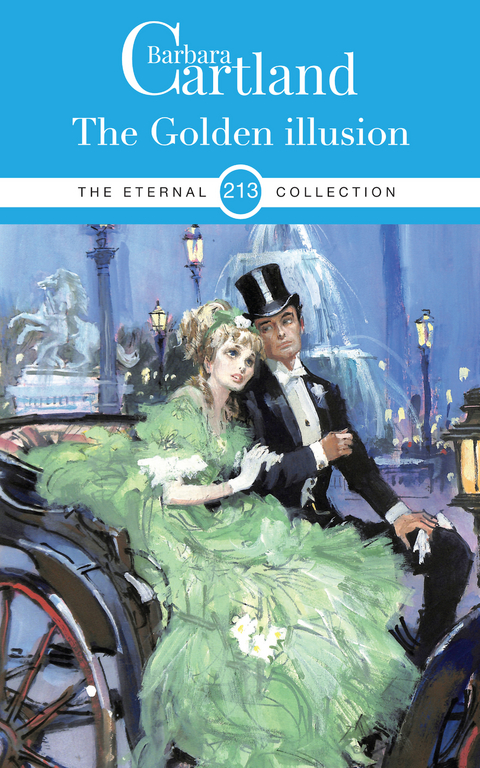
Golden Illusion (eBook)
298 Seiten
Barbara Cartland eBooks Ltd (Verlag)
978-1-78867-147-7 (ISBN)
Barbara Cartland was the world's most prolific novelist who wrote an amazing 723 books in her lifetime, of which no less than 644 were romantic novels with worldwide sales of over 1 billion copies and her books were translated into 36 different languages. As well as romantic novels, she wrote historical biographies, 6 autobiographies, theatrical plays and books of advice on life, love, vitamins and cookery. She wrote her first book at the age of 21 and it was called Jigsaw. It became an immediate bestseller and sold 100,000 copies in hardback in England and all over Europe in translation. Between the ages of 77 and 97 she increased her output and wrote an incredible 400 romances as the demand for her romances was so strong all over the world. She wrote her last book at the age of 97 and it was entitled perhaps prophetically The Way to Heaven. Her books have always been immensely popular in the United States where in 1976 her current books were at numbers 1 & 2 in the B. Dalton bestsellers list, a feat never achieved before or since by any author. Barbara Cartland became a legend in her own lifetime and will be best remembered for her wonderful romantic novels so loved by her millions of readers throughout the world, who have always collected her books to read again and again, especially when they feel miserable or depressed. Her books will always be treasured for their moral message, her pure and innocent heroines, her handsome and dashing heroes, her blissful happy endings and above all for her belief that the power of love is more important than anything else in everyone's life.
Since her mother's death, the beautiful but innocent Linetta Falaise has led a sheltered life under the wing of her kindly French Governess. So she is heartbroken to find that her beloved Mademoiselle is at death's door and that she, Linetta, had unknowingly been living off her meagre savings for the last two years.As she now has no money, there is no alternative but for Linetta to travel to Paris and ask Mademoiselle's niece, Marie-Ernestine, to help her find suitable employment, perhaps teaching English to French children.Almost as soon as she boards the cross-channel Steamer heading for Calais, her innocent eyes are opened to the wicked ways of the world when a strange man's unwanted and frightening attentions drive her to seek the protection of a handsome and noble stranger, the Marquis of Darleston, who is travelling to Paris on a secret mission for the British Prime Minister.After they part company, Linetta is introduced to the heady glamour of Paris Society by the glamorous Marie-Ernestine, who is really the celebrated and infamous Blanche d'Antigney.Linetta is appalled by Les Grandes Cocottes, who sell love to the highest bidder, especially since she is expected to join them because she is so young and enchanting.Afraid, alone and beset by lecherous 'gentlemen', Linetta remembers the handsome distinguished Marquis she met on the Steamer and prays fervently that he will come to her rescue yet again.
Chapter Two
The vision of beauty in the bed sat up and asked in a gay lilting voice,
“Who are you?”
Linetta walked a little nearer.
“I am Linetta Falaise – and I have a letter from Mademoiselle Antigny for her niece, Marie-Ernestine.”
“From Aunt Teresa?”
Linetta started. Could this really be Marie-Ernestine?
She drew the letter from her handbag and coming nearer to the fantastic blue and lace bed handed it to the woman lying in the middle of it.
She thought as she did so that she had been right in thinking that the model in the picture looked like a Goddess. The milk-white shoulders and beneath them the pink-tipped breasts that were very evident under the diaphanous nightgown had a voluptuousness that even in her innocence she was aware of.
“How is my aunt?”
The question made Linetta realise, as she had been staring at her in a bemused fashion, that she had bad news to impart
“I-I am – afraid,” she said hesitatingly, “that your – aunt is – dead.”
“Dead?” Marie-Ernestine almost screamed and she crossed herself, murmuring as she did so,
“May le Bon Dieu have mercy on her soul. May she rest in peace.”
The gesture made Linetta feel as if some of her surprise as well as her apprehension disappeared.
She noticed for the first time that Marie-Ernestine wore round her neck a little gold crucifix attached to a gold chain.
It hung in the valley between her breasts and seemed somehow a strange contrast to the exotic luxury of the bedroom.
Marie-Ernestine tore open the envelope and drew out the letter.
“I am afraid I had to write the letter for, your aunt,” Linetta explained, “but she signed it the day before she died.”
“I cannot imagine her dead!” Marie-Ernestine exclaimed. “She was my only living relative and the only one who still called me by my real name.”
She paused, looked at Linetta and said,
“In Paris I am known as ‘Blanche’. It was the name the girls at the Convent gave me because my skin was so white and no one addresses me anymore as ‘Marie-Ernestine’.”
There did not seem to be anything that Linetta could say, so she waited until raising her eyes once again from the letter Blanche said,
“Sit down. I see my aunt has set me a problem where you are concerned.”
“I would not wish to be – any trouble,” Linetta murmured humbly.
She looked around for a chair, found one and noticed that on a console table not far from the bed there stood an ivory statuette of Christ.
Like the gold crucifix round Blanche’s neck it gave Linetta a feeling of comfort, even while it was impossible to think of this beautiful woman with the head of a Bacchante as Mademoiselle’s niece.
Blanche went on reading the letter and Linetta noticed that her complexion was flawless.
She could quite understand why she had been nicknamed ‘Blanche’ and her mouth was curved exactly as Paul Baudry had portrayed it in his picture.
She was not to know that a year later Charles Dinet was to write about her,
“Her sensational mouth was meant to sing or drain a glass of champagne, the wine of love.”
Linetta only knew that, despite her surroundings, Blanche seemed more approachable and more human than when she had first entered the room.
When she came to the end of the letter, Blanche raised her head and Linetta saw that her brilliant blue eyes were swimming in tears.
“She loved me,” she wailed to Linetta. “Aunt Teresa always loved me. How I wish I could have been with her when she died.”
“It was very quick,” Linetta told her comfortingly. “She did not suffer very much. Even now I can hardly believe she is dead.”
“She wrote to me of how happy she was living with your mother and teaching you,” Blanche said. “But I always imagined you as well off and rich. Is it really true that you have no money?”
“None!” Linetta answered. “In fact, although I was not aware of it, your aunt spent all her savings on me these last two years since my mother died.”
“I cannot imagine that she could have saved very much,” Blanche commented. “Still there must have been something.”
“I am so ashamed that I was not aware of her generosity,” Linetta replied. “I would have found work of some sort, but I am not certain what I could have done, not in the village where we were living at any rate.”
Blanche looked at Linetta and smiled. It was the friendly spontaneous smile of one woman to another.
“We will find something,” she said with comforting conviction.
She rang the bell and a lady’s maid, wearing a very smart starched linen and lace apron, came hurrying into the room carrying coffee and rolls.
There was coffee for Linetta too and not until the maid had left the room did she ask tentatively,
“Is this your house?”
“Mais oui,” Blanche answered. “But I have been here only a short time. I have been living in Russia for nearly five years.”
“In Russia?” Linetta exclaimed in astonishment.
She could not have been more surprised if Blanche had said that she had been to the moon.
“I forgot, of course, and Aunt Teresa would not have realised it,” Blanche responded. “Any letters I wrote to her were sent to France in the Diplomatic Bag. The post in Russia is hopeless.”
“What were you doing in Russia?” Linetta asked.
“I was staying with – a friend,” Blanche answered.
There was a perceptible pause before the last two words and Linetta had the impression that she had been about to say something else.
“It was exciting. Wildly exciting!” she went on quickly. “I had a large house in the Grand Morskoi, a legion of servants, monjiks they were called, and my salon was the smartest, the most amusing and undoubtedly the gayest in the whole of St. Petersburg!”
She gave a little sigh.
“Hélas! The luxury, the parties and the men of Russia are indescribable.”
She paused to add as if to herself,
“The elite of St. Petersburg would assemble round my Samovar at eleven o’clock at night to talk, to drink wine, to sing and to make love!”
She gave a low laugh.
“At five the next morning, the silent monjiks would collect the guests who were still snoring in the corners of the room and take them home.”
Linetta listened to her wide-eyed. Then as if in answer to a question that was in her mind, although it had not passed her lips, Blanche said,
“And, of course, I was a triumph at the French theatre!”
“You are an actress?” Linetta asked and knew that this was what she had wanted to know ever since she had entered the house.
“Tiens! Do you mean to say I forgot to inform Aunt Teresa that I was on the stage?”
“If you did, she did not tell me,” Linetta answered.
“Mon Dieu! I am so used to it myself that I suppose I omitted to mention it. It must have been in 1858, all of eleven years ago that I made my debut as the living statue of La Belle Hélène in d’Ennery’s Faust.”
She laughed.
“I had nothing to say, but what they called my ‘plastic beauty’ was an enormous success.”
Linetta realised that she was not boasting, she was merely stating a fact.
“But, if I was a success in Paris, I was a sensation in St. Petersburg and I suppose that the applause and adulation went to my head.”
She gave a little laugh.
“I made a fool of myself!”
There was something endearing in the frankness of her words.
“What did you do?” Linetta asked.
Blanche laughed.
“In wild defiance of protocol I decided to attend the gala performance that ended the Winter Season at the Opera and I made up my mind to wear a gown which I would outshine both the others actresses and the audience in.”
She looked so lovely as she related her story that Linetta was ready to believe she would outshine everybody and everything.
“I found exactly what I wanted at my couturier,” Blanche went on. “The gown was superb. It had come from Paris and I knew that there was nothing like it in the whole of Russia. But it had in fact been ordered by the Czarina.”
Linetta listened wide-eyed.
“I was mad! Of course I was mad,” Blanche related. “The couturier tried to stop me doing anything so provocative, but I thrust a bundle of notes into his hand and hurried from the shop with the gown.”
“What happened?” Linetta enquired.
“That evening I wore it and the Czarina seated in her box looked at me with an anger that she could not hide.”
She paused to finish dramatically,
“The next day Mezentseff, the Chief of the Secret Police, was commanded to expel me from Russia!”
“Oh, no!” Linetta cried. “But that was cruel and surely the gown could not have been that important?”
Blanche did not trouble to explain that it was not only the gown but a great many other things that had incensed not only the Czarina but also all the other women of Social standing in St. Petersburg.
Instead she shrugged her shoulders and continued,
“It did not matter. When I returned to Paris, everyone was pleased to see me, and I knew the best way I could take my revenge on Russia was to make myself a distinguished member of the stage in France.”
To Linetta it was like listening to a Fairytale.
She had the feeling that Blanche was not talking to her personally, but because she was connected with her aunt she was relating her life story as if to a relation....
| Erscheint lt. Verlag | 31.1.2019 |
|---|---|
| Sprache | englisch |
| Themenwelt | Literatur ► Historische Romane |
| ISBN-10 | 1-78867-147-3 / 1788671473 |
| ISBN-13 | 978-1-78867-147-7 / 9781788671477 |
| Informationen gemäß Produktsicherheitsverordnung (GPSR) | |
| Haben Sie eine Frage zum Produkt? |
 EPUB (Adobe DRM)
Kopierschutz: Adobe-DRM
Adobe-DRM ist ein Kopierschutz, der das eBook vor Mißbrauch schützen soll. Dabei wird das eBook bereits beim Download auf Ihre persönliche Adobe-ID autorisiert. Lesen können Sie das eBook dann nur auf den Geräten, welche ebenfalls auf Ihre Adobe-ID registriert sind.
Details zum Adobe-DRM
Dateiformat: EPUB (Electronic Publication)
EPUB ist ein offener Standard für eBooks und eignet sich besonders zur Darstellung von Belletristik und Sachbüchern. Der Fließtext wird dynamisch an die Display- und Schriftgröße angepasst. Auch für mobile Lesegeräte ist EPUB daher gut geeignet.
Systemvoraussetzungen:
PC/Mac: Mit einem PC oder Mac können Sie dieses eBook lesen. Sie benötigen eine
eReader: Dieses eBook kann mit (fast) allen eBook-Readern gelesen werden. Mit dem amazon-Kindle ist es aber nicht kompatibel.
Smartphone/Tablet: Egal ob Apple oder Android, dieses eBook können Sie lesen. Sie benötigen eine
Geräteliste und zusätzliche Hinweise
Buying eBooks from abroad
For tax law reasons we can sell eBooks just within Germany and Switzerland. Regrettably we cannot fulfill eBook-orders from other countries.
aus dem Bereich