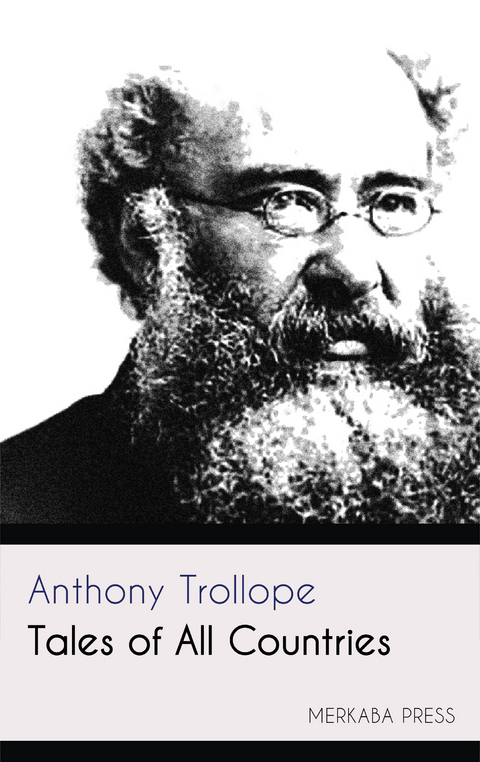
Tales of All Countries (eBook)
188 Seiten
Merkaba Press (Verlag)
978-0-00-002483-1 (ISBN)
The Pyreneean valley in which the baths of Vernet are situated is not much known to English, or indeed to any travellers. Tourists in search of good hotels and picturesque beauty combined, do not generally extend their journeys to the Eastern Pyrenees. They rarely get beyond Luchon; and in this they are right, as they thus end their peregrinations at the most lovely spot among these mountains, and are as a rule so deceived, imposed on, and bewildered by guides, innkeepers, and horse-owners, at this otherwise delightful place, as to become undesirous of further travel. Nor do invalids from distant parts frequent Vernet. People of fashion go to the Eaux Bonnes and to Luchon, and people who are really ill to Baréges and Cauterets. It is at these places that one meets crowds of Parisians, and the daughters and wives of rich merchants from Bordeaux, with an admixture, now by no means inconsiderable, of Englishmen and Englishwomen. But the Eastern Pyrenees are still unfrequented. And probably they will remain so; for though there are among them lovely valleys-and of all such the valley of Vernet is perhaps the most lovely-they cannot compete with the mountain scenery of other tourists-loved regions in Europe. At the Port de Venasquez and the Brèche de Roland in the Western Pyrenees, or rather, to speak more truly, at spots in the close vicinity of these famous mountain entrances from France into Spain, one can make comparisons with Switzerland, Northern Italy, the Tyrol, and Ireland, which will not be injurious to the scenes then under view. But among the eastern mountains this can rarely be done. The hills do not stand thickly together so as to group themselves; the passes from one valley to another, though not wanting in altitude, are not close pressed together with overhanging rocks, and are deficient in grandeur as well as loveliness. And then, as a natural consequence of all this, the hotels-are not quite as good as they should be.
But there is one mountain among them which can claim to rank with the Píc du Midi or the Maledetta. No one can pooh-pooh the stern old Canigou, standing high and solitary, solemn and grand, between the two roads which run from Perpignan into Spain, the one by Prades and the other by Le Boulon. Under the Canigou, towards the west, lie the hot baths of Vernet, in a close secluded valley, which, as I have said before, is, as far as I know, the sweetest spot in these Eastern Pyrenees...
THE O’CONORS OF CASTLE CONOR, COUNTY MAYO.
I shall never forget my first introduction to country life in Ireland, my first day’s hunting there, or the manner in which I passed the evening afterwards. Nor shall I ever cease to be grateful for the hospitality which I received from the O’Conors of Castle Conor. My acquaintance with the family was first made in the following manner. But before I begin my story, let me inform my reader that my name is Archibald Green.
I had been for a fortnight in Dublin, and was about to proceed into county Mayo on business which would occupy me there for some weeks. My head-quarters would, I found, be at the town of Ballyglass; and I soon learned that Ballyglass was not a place in which I should find hotel accommodation of a luxurious kind, or much congenial society indigenous to the place itself.
“But you are a hunting man, you say,” said old Sir P—— C——; “and in that case you will soon know Tom O’Conor. Tom won’t let you be dull. I’d write you a letter to Tom, only he’ll certainly make you out without my taking the trouble.”
I did think at the time that the old baronet might have written the letter for me, as he had been a friend of my father’s in former days; but he did not, and I started for Ballyglass with no other introduction to any one in the county than that contained in Sir P——’s promise that I should soon know Mr. Thomas O’Conor.
I had already provided myself with a horse, groom, saddle and bridle, and these I sent down, en avant, that the Ballyglassians might know that I was somebody. Perhaps, before I arrived, Tom O’Conor might learn that a hunting man was coming into the neighbourhood, and I might find at the inn a polite note intimating that a bed was at my service at Castle Conor. I had heard so much of the free hospitality of the Irish gentry as to imagine that such a thing might be possible.
But I found nothing of the kind. Hunting gentlemen in those days were very common in county Mayo, and one horse was no great evidence of a man’s standing in the world. Men there, as I learnt afterwards, are sought for themselves quite as much as they are elsewhere; and though my groom’s top-boots were neat, and my horse a very tidy animal, my entry into Ballyglass created no sensation whatever.
In about four days after my arrival, when I was already infinitely disgusted with the little pot-house in which I was forced to stay, and had made up my mind that the people in county Mayo were a churlish set, I sent my horse on to a meet of the fox-hounds, and followed after myself on an open car.
No one but an erratic fox-hunter such as I am,—a fox-hunter, I mean, whose lot it has been to wander about from one pack of hounds to another,—can understand the melancholy feeling which a man has when he first intrudes himself, unknown by any one, among an entirely new set of sportsmen. When a stranger falls thus as it were out of the moon into a hunt, it is impossible that men should not stare at him and ask who he is. And it is so disagreeable to be stared at, and to have such questions asked! This feeling does not come upon a man in Leicestershire or Gloucestershire, where the numbers are large, and a stranger or two will always be overlooked, but in small hunting fields it is so painful that a man has to pluck up much courage before he encounters it.
We met on the morning in question at Bingham’s Grove. There were not above twelve or fifteen men out, all of whom, or nearly all, were cousins to each other. They seemed to be all Toms, and Pats, and Larrys, and Micks. I was done up very knowingly in pink, and thought that I looked quite the thing; but for two or three hours nobody noticed me.
I had my eyes about me, however, and soon found out which of them was Tom O’Conor. He was a fine-looking fellow, thin and tall, but not largely made, with a piercing gray eye, and a beautiful voice for speaking to a hound. He had two sons there also, short, slight fellows, but exquisite horsemen. I already felt that I had a kind of acquaintance with the father, but I hardly knew on what ground to put in my claim.
We had no sport early in the morning. It was a cold bleak February day, with occasional storms of sleet. We rode from cover to cover, but all in vain. “I am sorry, sir, that we are to have such a bad day, as you are a stranger here,” said one gentleman to me. This was Jack O’Conor, Tom’s eldest son, my bosom friend for many a year after. Poor Jack! I fear that the Encumbered Estates Court sent him altogether adrift upon the world.
“We may still have a run from Poulnaroe, if the gentleman chooses to come on,” said a voice coming from behind with a sharp trot. It was Tom O’Conor.
“Wherever the hounds go, I’ll follow,” said I.
“Then come on to Poulnaroe,” said Mr. O’Conor. I trotted on quickly by his side, and before we reached the cover had managed to slip in something about Sir P. C.
“What the deuce!” said he. “What! a friend of Sir P——’s? Why the deuce didn’t you tell me so? What are you doing down here? Where are you staying?” &c. &c. &c.
At Poulnaroe we found a fox, but before we did so Mr. O’Conor had asked me over to Castle Conor. And this he did in such a way that there was no possibility of refusing him—or, I should rather say, of disobeying him. For his invitation came quite in the tone of a command.
“You’ll come to us of course when the day is over—and let me see; we’re near Ballyglass now, but the run will be right away in our direction. Just send word for them to send your things to Castle Conor.”
“But they’re all about, and unpacked,” said I.
“Never mind. Write a note and say what you want now, and go and get the rest to-morrow yourself. Here, Patsey!—Patsey! run into Ballyglass for this gentleman at once. Now don’t be long, for the chances are we shall find here.” And then, after giving some further hurried instructions he left me to write a line in pencil to the innkeeper’s wife on the back of a ditch.
This I accordingly did. “Send my small portmanteau,” I said, “and all my black dress clothes, and shirts, and socks, and all that, and above all my dressing things which are on the little table, and the satin neck-handkerchief, and whatever you do, mind you send my pumps;” and I underscored the latter word; for Jack O’Conor, when his father left me, went on pressing the invitation. “My sisters are going to get up a dance,” said he; “and if you are fond of that kind of things perhaps we can amuse you.” Now in those days I was very fond of dancing—and very fond of young ladies too, and therefore glad enough to learn that Tom O’Conor had daughters as well as sons. On this account I was very particular in underscoring the word pumps.
“And hurry, you young divil,” Jack O’Conor said to Patsey.
“I have told him to take the portmanteau over on a car,” said I.
“All right; then you’ll find it there on our arrival.”
We had an excellent run, in which I may make bold to say that I did not acquit myself badly. I stuck very close to the hounds, as did the whole of the O’Conor brood; and when the fellow contrived to earth himself, as he did, I received those compliments on my horse, which is the most approved praise which one fox-hunter ever gives to another.
“We’ll buy that fellow of you before we let you go,” said Peter, the youngest son.
“I advise you to look sharp after your money if you sell him to my brother,” said Jack.
And then we trotted slowly off to Castle Conor, which, however, was by no means near to us. “We have ten miles to go;—good Irish miles,” said the father. “I don’t know that I ever remember a fox from Poulnaroe taking that line before.”
“He wasn’t a Poulnaroe fox,” said Peter.
“I don’t know that,” said Jack; and then they debated that question hotly.
Our horses were very tired, and it was late before we reached Mr. O’Conor’s house. That getting home from hunting with a thoroughly weary animal, who has no longer sympathy or example to carry him on, is very tedious work. In the present instance I had company with me; but when a man is alone, when his horse toes at every ten steps, when the night is dark and the rain pouring, and there are yet eight miles of road to be conquered,—at such times a man is almost apt to swear that he will give up hunting.
At last we were in the Castle Conor stable yard;—for we had approached the house by some back way; and as we entered the house by a door leading through a wilderness of back passages, Mr. O’Conor said out loud, “Now, boys, remember I sit down to dinner in twenty minutes.” And then turning expressly to me, he laid his hand kindly upon my shoulder and said, “I hope you will make yourself quite at home at Castle Conor,—and whatever you do, don’t keep us waiting for dinner. You can dress in twenty minutes, I suppose?”
“In ten!” said I, glibly.
“That’s well. Jack and Peter will show you your room,” and so he turned away and left us.
My two young friends made their way into the great hall, and thence into the drawing-room, and I followed them. We were all dressed in pink, and had waded deep through bog and mud. I did not exactly know whither I was being led in this guise, but I soon found myself in the presence of two young ladies, and of a girl about thirteen years of age.
“My sisters,” said Jack, introducing me very laconically; “Miss O’Conor, Miss Kate O’Conor, Miss Tizzy O’Conor.”
“My name is not Tizzy,” said the younger;...
| Erscheint lt. Verlag | 7.8.2017 |
|---|---|
| Sprache | englisch |
| Themenwelt | Literatur ► Romane / Erzählungen |
| ISBN-10 | 0-00-002483-X / 000002483X |
| ISBN-13 | 978-0-00-002483-1 / 9780000024831 |
| Informationen gemäß Produktsicherheitsverordnung (GPSR) | |
| Haben Sie eine Frage zum Produkt? |
 EPUB (Adobe DRM)
Größe: 453 KB
Kopierschutz: Adobe-DRM
Adobe-DRM ist ein Kopierschutz, der das eBook vor Mißbrauch schützen soll. Dabei wird das eBook bereits beim Download auf Ihre persönliche Adobe-ID autorisiert. Lesen können Sie das eBook dann nur auf den Geräten, welche ebenfalls auf Ihre Adobe-ID registriert sind.
Details zum Adobe-DRM
Dateiformat: EPUB (Electronic Publication)
EPUB ist ein offener Standard für eBooks und eignet sich besonders zur Darstellung von Belletristik und Sachbüchern. Der Fließtext wird dynamisch an die Display- und Schriftgröße angepasst. Auch für mobile Lesegeräte ist EPUB daher gut geeignet.
Systemvoraussetzungen:
PC/Mac: Mit einem PC oder Mac können Sie dieses eBook lesen. Sie benötigen eine
eReader: Dieses eBook kann mit (fast) allen eBook-Readern gelesen werden. Mit dem amazon-Kindle ist es aber nicht kompatibel.
Smartphone/Tablet: Egal ob Apple oder Android, dieses eBook können Sie lesen. Sie benötigen eine
Geräteliste und zusätzliche Hinweise
Buying eBooks from abroad
For tax law reasons we can sell eBooks just within Germany and Switzerland. Regrettably we cannot fulfill eBook-orders from other countries.
aus dem Bereich