


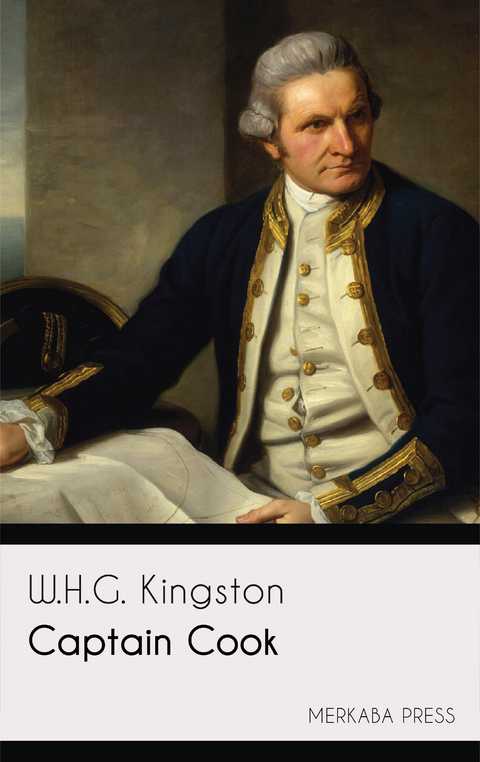
Captain Cook (eBook)
111 Seiten
Merkaba Press (Verlag)
978-0-00-002477-0 (ISBN)
Among all those Englishmen who, from a humble origin, have risen to an honourable position, Captain James Cook is especially worthy of record. His parents were of the peasant class-his father having commenced life as a farm-labourer, and his mother being a cottager's daughter. Probably, however, they were both superior to others of the same station, as the husband, in process of time, became farm-bailiff to his employer-a Mr Thomas Skottowe. This was about the year 1730, and the farm of which he had the management was called Airy-Holme, near Ayton, in Yorkshire. Not far from this place, at the village of Marton, near Stockton-upon-Tees; his son James was born, on October 27, 1728. James was one of nine children, all of whom he survived, with the exception of a sister who married a fisherman at Redcar.
The father of this family spent the latter years of his life with his daughter at Redcar, and was supposed to have been about eighty-five years old at the time of his death; so that he must have had the satisfaction of seeing his son rising in his profession, though probably he little thought of that son as establishing a fame which would be handed down in history.
James Cook does not appear to have enjoyed any peculiar educational advantages, but owed his subsequent advancement chiefly to his own intelligence, perseverance, and diligence. He first went to a village school, and was afterwards sent, at the expense of Mr Skottowe, to an ordinary commercial school, kept by a Mr Pullen. He continued there four years, and was then apprenticed to Mr William Sanderson, a grocer and haberdasher at the fishing town of Straiths, ten miles from Whitby. It may be supposed that the occupation in which he was engaged was not suited to his taste. The sea was constantly before his eyes, and the desire to seek his fortune on it sprang up within him, and grew stronger and stronger, till in about a year after he went to Straiths he obtained a release from his engagement with Mr Sanderson, and apprenticed himself to Messrs Walker and Company, shipowners of Whitby. He went to sea for the first time when he was about eighteen, on board one of their vessels-the Truelove collier, (Note 1) of four hundred and fifty tons burden, trading between Newcastle and London. The lad soon showed that he was well fitted for his new profession, and in 1748, not two years after he had commenced it, we find him especially directed to assist in fitting for sea the Three Brothers, a new ship of six hundred tons. While he served on board this ship she was hired by Government as a transport; and on her being paid off she was employed in the Norway trade.
After making several voyages in the Three Brothers up the Baltic, young Cook was promoted to the rank of mate on board the Friendship. He had by this time gained the goodwill of his employers; and had made several other friends on shore, who, before long, were enabled to render him essential service. He was now known as a thorough seamen; indeed, from the moment he went on board ship, he had steadily applied his mind to acquiring a knowledge of his profession. Still he served on as mate of the Friendship till the breaking out of the war between England and France in 1756, when he made up his mind to push his fortunes in the Royal Navy. He knew that at all events there was a great probability of his being pressed into the service, and he had good reason to hope that he might be placed ere long on the quarter-deck, since many young men at that time had been who went to sea, as he had done, before the mast. He accordingly volunteered, and entered as an able seaman on board the Eagle, of sixty guns, then commanded by Captain Hamer, but shortly afterwards by Captain Palliser, who became the well-known Sir Hugh Palliser-Cook's warm and constant friend.
As soon as the young sailor's Yorkshire friends heard that he had entered on board a man-of-war, they exerted themselves on his behalf, and a letter of introduction was procured from Mr Osbaldeston, Member for the county, to his captain, who, having already remarked the intelligence and assiduity Cook exhibited in all his professional duties, was the more ready to give him a helping hand...
Chapter Two.
First Voyage of Discovery. August 1768 to July 1771.
In the year 1763, on the restoration of peace, the desire to explore unknown seas and to discover new countries revived among the English, and was warmly encouraged by King George the Third. Two expeditions were at once fitted out to circumnavigate the globe—one under Lord Byron, and the other under Captains Wallis and Carteret; the former commanding the Dolphin, in which Lord Byron had just returned, the latter the Swallow. As, however, Captains Wallis and Carteret accidentally parted company at an early period of their voyage, and kept different routes, they are generally considered as having led two separate expeditions.
Before the return of these ships, another expedition was determined on, the immediate object of which was to observe a transit of Venus which it had been calculated by astronomers would occur in 1769. It was believed that one of the Marquesas, or one of the Friendly Islands, called, by Tasman, Amsterdam, Rotterdam, and Middleburg, would be an advantageous spot for making the proposed observation.
The King was memorialised by the Royal Society, and through his Majesty’s intervention the Lords Commissioners of the Admiralty undertook to furnish a suitable vessel and crew to convey the astronomers and other scientific persons who might be selected to carry out the proposed objects. The Royal Society had fixed on Mr Alexander Dalrymple to take the direction of the expedition; but as he was not in the Royal Navy, Sir Edward Hawke, then at the head of the Admiralty, would not hear of his being appointed. Mr Dalrymple, on the other hand, would not consent to go unless he received a brevet commission as captain. It was necessary, therefore, to find some one else, and Mr Stephens, the Secretary of the Admiralty, a warm supporter of the expedition, mentioned Cook to the Board, and suggested that Sir Hugh Palliser’s opinion should be asked respecting him. This, as may be supposed, was in every respect favourable; and consequently Lieutenant Cook was directed to hold himself in readiness to take command of the proposed expedition. Sir Hugh Palliser was requested to select a fit ship for the purpose, and with Cook’s assistance he fixed on a barque of three hundred and seventy tons, to which the name of the Endeavour was given. She mounted ten carriage and ten swivel guns; her crew, besides the commander, consisted of eighty-four persons, and she was provisioned for eighteen months.
The well-known Sir Joseph Banks, then Mr Banks, one of the chief promoters of the expedition, volunteered to accompany it. On leaving Oxford he had visited the coasts of Newfoundland and Labrador, to obtain information on scientific subjects. Although he suffered no small amount of hardship on that occasion, he returned home with unabated zeal in the cause he had adopted, and ready again to leave all the advantages which his position afforded him, for the discomfort and dangers of a long voyage in unknown seas. Mr Banks was, however, more than a philosopher—he was a large-hearted philanthropist, and he was animated with the hope of diffusing some of the advantages of civilisation and Christianity among the people who might be discovered. He engaged, as naturalist to the expedition, the services of Dr Solander, a Swede by birth, educated under Linnaeus, from whom he had brought letters of introduction to England. Mr Banks also, at his own charge, took out a secretary and two artists—one to make drawings from subjects of natural history, the other to take sketches of scenery and the portraits of the natives who might be met with. He had likewise four personal attendants, two of whom were negroes.
The Government, on its part, appointed Mr Charles Green, who had long been assistant to Dr Bradley at the Royal Observatory, Greenwich, to assist Lieutenant Cook in the astronomical department of the expedition; and in every respect the persons engaged in this celebrated expedition were well fitted to attain the objects contemplated.
While these preparations were going forward, Captain Wallis returned from his voyage round the world. He expressed his opinion that a harbour in an island he had discovered, and called King George’s Island, since well-known as Otaheite or Tahiti, was a fit spot for observing the transit of Venus. That island was accordingly to be the first destination of the Endeavour. After having accomplished the primary object of the voyage, the commander was directed to proceed in making discoveries through the wide extent of the Great Southern Ocean.
Lieutenant Cook received his commission as commander of the Endeavour (which was then in the basin in Deptford Yard) on May 25, 1768. On the 27th he went on board, and immediately began fitting her for sea. The work in dockyards was not executed so rapidly in those days as it is now, and it was upwards of two months before the vessel was ready. On July 30 she dropped down the river; but it was not till August 15 that she reached Plymouth. On Friday, August 26, the wind becoming fair, the Endeavour finally put to sea, and commenced the first of one of the most memorable series of voyages which have ever been performed by a single vessel. Next to Commander Cook in authority in the Endeavour were her two lieutenants—Zachary Hicks and John Gore; her senior mate was Charles Clerke, who accompanied Cook in each of his subsequent voyages, and succeeded to the command of the third expedition on the death of his beloved captain. He had previously served as midshipman under Lord Byron in his first voyage round the world.
A long sea voyage is almost always felt to be extremely tedious and dull to landsmen; but every change in the atmosphere, the varied appearance presented by the sea, the numberless creatures found in it, the birds which hovered about the ship or pitched on the rigging, all afforded matter of interest to the enlightened persons on board the Endeavour.
At Madeira the naturalists of the expedition set to work collecting specimens. The social condition of the people has probably altered little since those days, though the monasteries, which then existed, have long since been abolished. The nuns of the convent of Santa Clara especially amused Mr Banks and his companions by the simplicity of the questions they put on hearing that they were philosophers. Among others, they requested them to ascertain by their art whether a spring of pure water existed within the walls of their convent, and also when the next thunderstorm would occur.
On leaving Madeira the course was shaped for Rio de Janeiro, which was reached on November 13. The voyagers were not treated by the viceroy with the courtesy which might have been expected. The object of the voyage was utterly beyond the comprehension of that functionary, who could form no other conception of the matter than that it had something to do with the passing of the North Star through the South Pole. This ignorance and suspicion caused the voyagers a great deal of annoyance during the whole of their stay; though the viceroy could not refuse them water and other necessaries. When, at length, these were procured, and the Endeavour was going out of the harbour, she was fired at from the forts of Santa Cruz. Cook immediately sent on shore to demand the cause of this act. The excuse offered by the commandant of the port was that he had received no orders from the viceroy to allow the ship to pass. It appeared that the letter had been written, but that through neglect it had not been forwarded. Through the whole of the contest with the viceroy, Cook behaved with equal spirit and discretion. Among the remarks which Cook makes in his journal on Brazil, is one on the fearful expense of life at which the royal gold mines in that country were worked. No less than forty thousand negroes were annually imported to labour in the royal mines. In the year 1766, through an epidemic, the number required falling short, twenty thousand more were drafted from the town of Rio. A very similar account may be given of the silver and other mines on the other side of the continent; while the treacherous system which was organised to supply the demand for labour from among the inhabitants of the Pacific Islands must be looked on with even greater horror and indignation than that which existed for supplying Brazil with slave labour. So strictly were the Brazilian gold mines guarded, that no stranger was allowed to visit them, and any person found on the roads leading to them was immediately hanged by the guards stationed there. Altogether Cook formed a very unfavourable opinion of the inhabitants of Brazil, though few parts of the tropics surpass it in beauty of climate, fertility of soil, and power of production.
After a stay of three weeks in the harbour of Rio, the Endeavour put to sea on December 7, and stood down the coast of South America. On approaching the latitudes of the Falkland Islands, the crew, complaining of cold, received what was called a Magellanic jacket, and a pair of trousers made of a thick woollen stuff called Fearnought. Instead of going through the Straits of Magellan, as was the custom in those times, the Endeavour was steered from the Strait of Le Maire between Helen Island and Tierra del Fuego. On her anchoring in the Bay of Good Success, several of the party went on shore. Thirty or forty Indians soon made their appearance, but, distrustful of the strangers, quickly retreated to a distance. On this, Mr Banks and Dr Solander advanced, when two of the Indians approached them and sat down. As the Englishmen drew near, the savages rose and each threw away from him a stick which he had in his hand, returning immediately to their companions and making signs to the white men to follow. This they did, and friendly relations were at once established...
| Erscheint lt. Verlag | 7.8.2017 |
|---|---|
| Sprache | englisch |
| Themenwelt | Literatur ► Biografien / Erfahrungsberichte |
| ISBN-10 | 0-00-002477-5 / 0000024775 |
| ISBN-13 | 978-0-00-002477-0 / 9780000024770 |
| Informationen gemäß Produktsicherheitsverordnung (GPSR) | |
| Haben Sie eine Frage zum Produkt? |
 EPUB (Adobe DRM)
Größe: 257 KB
Kopierschutz: Adobe-DRM
Adobe-DRM ist ein Kopierschutz, der das eBook vor Mißbrauch schützen soll. Dabei wird das eBook bereits beim Download auf Ihre persönliche Adobe-ID autorisiert. Lesen können Sie das eBook dann nur auf den Geräten, welche ebenfalls auf Ihre Adobe-ID registriert sind.
Details zum Adobe-DRM
Dateiformat: EPUB (Electronic Publication)
EPUB ist ein offener Standard für eBooks und eignet sich besonders zur Darstellung von Belletristik und Sachbüchern. Der Fließtext wird dynamisch an die Display- und Schriftgröße angepasst. Auch für mobile Lesegeräte ist EPUB daher gut geeignet.
Systemvoraussetzungen:
PC/Mac: Mit einem PC oder Mac können Sie dieses eBook lesen. Sie benötigen eine
eReader: Dieses eBook kann mit (fast) allen eBook-Readern gelesen werden. Mit dem amazon-Kindle ist es aber nicht kompatibel.
Smartphone/Tablet: Egal ob Apple oder Android, dieses eBook können Sie lesen. Sie benötigen eine
Geräteliste und zusätzliche Hinweise
Buying eBooks from abroad
For tax law reasons we can sell eBooks just within Germany and Switzerland. Regrettably we cannot fulfill eBook-orders from other countries.
aus dem Bereich


