


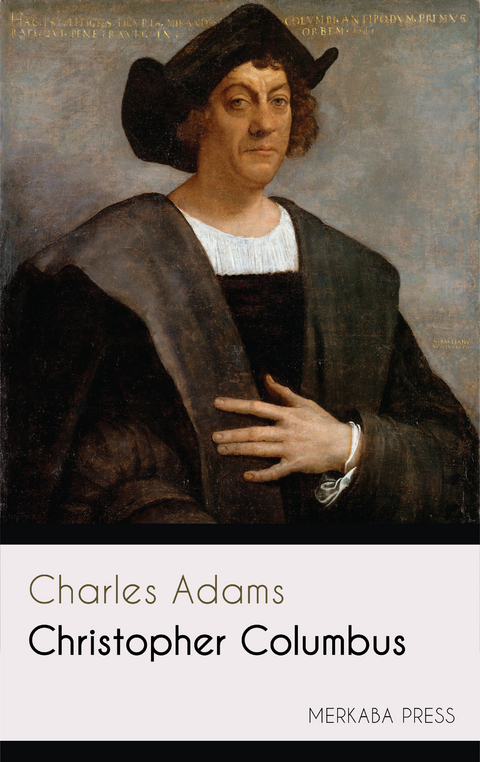
Christopher Columbus (eBook)
222 Seiten
Merkaba Press (Verlag)
978-0-00-002537-1 (ISBN)
At the northwest corner of the Italian peninsula the coast-line, as it approaches the French border, bends around to the west in such a way as to form a kind of rounded angle, which, according to the fertile fancy of the Greeks, resembles the human knee. It was probably in recognition of this geographical peculiarity that the hamlet established at this point received some centuries before the Christian era the name which has since been evolved into Genoa. The situation is not only one of the most picturesque in Europe, but it is peculiarly adapted to the development of a small maritime city. For many miles it is the only point at which Nature has afforded a good opportunity for a harbor. Its geographical relations with the region of the Alps and the plains of northern Italy seem to have designated it as the natural point where a common desire for gain should bring into profitable relations the trading propensities of the people along the shores of the Mediterranean. During nearly two thousand years the situation was made all the more favourable by the ease with which it might be defended; for the range of mountains, which encircles it at a distance of only a few miles, made it easy for the inhabitants to protect themselves against the assaults of their enemies.
The favouring conditions thus afforded gave to Genoa early in the Christian era a commercial prestige of some importance. The turbulence of the Middle Ages made rapidity of growth quite impossible; but in the time of the Crusades this picturesque city received a large share of that impulse which gave so much life to Venice and the other maritime towns of Italy. Like other cities of its kind, it was filled with seafaring men. It is easy to believe that the boys who grew up in Genoa during the centuries of the Crusades and immediately after, had their imaginations and memories filled to overflowing with accounts of such wonderful adventures as those which, about that time, found expression in the writings of Marco Polo and John de Mandeville. The tales of seafaring adventurers always have a wonderful attraction for boys; and we can well imagine that the yarns spun by the returning sailors of the fourteenth and fifteenth centuries had an altogether peculiar and exceptional fascination...
CHAPTER II.
ATTEMPTS TO SECURE ASSISTANCE.
An enterprise so vast and hazardous as that proposed by Columbus was not likely to receive adequate assistance from any private benefactor. Though the Portuguese had long been considered daring navigators, no one of them had yet undertaken an expedition in any way comparable in point of novelty and boldness with that now proposed. The explorers of Prince Henry had skirted along the coasts of Africa, following out lines of discovery that had already been somewhat plainly marked out. But what Columbus now proposed was the bolder course of cutting loose from old traditions and methods, and sailing directly west into an unknown space. Capital was even more conservative and timid in the fifteenth century than it is at the present time; and therefore great expeditions were much more dependent upon governmental assistance. It was not singular, therefore, that Columbus found himself obliged to seek for governmental support and protection.
But in this, as in so many other details in the life of Columbus, it is impossible at the present time to be confident that we have ascertained the exact truth. Many of the early accounts are conflicting; and not a few of the prevailing impressions are founded on evidence that will not bear the test of critical examination. For example, nearly all of the historians assert that Columbus made application for assistance to the governments of Genoa and Venice.
The only authority for belief that the Admiral applied to Genoa is a statement of Ramusio, who affirms that he received his information from Peter Martyr. In the course of the narrative he says that when the application was rejected, Columbus, at the age of forty, determined to go to Portugal. Unfortunately, to our acceptance of this circumstantial statement there are several very serious obstacles. In the first place, no authority for such an assertion can be found in all the writings of Peter Martyr. Again, the archives of Genoa have been thoroughly explored in vain for any evidence of such an application. But most important of all, the assertion, if true, would prove that Columbus was born as early as 1430. We should also be obliged to infer that two of his children by the same mother differed in age by at least thirty-six years. The impression that Columbus made application for assistance to Genoa may therefore safely be dismissed as apocryphal.
The evidence in regard to an application to Venice, though less positive in its nature, is also inconclusive. The Venetian historian Carlo Antonio Marin, whose history of Venetian commerce was not published till the year 1800, was the first to give currency to the story. His authority is this. He says that Francesco Pesaro said to him some ten or twelve years before,—that is, about 1780,—that in making some researches in the archives of the Council of Ten, he had seen and read a letter of Columbus making application to the Venetian Government for assistance. But although diligent search has since been made at two different times throughout the archives for the years between 1470 and 1492, no trace of such a letter has ever been found. It is possible that this important document may have been destroyed when, just before the preliminaries of Leoben, in May, 1797, a mob invaded the hall of the Council of Ten and dispersed such of the papers as could be found. But until some further evidence comes to light, it must be considered doubtful whether application to Venice was ever made.
In regard to applications to Portugal, England, and France, the evidence is less incomplete, though here, too, we meet with not a few conflicting statements.
In one of his letters to the Spanish sovereigns Columbus says: “For twenty-seven years I had been trying to get recognition, but at the end of that period all my projects were turned to ridicule.... But notwithstanding this fact,” he continues, “I pressed on with zeal, and responded to France, Portugal, and England that I reserved for the king and queen those countries and those domains.” Elsewhere he says: “In order to serve your Highnesses, I listened to neither England nor Portugal nor France, whose princes wrote me letters which your Highnesses can see in the hands of Dr. Villalono.”
There is another bit of evidence on this subject that is not less interesting. On the 19th of March, 1493, Duke of Medina Celi wrote to Cardinal de Mendoza asking that he might be permitted to send vessels every year to trade in America, and urging as a reason for this special favor the fact that he had prevented Columbus from going to the service of France and had held him to the service of Spain, at a time when he had opportunities for going elsewhere.
But as if to prevent us from being too confident that we have arrived at the exact truth, Columbus in another of his letters gives us a statement which, if it stood alone, would seem to prove that John II. not only made no offer, but stubbornly refused all assistance. He says: “The king of Portugal refused with blindness to second me in my projects of maritime discovery, for God closed his eyes, ears, and all his senses, so that in fourteen years I was not able to make him listen to what I advanced.”
From this it would seem to be certain that the offer of Portugal alluded to in the letter above quoted was not made earlier than 1487, fully two years after Columbus had arrived in Spain.
That Columbus’s application was made as early as 1474, the Toscanelli correspondence is sufficient proof. But the moment was not auspicious. John II., who was then reigning, appears to have had no aversion to giving aid to such an enterprise; but he was involved in expensive wars, and any additional drafts upon the treasury would have met with exceptional difficulty.
But there was another reason that ought not to be overlooked. The recent maritime history of Portugal had given the Government a very natural feeling of self-reliance. The extraordinary efforts and successes of Prince Henry had borne fruit. Portugal had not only raised up a large number of skilful explorers, but had attracted to Lisbon all the great navigators of the time. Diego Cam and Behaim had gone beyond the Congo. Affonso de Aviero had visited the kingdom of Benin, and Pedro de Covilham had advanced to Calicut by way of the Red Sea. Affonso de Pavia had reached Abyssinia, and Bartholomew Diaz was at the point of doubling the Cape of Good Hope. Thus a vast number of expeditions had been sent out, not only to the coasts of Africa, but also to the open sea. In 1513 De Mafra testified that the king of Portugal had sent out two exploring expeditions that had returned without results. In view of all these facts the refusal of the Portuguese monarch might easily be explained on the ground of anterior engagements to his own subjects.
But notwithstanding the assurances of Columbus himself, it is certain that there was no absolute refusal. On the contrary, there is positive proof that the king took the matter into most careful consideration. He not only listened with attention to the scheme, but, if we may believe the testimony of Fernando, gave a qualified promise of support. Columbus accepted an invitation of the monarch to unfold his hypothesis in reference to the extent of Asia, the splendors of the region described by Marco Polo, the shortness of the distance across the Atlantic, and the entire practicability of reaching the East Indies by a directly westward course.
Of this interview we have two accounts, one written by the Admiral’s son Fernando, and the other by De Barros, the Portuguese historiographer. According to Fernando, his father supported the prosecution of the plan by such excellent reasons that the king did not hesitate to give his consent. But when Columbus, being a man of lofty and noble ideals, demanded honorable titles and rewards, the king found the matter quite beyond the means then at his disposal. De Barros, on the other hand, assures us that the seeming acquiescence of the king was simply his manner of answering what he regarded as the unreasonable importunities of Columbus. He considered the navigator as a vainglorious man, fond of displaying his abilities and given to fantastic notions, such as those respecting the island of Cipango. According to this same authority, it was but another way of getting rid of Columbus that the king referred the whole subject to a committee of the Council for Geographical Affairs.
It is said that councils of war never fight, and that advisory boards regard the promoters of new schemes as their natural enemies. The committee to whom the king referred the proposal of Columbus was made up of two Jewish physicians and a bishop. Although the physicians, Roderigo and Joseph, were reputed as the most able cosmographers of the realm, they had not much hesitation in deciding that the project was extravagant and visionary. With this judgment the ecclesiastical member of the council seems to have agreed.
The king, however, as if unwilling to lose any valuable opportunity, does not appear to have been satisfied with this answer. As the story goes, he convoked his royal council, and asked their advice whether to adopt this new route, or to pursue that which had already been opened.
Von Concelos, the historian of King John II., has given a graphic account of the discussion held before this council. The Bishop of Ceuta, the same important dignitary that had been a member of the committee of three, opposed this scheme in a cool and deliberate speech. The opposite side was presented by Dom Pedro de Meneses with so much eloquence and power that the impression he made quite surpassed that of the colder reasonings of the bishop. What followed was apparently prompted by a consciousness that the advocates of...
| Erscheint lt. Verlag | 8.8.2017 |
|---|---|
| Sprache | englisch |
| Themenwelt | Literatur ► Biografien / Erfahrungsberichte |
| ISBN-10 | 0-00-002537-2 / 0000025372 |
| ISBN-13 | 978-0-00-002537-1 / 9780000025371 |
| Informationen gemäß Produktsicherheitsverordnung (GPSR) | |
| Haben Sie eine Frage zum Produkt? |
 EPUB (Adobe DRM)
Größe: 226 KB
Kopierschutz: Adobe-DRM
Adobe-DRM ist ein Kopierschutz, der das eBook vor Mißbrauch schützen soll. Dabei wird das eBook bereits beim Download auf Ihre persönliche Adobe-ID autorisiert. Lesen können Sie das eBook dann nur auf den Geräten, welche ebenfalls auf Ihre Adobe-ID registriert sind.
Details zum Adobe-DRM
Dateiformat: EPUB (Electronic Publication)
EPUB ist ein offener Standard für eBooks und eignet sich besonders zur Darstellung von Belletristik und Sachbüchern. Der Fließtext wird dynamisch an die Display- und Schriftgröße angepasst. Auch für mobile Lesegeräte ist EPUB daher gut geeignet.
Systemvoraussetzungen:
PC/Mac: Mit einem PC oder Mac können Sie dieses eBook lesen. Sie benötigen eine
eReader: Dieses eBook kann mit (fast) allen eBook-Readern gelesen werden. Mit dem amazon-Kindle ist es aber nicht kompatibel.
Smartphone/Tablet: Egal ob Apple oder Android, dieses eBook können Sie lesen. Sie benötigen eine
Geräteliste und zusätzliche Hinweise
Buying eBooks from abroad
For tax law reasons we can sell eBooks just within Germany and Switzerland. Regrettably we cannot fulfill eBook-orders from other countries.
aus dem Bereich


