


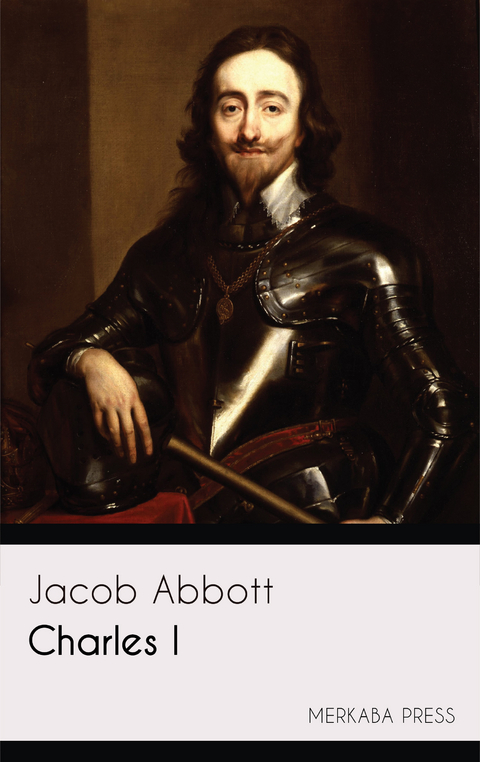
Charles I (eBook)
111 Seiten
Merkaba Press (Verlag)
978-0-00-002261-5 (ISBN)
King Charles the First was born in Scotland. It may perhaps surprise the reader that an English king should be born in Scotland. The explanation is this:
They who have read the history of Mary Queen of Scots, will remember that it was the great end and aim of her life to unite the crowns of England and Scotland in her own family. Queen Elizabeth was then Queen of England. She lived and died unmarried. Queen Mary and a young man named Lord Darnley were the next heirs. It was uncertain which of the two had the strongest claim. To prevent a dispute, by uniting these claims, Mary made Darnley her husband. They had a son, who, after the death of his father and mother, was acknowledged to be the heir to the British throne, whenever Elizabeth's life should end. In the mean time he remained King of Scotland. His name was James. He married a princess of Denmark; and his child, who afterward was King Charles the First of England, was born before he left his native realm.
King Charles's mother was, as has been already said, a princess of Denmark. Her name was Anne. The circumstances of her marriage to King James were quite extraordinary, and attracted great attention at the time. It is, in some sense, a matter of principle among kings and queens, that they must only marry persons of royal rank, like themselves; and as they have very little opportunity of visiting each other, residing as they do in such distant capitals, they generally choose their consorts by the reports which come to them of the person and character of the different candidates. The choice, too, is very much influenced by political considerations, and is always more or less embarrassed by negotiations with other courts, whose ministers make objections to this or that alliance, on account of its supposed interference with some of their own political schemes...
Chapter I.
His Childhood and Youth.
1600-1622
King Charles the First was born in Scotland. It may perhaps surprise the reader that an English king should be born in Scotland. The explanation is this:
They who have read the history of Mary Queen of Scots, will remember that it was the great end and aim of her life to unite the crowns of England and Scotland in her own family. Queen Elizabeth was then Queen of England. She lived and died unmarried. Queen Mary and a young man named Lord Darnley were the next heirs. It was uncertain which of the two had the strongest claim. To prevent a dispute, by uniting these claims, Mary made Darnley her husband. They had a son, who, after the death of his father and mother, was acknowledged to be the heir to the British throne, whenever Elizabeth's life should end. In the mean time he remained King of Scotland. His name was James. He married a princess of Denmark; and his child, who afterward was King Charles the First of England, was born before he left his native realm.
King Charles's mother was, as has been already said, a princess of Denmark. Her name was Anne. The circumstances of her marriage to King James were quite extraordinary, and attracted great attention at the time. It is, in some sense, a matter of principle among kings and queens, that they must only marry persons of royal rank, like themselves; and as they have very little opportunity of visiting each other, residing as they do in such distant capitals, they generally choose their consorts by the reports which come to them of the person and character of the different candidates. The choice, too, is very much influenced by political considerations, and is always more or less embarrassed by negotiations with other courts, whose ministers make objections to this or that alliance, on account of its supposed interference with some of their own political schemes.
As it is very inconvenient, moreover, for a king to leave his dominions, the marriage ceremony is usually performed at the court where the bride resides, without the presence of the bridegroom, he sending an embassador to act as his representative. This is called being married by proxy. The bride then comes to her royal husband's dominions, accompanied by a great escort. He meets her usually on the frontiers; and there she sees him for the first time, after having been married to him some weeks by proxy. It is true, indeed, that she has generally seen his picture, that being usually sent to her before the marriage contract is made. This, however, is not a matter of much consequence, as the personal predilections of a princess have generally very little to do with the question of her marriage.
Now King James had concluded to propose for the oldest daughter of the King of Denmark and he entered into negotiations for this purpose. This plan, however, did not please the government of England, and Elizabeth, who was then the English queen, managed so to embarrass and interfere with the scheme, that the King of Denmark gave his daughter to another claimant. James was a man of very mild and quiet temperament, easily counteracted and thwarted in his plans; but this disappointment aroused his energies, and he sent a splendid embassy into Denmark to demand the king's second daughter, whose name was Anne. He prosecuted this suit so vigorously that the marriage articles were soon agreed to and signed. Anne embarked and set sail for Scotland. The king remained there, waiting for her arrival with great impatience. At length, instead of his bride, the news came that the fleet in which Anne had sailed had been dispersed and driven back by a storm, and that Anne herself had landed on the coast of Norway.
James immediately conceived the design of going himself in pursuit of her. But knowing very well that all his ministers and the officers of his government would make endless objections to his going out of the country on such an errand, he kept his plan a profound secret from them all. He ordered some ships to be got ready privately, and provided a suitable train of attendants, and then embarked without letting his people know where he was going. He sailed across the German Ocean to the town in Norway where his bride had landed. He found her there, and they were married. Her brother, who had just succeeded to the throne, having received intelligence of this, invited the young couple to come and spend the winter at his capital of Copenhagen; and as the season was far advanced, and the sea stormy, King James concluded to accept the invitation. They were received in Copenhagen with great pomp and parade, and the winter was spent in festivities and rejoicings. In the spring he brought his bride to Scotland. The whole world were astonished at the performance of such an exploit by a king, especially one of so mild, quiet, and grave a character as that which James had the credit of possessing.
Young Charles was very weak and feeble in his infancy. It was feared that he would not live many hours. The rite of baptism was immediately performed, as it was, in those days, considered essential to the salvation of a child dying in infancy that it should be baptized before it died. Notwithstanding the fears that were at first felt, Charles lingered along for some days, and gradually began to acquire a little strength. His feebleness was a cause of great anxiety and concern to those around him; but the degree of interest felt in the little sufferer's fate was very much less than it would have been if he had been the oldest son. He had a brother, Prince Henry, who was older than he, and, consequently, heir to his father's crown. It was not probable, therefore, that Charles would ever be king; and the importance of every thing connected with his birth and his welfare was very much diminished on that account.
It was only about two years after Charles's birth that Queen Elizabeth died, and King James succeeded to the English throne. A messenger came with all speed to Scotland to announce the fact. He rode night and day. He arrived at the king's palace in the night. He gained admission to the king's chamber, and, kneeling at his bedside, proclaimed him King of England. James immediately prepared to bid his Scotch subjects farewell, and to proceed to England to take possession of his new realm. Queen Anne was to follow him in a week or two, and the other children, Henry and Elizabeth; but Charles was too feeble to go.
In those early days there was a prevailing belief in Scotland, and, in fact, the opinion still lingers there, that certain persons among the old Highlanders had what they called the gift of the second sight—that is, the power of foreseeing futurity in some mysterious and incomprehensible way. An incident is related in the old histories connected with Charles's infancy, which is a good illustration of this. While King James was preparing to leave Scotland, to take possession of the English throne, an old Highland laird came to bid him farewell. He gave the king many parting counsels and good wishes, and then, overlooking the older brother, Prince Henry, he went directly to Charles, who was then about two years old, and bowed before him, and kissed his hand with the greatest appearance of regard and veneration. King James undertook to correct his supposed mistake, by telling him that that was his second son, and that the other boy was the heir to the crown. "No," said the old laird, "I am not mistaken. I know to whom I am speaking. This child, now in his nurse's arms, will be greater than his brother. This is the one who is to convey his father's name and titles to succeeding generations." This prediction was fulfilled; for the robust and healthy Henry died, and the feeble and sickly-looking Charles lived and grew, and succeeded, in due time, to his father's throne.
Now inasmuch as, at the time when this prediction was uttered, there seemed to be little human probability of its fulfillment, it attracted attention; its unexpected and startling character made every one notice and remember it; and the old laird was at once an object of interest and wonder. It is probable that this desire to excite the admiration of the auditors, mingled insensibly with a sort of poetic enthusiasm, which a rude age and mountainous scenery always inspire, was the origin of a great many such predictions as these; and then, in the end, those only which turned out to be true were remembered, while the rest were forgotten; and this was the way that the reality of such prophetic powers came to be generally believed in.
Feeble and uncertain of life as the infant Charles appeared to be, they conferred upon him, as is customary in the case of young princes, various titles of nobility. He was made a duke, a marquis, an earl, and a baron, before he had strength enough to lift up his head in his nurse's arms. His title as duke was Duke of Albany; and as this was the highest of his nominal honors, he was generally known under that designation while he remained in Scotland.
When his father left him, in order to go to England and take possession of his new throne, he appointed a governess to take charge of the health and education of the young duke. This governess was Lady Cary. The reason why she was appointed was, not because of her possessing any peculiar qualifications for such a charge, but because her husband, Sir Robert Cary, had been the messenger employed by the English government to communicate to James the death of Elizabeth, and to announce to him his accession to the throne. The bearer of good news to a monarch must always be rewarded, and James recompensed Sir Robert for his service by appointing his wife to the post of governess of his...
| Erscheint lt. Verlag | 25.7.2017 |
|---|---|
| Sprache | englisch |
| Themenwelt | Literatur ► Biografien / Erfahrungsberichte |
| ISBN-10 | 0-00-002261-6 / 0000022616 |
| ISBN-13 | 978-0-00-002261-5 / 9780000022615 |
| Informationen gemäß Produktsicherheitsverordnung (GPSR) | |
| Haben Sie eine Frage zum Produkt? |
 EPUB (Adobe DRM)
Größe: 177 KB
Kopierschutz: Adobe-DRM
Adobe-DRM ist ein Kopierschutz, der das eBook vor Mißbrauch schützen soll. Dabei wird das eBook bereits beim Download auf Ihre persönliche Adobe-ID autorisiert. Lesen können Sie das eBook dann nur auf den Geräten, welche ebenfalls auf Ihre Adobe-ID registriert sind.
Details zum Adobe-DRM
Dateiformat: EPUB (Electronic Publication)
EPUB ist ein offener Standard für eBooks und eignet sich besonders zur Darstellung von Belletristik und Sachbüchern. Der Fließtext wird dynamisch an die Display- und Schriftgröße angepasst. Auch für mobile Lesegeräte ist EPUB daher gut geeignet.
Systemvoraussetzungen:
PC/Mac: Mit einem PC oder Mac können Sie dieses eBook lesen. Sie benötigen eine
eReader: Dieses eBook kann mit (fast) allen eBook-Readern gelesen werden. Mit dem amazon-Kindle ist es aber nicht kompatibel.
Smartphone/Tablet: Egal ob Apple oder Android, dieses eBook können Sie lesen. Sie benötigen eine
Geräteliste und zusätzliche Hinweise
Buying eBooks from abroad
For tax law reasons we can sell eBooks just within Germany and Switzerland. Regrettably we cannot fulfill eBook-orders from other countries.
aus dem Bereich


