


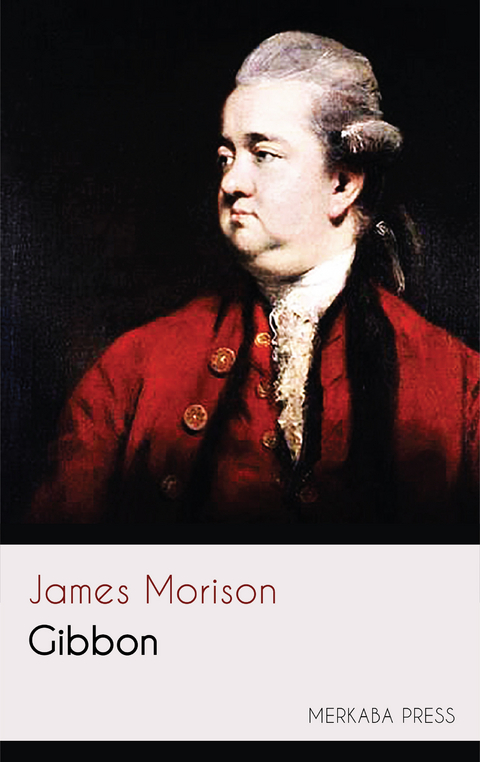
Gibbon (eBook)
155 Seiten
Merkaba Press (Verlag)
978-0-00-002300-1 (ISBN)
Edward Gibbon was born at Putney, near London, on 27th April in the year 1737. After the reformation of the calendar his birthday became the 8th of May. He was the eldest of a family of seven children; but his five brothers and only sister all died in early infancy, and he could remember in after life his sister alone, whom he also regretted.
He is at some pains in his Memoirs to show the length and quality of his pedigree, which he traces back to the times of the Second and Third Edwards. Noting the fact, we pass on to a nearer ancestor, his grandfather, who seems to have been a person of considerable energy of character and business talent. He made a large fortune, which he lost in the South-Sea Scheme, and then made another before his death. He was one of the Commissioners of Customs, and sat at the Board with the poet Prior; Bolingbroke was heard to declare that no man knew better than Mr. Edward Gibbon the commerce and finances of England. His son, the historian's father, was a person of very inferior stamp. He was educated at Westminster and Cambridge, travelled on the Continent, sat in Parliament, lived beyond his means as a country gentleman, and here his achievements came to an end. He seems to have been a kindly but a weak and impulsive man, who however had the merit of obtaining and deserving his son's affection by genial sympathy and kindly treatment.
CHAPTER II.
AT LAUSANNE.
The elder Gibbon showed a decision of character and prompt energy in dealing with his son's conversion to Romanism, which were by no means habitual with him. He swiftly determined to send him out of the country, far away from the influences and connections which had done such harm. Lausanne in Switzerland was the place selected for his exile, in which it was resolved he should spend some years in wholesome reflections on the error he had committed in yielding to the fascinations of Roman Catholic polemics. No time was lost: Gibbon had been received into the Church on the 8th of June, 1753, and on the 30th of the same month he had reached his destination. He was placed under the care of a M. Pavillard, a Calvinist minister, who had two duties laid upon him, a general one, to superintend the young man's studies, a particular and more urgent one, to bring him back to the Protestant faith.
It was a severe trial which Gibbon had now to undergo. He was by nature shy and retiring; he was ignorant of French; he was very young; and with these disadvantages he was thrown among entire strangers alone. After the excitement and novelty of foreign travel were over, and he could realise his position, he felt his heart sink within him. From the luxury and freedom of Oxford he was degraded to the dependence of a schoolboy. Pavillard managed his expenses, and his supply of pocket-money was reduced to a small monthly allowance. "I had exchanged," he says, "my elegant apartment in Magdalen College for a narrow gloomy street, the most unfrequented in an unhandsome town, for an old inconvenient house, and for a small chamber ill-contrived and ill-furnished, which on the approach of winter, instead of a companionable fire, must be warmed by the dull and invisible heat of a stove." Under these gloomy auspices he began the most profitable, and after a time the most pleasant, period of his whole life, one on which he never ceased to look back with unmingled satisfaction as the starting-point of his studies and intellectual progress.
The first care of his preceptor was to bring about his religious conversion. Gibbon showed an honourable tenacity to his new faith, and a whole year after he had been exposed to the Protestant dialectics of Pavillard he still, as the latter observed with much regret, continued to abstain from meat on Fridays. There is something slightly incongruous in the idea of Gibbon fasting out of religious scruples, but the fact shows that his religion had obtained no slight hold of him, and that although he had embraced it quickly, he also accepted with intrepid frankness all its consequences. His was not an intellect that could endure half measures and half lights; he did not belong to that class of persons who do not know their own minds.
However it is not surprising that his religion, placed where he was, was slowly but steadily undermined. The Swiss clergy, he says, were acute and learned on the topics of controversy, and Pavillard seems to have been a good specimen of his class. An adult and able man, in daily contact with a youth in his own house, urging persistently but with tact one side of a thesis, could hardly fail in the course of time to carry his point. But though Gibbon is willing to allow his tutor a handsome share in the work of his conversion, he maintains that it was chiefly effected by his own private reflections. And this is eminently probable. What logic had set up, logic could throw down. He gives us a highly characteristic example of the reflections in question. "I still remember my solitary transport at the discovery of a philosophical argument against the doctrine of transubstantiation: that the text of Scripture which seems to inculcate the Real Presence is attested only by a single sense—our sight; while the real presence itself is disproved by three of our senses—the sight, the touch, and the taste." He was unaware of the distinction between the logical understanding and the higher reason, which has been made since his time to the great comfort of thinkers of a certain stamp. Having reached so far, his progress was easy and rapid. "The various articles of the Romish creed disappeared like a dream, and after a full conviction, on Christmas-day, 1754, I received the sacrament in the church of Lausanne. It was here that I suspended my religious inquiries, acquiescing with implicit belief in the tenets and mysteries which are adopted by the general consent of Catholics and Protestants." He thus had been a Catholic for about eighteen months.
Gibbon's residence at Lausanne was a memorable epoch in his life on two grounds. Firstly, it was during the five years he spent there that he laid the foundations of that deep and extensive learning by which he was afterwards distinguished. Secondly, the foreign education he there received, at the critical period when the youth passes into the man, gave a permanent bent to his mind, and made him a continental European rather than an insular Englishman—two highly important factors in his intellectual growth.
He says that he went up to Oxford with a "stock of erudition which might have puzzled a doctor, and a degree of ignorance of which a schoolboy might have been ashamed." Both erudition and ignorance were left pretty well undisturbed during his short and ill-starred university career. At Lausanne he found himself, for the first time, in possession of the means of successful study, good health, calm, books, and tuition, up to a certain point: that point did not reach very far. The good Pavillard, an excellent man, for whom Gibbon ever entertained a sincere regard, was quite unequal to the task of forming such a mind. There is no evidence that he was a ripe or even a fair scholar, and the plain fact is that Gibbon belongs to the honourable band of self-taught men. "My tutor," says Gibbon, "had the good sense to discern how far he could be useful, and when he felt that I advanced beyond his speed and measure, he wisely left me to my genius." Under that good guidance he formed an extensive plan of reviewing the Latin classics, in the four divisions of (1) Historians, (2) Poets, (3) Orators, and (4) Philosophers, in "chronological series from the days of Plautus and Sallust to the decline of the language and empire of Rome." In one year he read over the following authors: Virgil, Sallust, Livy, Velleius Paterculus, Valerius Maximus, Tacitus, Suetonius, Quintus Curtius, Justin, Florus, Plautus, Terence,and Lucretius. We may take his word when he says that this review, however rapid, was neither hasty nor superficial. Gibbon had the root of all scholarship in him, the most diligent accuracy and an unlimited faculty of taking pains. But he was a great scholar, not a minute one, and belonged to the robust race of the Scaligers and the Bentleys, rather than to the smaller breed of the Elmsleys and Monks, and of course he was at no time a professed philologer, occupied chiefly with the niceties of language. The point which deserves notice in this account of his studies is their wide sweep, so superior and bracing, as compared with that narrow restriction to the "authors of the best period," patronised by teachers who imperfectly comprehend their own business. Gibbon proceeded on the common-sense principle, that if you want to obtain a real grasp of the literature, history, and genius of a people, you must master that literature with more or less completeness from end to end, and that to select arbitrarily the authors of a short period on the grounds that they are models of style, is nothing short of foolish. It was the principle on which Joseph Scaliger studied Greek, and indeed occurs spontaneously to a vigorous mind eager for real knowledge.
Nor did he confine himself to reading: he felt that no one is sure of knowing a language who limits his study of it to the perusal of authors. He practised diligently Latin prose composition, and this in the simplest and most effectual way. "I translated an epistle of Cicero into French, and after throwing it aside till the words and phrases were obliterated from my memory, I retranslated my French into such Latin as I could find, and then compared each sentence of my imperfect version with the ease, the grace, the propriety of the Roman orator." The only odd thing in connection with this excellent method is that Gibbon in his Memoirs seems to think it was a novel discovery of his own, and would recommend it to the imitation of students, whereas it is as old as the days of Ascham at least. There is no indication that he ever in the least degree attempted Latin verse, and it is improbable that he should have done so, reading alone in Lausanne, under the slight supervision of such a teacher as Pavillard. The lack of this elegant frivolity will be less thought of now than it would some years ago. But we may admit that it would have been interesting to have a copy of hexameters or elegiacs by the historian of Rome. So much for Latin. In Greek he made far less progress. He had attained his nineteenth year before he learned the alphabet, and even after so late a beginning he did not prosecute the study with much energy.
M. Pavillard seems to have taught him little more than the rudiments. "After my tutor had left me to myself I worked my way through about half the Iliad, and afterwards interpreted alone a large portion of Xenophon and Herodotus. But my ardour, destitute of aid and emulation, gradually cooled, and from the barren task of searching words in a lexicon I withdrew to the free and familiar conversation of Virgil and Tacitus." This statement of the Memoirs is more than confirmed by the journal of his studies, where we find him, as late as the year 1762, when he was twenty-five years of age, painfully reading Homer,...
| Erscheint lt. Verlag | 25.7.2017 |
|---|---|
| Sprache | englisch |
| Themenwelt | Literatur ► Biografien / Erfahrungsberichte |
| ISBN-10 | 0-00-002300-0 / 0000023000 |
| ISBN-13 | 978-0-00-002300-1 / 9780000023001 |
| Informationen gemäß Produktsicherheitsverordnung (GPSR) | |
| Haben Sie eine Frage zum Produkt? |
 EPUB (Adobe DRM)
Größe: 196 KB
Kopierschutz: Adobe-DRM
Adobe-DRM ist ein Kopierschutz, der das eBook vor Mißbrauch schützen soll. Dabei wird das eBook bereits beim Download auf Ihre persönliche Adobe-ID autorisiert. Lesen können Sie das eBook dann nur auf den Geräten, welche ebenfalls auf Ihre Adobe-ID registriert sind.
Details zum Adobe-DRM
Dateiformat: EPUB (Electronic Publication)
EPUB ist ein offener Standard für eBooks und eignet sich besonders zur Darstellung von Belletristik und Sachbüchern. Der Fließtext wird dynamisch an die Display- und Schriftgröße angepasst. Auch für mobile Lesegeräte ist EPUB daher gut geeignet.
Systemvoraussetzungen:
PC/Mac: Mit einem PC oder Mac können Sie dieses eBook lesen. Sie benötigen eine
eReader: Dieses eBook kann mit (fast) allen eBook-Readern gelesen werden. Mit dem amazon-Kindle ist es aber nicht kompatibel.
Smartphone/Tablet: Egal ob Apple oder Android, dieses eBook können Sie lesen. Sie benötigen eine
Geräteliste und zusätzliche Hinweise
Buying eBooks from abroad
For tax law reasons we can sell eBooks just within Germany and Switzerland. Regrettably we cannot fulfill eBook-orders from other countries.
aus dem Bereich


