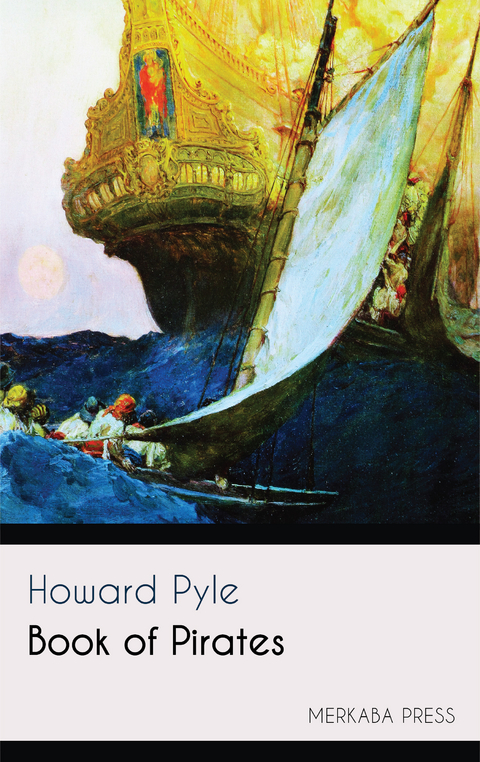
Book of Pirates (eBook)
155 Seiten
Merkaba Press (Verlag)
978-0-00-002258-5 (ISBN)
Just above the northwestern shore of the old island of Hispaniola-the Santo Domingo of our day-and separated from it only by a narrow channel of some five or six miles in width, lies a queer little hunch of an island, known, because of a distant resemblance to that animal, as the Tortuga de Mar, or sea turtle. It is not more than twenty miles in length by perhaps seven or eight in breadth; it is only a little spot of land, and as you look at it upon the map a pin's head would almost cover it; yet from that spot, as from a center of inflammation, a burning fire of human wickedness and ruthlessness and lust overran the world, and spread terror and death throughout the Spanish West Indies, from St. Augustine to the island of Trinidad, and from Panama to the coasts of Peru.
About the middle of the seventeenth century certain French adventurers set out from the fortified island of St. Christopher in longboats and hoys, directing their course to the westward, there to discover new islands. Sighting Hispaniola 'with abundance of joy,' they landed, and went into the country, where they found great quantities of wild cattle, horses, and swine.
Now vessels on the return voyage to Europe from the West Indies needed revictualing, and food, especially flesh, was at a premium in the islands of the Spanish Main; wherefore a great profit was to be turned in preserving beef and pork, and selling the flesh to homeward-bound vessels.
The northwestern shore of Hispaniola, lying as it does at the eastern outlet of the old Bahama Channel, running between the island of Cuba and the great Bahama Banks, lay almost in the very main stream of travel. The pioneer Frenchmen were not slow to discover the double advantage to be reaped from the wild cattle that cost them nothing to procure, and a market for the flesh ready found for them. So down upon Hispaniola they came by boatloads and shiploads, gathering like a swarm of mosquitoes, and overrunning the whole western end of the island. There they established themselves, spending the time alternately in hunting the wild cattle and buccanning the meat, and squandering their hardly earned gains in wild debauchery, the opportunities for which were never lacking in the Spanish West Indies...
THE GHOST OF CAPTAIN BRAND
It is not so easy to tell why discredit should be cast upon a man because of something that his grandfather may have done amiss, but the world, which is never overnice in its discrimination as to where to lay the blame, is often pleased to make the innocent suffer in the place of the guilty.
Barnaby True was a good, honest, biddable lad, as boys go, but yet he was not ever allowed altogether to forget that his grandfather had been that very famous pirate, Capt. William Brand, who, after so many marvelous adventures (if one may believe the catchpenny stories and ballads that were written about him), was murdered in Jamaica by Capt. John Malyoe, the commander of his own consort, the Adventure galley.
It has never been denied, that ever I heard, that up to the time of Captain Brand's being commissioned against the South Sea pirates he had always been esteemed as honest, reputable a sea captain as could be.
When he started out upon that adventure it was with a ship, the Royal Sovereign, fitted out by some of the most decent merchants of New York. The governor himself had subscribed to the adventure, and had himself signed Captain Brand's commission. So, if the unfortunate man went astray, he must have had great temptation to do so, many others behaving no better when the opportunity offered in those far-away seas where so many rich purchases might very easily be taken and no one the wiser.
To be sure, those stories and ballads made our captain to be a most wicked, profane wretch; and if he were, why, God knows he suffered and paid for it, for he laid his bones in Jamaica, and never saw his home or his wife and daughter again after he had sailed away on the Royal Sovereign on that long misfortunate voyage, leaving them in New York to the care of strangers.
At the time when he met his fate in Port Royal Harbor he had obtained two vessels under his command—the Royal Sovereign, which was the boat fitted out for him in New York, and the Adventure galley, which he was said to have taken somewhere in the South Seas. With these he lay in those waters of Jamaica for over a month after his return from the coasts of Africa, waiting for news from home, which, when it came, was of the very blackest; for the colonial authorities were at that time stirred up very hot against him to take him and hang him for a pirate, so as to clear their own skirts for having to do with such a fellow. So maybe it seemed better to our captain to hide his ill-gotten treasure there in those far-away parts, and afterward to try and bargain with it for his life when he should reach New York, rather than to sail straight for the Americas with what he had earned by his piracies, and so risk losing life and money both.
However that might be, the story was that Captain Brand and his gunner, and Captain Malyoe of the Adventure and the sailing master of the Adventure all went ashore together with a chest of money (no one of them choosing to trust the other three in so nice an affair), and buried the treasure somewhere on the beach of Port Royal Harbor. The story then has it that they fell a-quarreling about a future division of the money, and that, as a wind-up to the affair, Captain Malyoe shot Captain Brand through the head, while the sailing master of the Adventure served the gunner of the Royal Sovereign after the same fashion through the body, and that the murderers then went away, leaving the two stretched out in their own blood on the sand in the staring sun, with no one to know where the money was hid but they two who had served their comrades so.
It is a mighty great pity that anyone should have a grandfather who ended his days in such a sort as this, but it was no fault of Barnaby True's, nor could he have done anything to prevent it, seeing that he was not even born into the world at the time that his grandfather turned pirate, and was only one year old when he so met his tragical end. Nevertheless, the boys with whom he went to school never tired of calling him "Pirate," and would sometimes sing for his benefit that famous catchpenny song beginning thus:
Oh, my name was Captain Brand,A-sailing,And a-sailing;Oh, my name was Captain Brand,A-sailing free.Oh, my name was Captain Brand,And I sinned by sea and land,For I broke God's just command,A-sailing free.
'Twas a vile thing to sing at the grandson of so misfortunate a man, and oftentimes little Barnaby True would double up his fists and would fight his tormentors at great odds, and would sometimes go back home with a bloody nose to have his poor mother cry over him and grieve for him.
Not that his days were all of teasing and torment, neither; for if his comrades did treat him so, why, then, there were other times when he and they were as great friends as could be, and would go in swimming together where there was a bit of sandy strand along the East River above Fort George, and that in the most amicable fashion. Or, maybe the very next day after he had fought so with his fellows, he would go a-rambling with them up the Bowerie Road, perhaps to help them steal cherries from some old Dutch farmer, forgetting in such adventure what a thief his own grandfather had been.
Well, when Barnaby True was between sixteen and seventeen years old he was taken into employment in the countinghouse of Mr. Roger Hartright, the well-known West India merchant, and Barnaby's own stepfather.
It was the kindness of this good man that not only found a place for Barnaby in the countinghouse, but advanced him so fast that against our hero was twenty-one years old he had made four voyages as supercargo to the West Indies in Mr. Hartright's ship, the Belle Helen, and soon after he was twenty-one undertook a fifth. Nor was it in any such subordinate position as mere supercargo that he acted, but rather as the confidential agent of Mr. Hartright, who, having no children of his own, was very jealous to advance our hero into a position of trust and responsibility in the countinghouse, as though he were indeed a son, so that even the captain of the ship had scarcely more consideration aboard than he, young as he was in years.
As for the agents and correspondents of Mr. Hartright throughout these parts, they also, knowing how the good man had adopted his interests, were very polite and obliging to Master Barnaby—especially, be it mentioned, Mr. Ambrose Greenfield, of Kingston, Jamaica, who, upon the occasions of his visits to those parts, did all that he could to make Barnaby's stay in that town agreeable and pleasant to him.
So much for the history of our hero to the time of the beginning of this story, without which you shall hardly be able to understand the purport of those most extraordinary adventures that befell him shortly after he came of age, nor the logic of their consequence after they had occurred.
For it was during his fifth voyage to the West Indies that the first of those extraordinary adventures happened of which I shall have presently to tell.
At that time he had been in Kingston for the best part of four weeks, lodging at the house of a very decent, respectable widow, by name Mrs. Anne Bolles, who, with three pleasant and agreeable daughters, kept a very clean and well-served lodging house in the outskirts of the town.
One morning, as our hero sat sipping his coffee, clad only in loose cotton drawers, a shirt, and a jacket, and with slippers upon his feet, as is the custom in that country, where everyone endeavors to keep as cool as may be—while he sat thus sipping his coffee Miss Eliza, the youngest of the three daughters, came and gave him a note, which, she said, a stranger had just handed in at the door, going away again without waiting for a reply. You may judge of Barnaby's surprise when he opened the note and read as follows:
Mr. Barnaby True.
Sir,—Though you don't know me, I know you, and I tell you this: if you will be at Pratt's Ordinary on Harbor Street on Friday next at eight o'clock of the evening, and will accompany the man who shall say to you, "The Royal Sovereign is come in," you shall learn something the most to your advantage that ever befell you. Sir, keep this note, and show it to him who shall address these words to you, so to certify that you are the man he seeks.
Such was the wording of the note, which was without address, and without any superscription whatever.
The first emotion that stirred Barnaby was one of extreme and profound amazement. Then the thought came into his mind that some witty fellow, of whom he knew a good many in that town—and wild, waggish pranks they were—was attempting to play off some smart jest upon him. But all that Miss Eliza could tell him when he questioned her concerning the messenger was that the bearer of the note was a tall, stout man, with a red neckerchief around his neck and copper buckles to his shoes, and that he had the appearance of a sailorman, having a great big queue hanging down his back. But, Lord! what was such a description as that in a busy seaport town, full of scores of men to fit such a likeness? Accordingly, our hero put away the note into his wallet, determining to show it to his good friend Mr. Greenfield that evening, and to ask his advice upon it. So he did show it, and that gentleman's opinion was the same as his—that some wag was minded to play off a hoax upon him, and that the matter of the letter was all nothing but smoke.
Nevertheless, though Barnaby was thus confirmed in his opinion as to the nature of the communication he had received, he yet determined in his own mind that he would see the business...
| Erscheint lt. Verlag | 25.7.2017 |
|---|---|
| Sprache | englisch |
| Themenwelt | Literatur ► Romane / Erzählungen |
| ISBN-10 | 0-00-002258-6 / 0000022586 |
| ISBN-13 | 978-0-00-002258-5 / 9780000022585 |
| Informationen gemäß Produktsicherheitsverordnung (GPSR) | |
| Haben Sie eine Frage zum Produkt? |
 EPUB (Adobe DRM)
Größe: 270 KB
Kopierschutz: Adobe-DRM
Adobe-DRM ist ein Kopierschutz, der das eBook vor Mißbrauch schützen soll. Dabei wird das eBook bereits beim Download auf Ihre persönliche Adobe-ID autorisiert. Lesen können Sie das eBook dann nur auf den Geräten, welche ebenfalls auf Ihre Adobe-ID registriert sind.
Details zum Adobe-DRM
Dateiformat: EPUB (Electronic Publication)
EPUB ist ein offener Standard für eBooks und eignet sich besonders zur Darstellung von Belletristik und Sachbüchern. Der Fließtext wird dynamisch an die Display- und Schriftgröße angepasst. Auch für mobile Lesegeräte ist EPUB daher gut geeignet.
Systemvoraussetzungen:
PC/Mac: Mit einem PC oder Mac können Sie dieses eBook lesen. Sie benötigen eine
eReader: Dieses eBook kann mit (fast) allen eBook-Readern gelesen werden. Mit dem amazon-Kindle ist es aber nicht kompatibel.
Smartphone/Tablet: Egal ob Apple oder Android, dieses eBook können Sie lesen. Sie benötigen eine
Geräteliste und zusätzliche Hinweise
Buying eBooks from abroad
For tax law reasons we can sell eBooks just within Germany and Switzerland. Regrettably we cannot fulfill eBook-orders from other countries.
aus dem Bereich