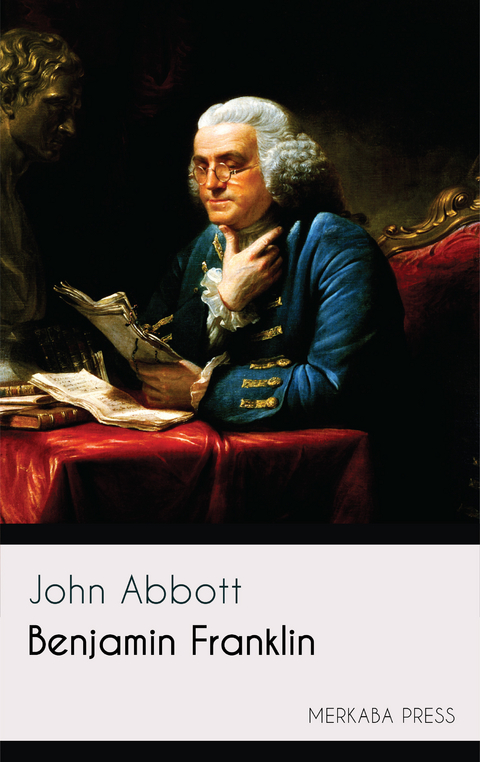
Benjamin Franklin (eBook)
115 Seiten
Merkaba Press (Verlag)
978-0-00-002256-1 (ISBN)
About the year 1685, Josiah Franklin, with his wife and three children, emigrated from Banbury, England, to seek his fortune in this new world. He was in all respects a very worthy man, intelligent, industrious, and influenced to conduct by high moral and religious principles. Several of Josiah Franklin's neighbors accompanied him in his removal.
Boston was then a straggling village, of five or six thousand inhabitants. In front spread out its magnificent bay, with its beautiful islands. In the rear the primeval forest extended, almost unbroken, through unexplored wilds to the Pacific. His trade was that of a dyer. Finding, however, but little employment in that business, he set up as a tallow chandler and soap boiler. Four years of life's usual joys and sorrows passed away when Mrs. Franklin died, leaving six children. The eldest was but eleven years of age. This motherless little family needed a maternal guardian. Within the year, Mr. Franklin married Abiah Folger, of Nantucket. She was the youngest daughter of Peter Folger, a man illustrious for many virtues, and of whom it has been well said, that 'he was worthy to be the grandfather of Benjamin Franklin.' She proved to be a noble woman, and was all that either husband or children could wish for. Ten children were the fruit of this union. Benjamin was born on the sixth of January, (O. S.) 1706.
CHAPTER II.
Developments of Character.
Views of the Sabbath—Writings of Collins and Shaftsbury—The creed of Collins—Franklin at sixteen—The Courant—Denunciations of the paper—Franklin’s mode of acquiring the art of composition—His success as a writer—The Editor prosecuted—Benjamin becomes Editor and Publisher—Jealousy of his brother—The runaway apprentice—The voyage to New York—Great disappointment—Eventful Journey to Philadelphia—Gloomy prospects—The dawn of brighter days.
Franklin was never scrupulous in the observance of the Sabbath. Still, though he but occasionally attended church, he at times very earnestly urged that duty upon his young friends. It is not probable that the preaching he heard in those days, was calculated to interest him. While a child under the parental roof, he ordinarily accompanied his parents, and seemed to regard it as his duty to do so.
He now, however, with an increasing sense of independence, very much preferred to spend his precious hours in his chamber, reading books which engrossed his most intense interest. Unfortunately many treatises fell into his hands in which unchristian sentiments were conveyed to his mind, by men of the highest intellectual character, and whose writings were invested with the most fascinating charms of eloquence.
Robert Boyle, an Irish nobleman of wealth and fervent piety, had established at Oxford a lectureship, the object of which was to prove the truth of the Christian religion. These lectures had found their way in tracts to the little library of Franklin’s father. When but fifteen years of age the boy read them, with a far keener relish than most school-boys now read the flashy novels of the day. In order to refute the arguments of the deists, the lecturers were bound to produce those arguments fairly and forcibly. But to this young boy’s piercing mind, the arguments against Christianity seemed stronger than those which were brought forward to refute them. Thus the lad became, not a positive unbeliever, but an honest doubter. He now sought earnestly for other works upon that all-important subject.
The two most important, influential and popular writers of that day were perhaps Anthony Collins and the Earl of Shaftsbury. These were both men of fortune, of polished education, and of great rhetorical and argumentative skill. Their influence over young minds was greatly increased by the courtesy and candor which pervaded all their writings. They ever wrote like gentlemen addressing gentlemen; and the views they urged were presented with the modesty of men who were earnestly seeking for the truth.
The main attack of both of these men was directed against the miracles of the Bible. It was very evident that, the Divine authority of the Bible being overthrown, the whole structure of the Christian religion and morality must pass away. Mr. Parton, in his admirable Life of Franklin, says,
“Any one who will turn over an edition of Shaftsbury, and try to read it with the mind of this merry and receptive printer’s boy, will perceive how entirely captivating it must have been to him. The raillery that was always the raillery of a gentleman; the irony so delicate as really to deceive some men who passed for acute; the fine urbanity that pervades even the passages called severe; the genuine reverence of the author for virtue; the spectacle revealed of a man uniting in himself all that is good in sense, with all that is agreeable in the man of the world,—how pleasing it must all have been to our inky apprentice as he munched his noon-day crust.”
The practical creed of Collins and Shaftsbury, so far as it can be gleaned from the obscurity of their brilliant pages, consisted in the entire renunciation of all that is deemed the spirituality of the Christian creed, and the simple enforcement of the ordinary principles of morality in man’s intercourse with his brother man. In substance they said,
“Be truthful and honest. Do not openly oppose the institutions of Christianity, for that will render you obnoxious to your neighbors. Conform to the ordinary usages of the society in the midst of which you move; and as to creeds, let them alone as unworthy of a moment’s thought.”
Franklin, at sixteen years of age, became a thorough convert to these views. He was virtually without any God. He had no rule of life but his own instincts; but those instincts were of a high order, emboldening his character and restraining him from all vulgar vice. Thus he wandered for many years; though there are many indications of an occasionally troubled mind, and though he at times struggled with great eagerness to obtain a higher state of moral perfection, he certainly never developed the character of a warm-hearted and devoted follower of Jesus.
James Franklin was prosperous in his business. On the 17th of August, 1721, he issued the first number of a newspaper entitled “The New England Courant.” Benjamin set the type, struck off the impression of two or three hundred, with a hand-press, and then traversed the streets, carrying the diminutive sheet to the homes of the subscribers. The Courant soon attracted attention. A knot of sparkling writers began to contribute to its columns, and while the paper was with increasing eagerness sought for, a clamor was soon raised against it. It was denounced as radical in its political tendencies, and as speaking contemptuously of the institutions of religion. Cotton Mather, even, launched one of his thunderbolts against it. He wrote,
“We find a notorious, scandalous paper called ‘The Courant’ full freighted with nonsense, unmanliness, raillery, profaneness, immorality, arrogance, calumnies, lies, contradictions and what not, all tending to quarrels and divisions, and to debauch and corrupt the mind and manners of New England.”
Increase Mather also denounced the paper, in terms still more emphatic.
At this time a strong antipathy was springing up between James, and his apprentice brother. James assumed the airs of a master, and was arrogant and domineering, at times in his anger proceeding even to blows. Benjamin was opinionated, headstrong and very unwilling to yield to another’s guidance. As Benjamin compared his own compositions with those which were sent to the Courant, he was convinced that he could write as well, if not better, than others. He, therefore, one evening prepared an article, before he was sixteen years of age, which, with the greatest care, was written in pure Addisonian diction. Disguising his hand, he slipped this at night under the door of the printing office. The next morning several contributors were chatting together in the editorial office, as Benjamin stood at the printing case setting his types. The anonymous article was read and freely commented upon. The young writer was delighted in finding it highly commended, and in their guesses for the author, the names of the most distinguished men in Boston were mentioned.
The singular nom de plume he assumed was “Silence Dogood.” Over that signature he wrote many articles before it was ascertained that he was the author. These articles attracted so much attention that young Benjamin could not refrain from claiming their paternity. This led his brother and others to regard him with far more respect than heretofore.
But the Courant, while popular with the masses, became unpopular with the governmental authorities and with the religious community. As a slap in the face of the government, a fictitious letter was written, professedly from Newport, stating that a piratic ship had appeared off the coast, plundering, burning, and destroying. It was then stated that the government of Massachusetts was fitting out an armed vessel to attack the pirate, and that, wind and weather permitting, the vessel would sail from Boston sometime during the month.
This reflection upon the dilatoriness of government gave great offence. The members of the Council summoned Franklin before them to answer for the libel. He admitted that he was the publisher of the paper, but refused to give the name of the writer. The Council decided that the paragraph was a high affront to the government, and ordered his imprisonment in the Boston jail. Here he was incarcerated for a week. Crushed by his misfortunes he wrote a very humble letter stating that his close confinement endangered his life, and begging that he might enjoy the liberty of the jail-yard. His request was granted, and for three weeks more he remained a prisoner, though with daily permission to leave his cell.
During this time Benjamin conducted the paper, editing it, setting the type, printing the sheets and distributing the copies to the subscribers. He was still but a boy of sixteen. James was eventually released from prison, but the general character of the Courant remained unchanged. Unworthy professors of Christianity were incessantly assailed. The virtues of true Christians—of the multitudes of the disciples of Jesus, who were mothers in Israel, or who were Israelites indeed in whom there was no guile, were forgotten; while every mean and contemptible act of hypocrites and apostates was proclaimed with trumpet resonance.
At length the Council declared in reference to a peculiarly obnoxious copy of the paper, that the Courant of that date contained many passages perverting the Holy Scriptures, and slandering the civil government, the ministers, and the good people of the land. A committee of three was appointed to report upon the matter. After two days they brought in the following decision:
“We are humbly of opinion that the tendency of said paper, is to mock religion and bring it into contempt; that the Holy Scriptures are therein...
| Erscheint lt. Verlag | 25.7.2017 |
|---|---|
| Sprache | englisch |
| Themenwelt | Literatur ► Biografien / Erfahrungsberichte |
| ISBN-10 | 0-00-002256-X / 000002256X |
| ISBN-13 | 978-0-00-002256-1 / 9780000022561 |
| Informationen gemäß Produktsicherheitsverordnung (GPSR) | |
| Haben Sie eine Frage zum Produkt? |
 EPUB (Adobe DRM)
Größe: 257 KB
Kopierschutz: Adobe-DRM
Adobe-DRM ist ein Kopierschutz, der das eBook vor Mißbrauch schützen soll. Dabei wird das eBook bereits beim Download auf Ihre persönliche Adobe-ID autorisiert. Lesen können Sie das eBook dann nur auf den Geräten, welche ebenfalls auf Ihre Adobe-ID registriert sind.
Details zum Adobe-DRM
Dateiformat: EPUB (Electronic Publication)
EPUB ist ein offener Standard für eBooks und eignet sich besonders zur Darstellung von Belletristik und Sachbüchern. Der Fließtext wird dynamisch an die Display- und Schriftgröße angepasst. Auch für mobile Lesegeräte ist EPUB daher gut geeignet.
Systemvoraussetzungen:
PC/Mac: Mit einem PC oder Mac können Sie dieses eBook lesen. Sie benötigen eine
eReader: Dieses eBook kann mit (fast) allen eBook-Readern gelesen werden. Mit dem amazon-Kindle ist es aber nicht kompatibel.
Smartphone/Tablet: Egal ob Apple oder Android, dieses eBook können Sie lesen. Sie benötigen eine
Geräteliste und zusätzliche Hinweise
Buying eBooks from abroad
For tax law reasons we can sell eBooks just within Germany and Switzerland. Regrettably we cannot fulfill eBook-orders from other countries.
aus dem Bereich