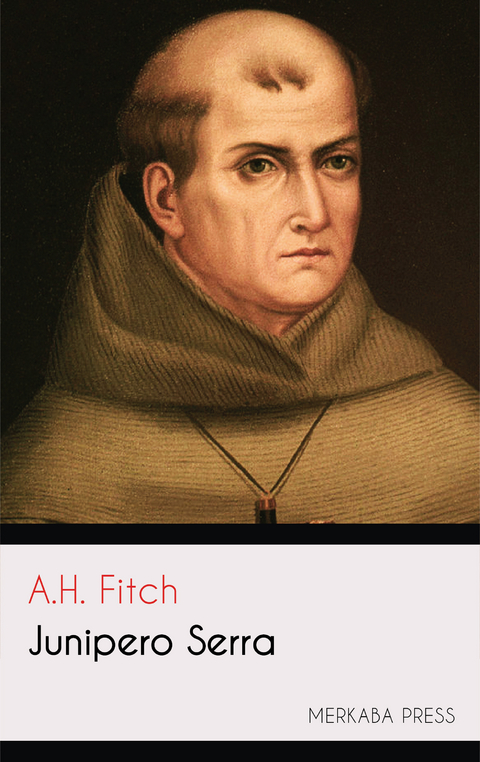
Junipero Serra (eBook)
115 Seiten
Merkaba Press (Verlag)
978-0-00-002314-8 (ISBN)
The best and most interesting method of obtaining historical information is the biographical. This is equally true whether the reader is studying a particular period relating to his own country or is taking a broad survey of universal history. Biography, especially when supplemented by extracts from original sources, leaves upon the mind a more definite impression than any other form of historical writing, with the one great exception of autobiography, of which unfortunately there is too little.
When, therefore, I desired certain information relating to the central and dominant figure in California during the early period of Spanish occupation, I turned to Francisco Palou's biography of Fray Junipero Serra. This work, together with his Noticias de la Nueva California, is today the standard history of Spanish California, and constitutes the source from which every historian of that state draws his facts for the years 1769 to 1785.
While Palou's account of his friend's life and labors on the Pacific coast is of great interest to the student of California history, it is perhaps not too much to say that his book makes but dry reading for the average person. There can be little doubt that the admiration and love Palou entertained for Junipero induced him to chronicle his life with the sole view of procuring for him recognition in the church as one of her saints; hence the prominence accorded the religious aspect of Junipero's life, the detailed narration of miraculous happenings in his career, etc., which detract for the general reader from the historical interest of the book.
Although every work on California since Palou's days necessarily contains references to Fray Junipero Serra, no other biography of him has been written. It was to supply this lack, and also because Palou's biography has to my knowledge never been translated [Since this was written, a translation of Palou's Vida has been published], that I undertook to write the present work, not, however, without many misgivings as to my ability to do justice to the subject. The national, and not merely local, interest of Junipero, as the preserver to Spain (and thereby indirectly to the United States) of the Pacific coast, from San Francisco to San Diego, becomes evident to all who read the history of California.
Just in so far as our importance as a nation is affected by our coast line, does the nation owe a debt to Junipero Serra. Even Mr. Hubert Bancroft, who in his invaluable History of California but faintly disguises his dislike of the friar, says: 'It did not require Palou's eulogistic pen to prove him a great and remarkable man.'
Youth and Early Manhood
There still clings to the name of California a pleasant halo of romance, although the mystery which some two hundred odd years ago lent a subtle charm to that name has long since departed, together with those dauntless Spanish spirits who sailed the seas, to plant the emblem of the church and Spain on Californian soil.
The names of Cortes, of Cabrillo, and Vizcaino, those intrepid discoverers and explorers of the Pacific by the coast of California, are familiar to all. But how many of us, beyond the boundaries of that western state, have heard the name of Fray Junipero Serra? And yet, had it not been for this Franciscan friar, the history of these United States of ours might have been strangely altered. The Russians—the ever-present bugbear of Spain and her American colonies in the Eighteenth century—might finally have swooped down from the far North and raised the standard of the Czar in Alta California. Or England, incited thereto by reports from her many sailor adventurers, might have sent forth to that land of sunshine and flowers the nucleus of a thriving English colony.
In their isolated state, it is doubtful if the people of such a colony would have dreamed of claiming independent sovereignty. The surrounding country was filled with savages, while on beyond stretched eastward for thousands of miles a continent unknown, unexplored, and full of fearful mystery. By sea, too, the Californian colonies were not much nearer the Atlantic coast, for the voyage around the Horn, which in our time can be made in sixty days, could not then be made under one hundred and fifty or two hundred days. It is safe to say that England would have been sure of her Californian possessions and so would have retained, perhaps permanently, her foothold in these states.
But a brown-frocked friar from the terraced island of Majorca has made of such possibilities idle, fruitless conjectures. It was because of his daring determination and intrepid spirit that California was not abandoned by the Spaniards. And it was owing to his ceaseless toil that later the long chain of missions was laid which carried civilization from the wilds of San Diego to the oft fog-enshrouded sand dunes of San Francisco harbor. Spain took possession of California, but it was Fray Junipero Serra who retained it for her, and the history of California offers us no more interesting picture than that of this Franciscan friar.
Francisco Palou, the faithful friend, pupil, and biographer of Fray Junipero, tells us quaintly that this "indefatigable servant in the vineyard of our Saviour began his laborious life the twenty-fourth day of November in the year 1713, at one o'clock in the morning, in the town of Petra in the Island of Majorca."
There are probably no more beautiful islands in the world than the Balearic Islands. The ancients gave to them the name of Aphrodisiades, or Islands of Love. Majorca is the largest and loveliest of them all. It was counted at one time the great market of Europe. In the eighteenth century, as far as commercial importance was concerned, the islands could be numbered among the "forgotten isles." In this fair land of the orange and the ruby muscatel, the inhabitants were industrious, extremely hospitable, and of an orthodoxy that even the rationalizing spirit of eighteenth-century Europe could not disturb.
Such was the birthplace of Fray Junipero Serra. His parents were Antonio Serra and Margarita Ferrer, pious, honest peasants of exemplary habits. They named their infant son Miguel Joseph. He was baptized the day of his birth. The child was early instructed in the Catholic faith, as soon as he began to walk his parents taking him regularly to the church and convent of San Bernadino in Petra. He gained the affections of the good fathers in the convent, who taught the boy to sing, and he served as chorister and acolyte in the parish church, to the great delight of his parents. He was small is stature and not so robust as little peasant boys are generally conceived to be; but if he was constitutionally frail, he was also constitutionally intrepid. He had an ardent temperament and possessed a strength of will and intellect which would have made him an important factor in any walk of life he might have chosen.
His purpose to become a Franciscan was formed in early childhood, just as later his purpose to become a missionary was formed in early manhood. There were, therefore, in Junipero's life no wasted years in which the mind struggled blindly in a career not suited to it till it finally threw off its yoke and found its proper sphere. In another respect he was also peculiarly noteworthy. His life can be searched in vain for a single record of sin, or frivolity, or dreary waste places. He was not converted after years spent in dissipation. His soul from childhood to the hour of his death remained ever exquisitely clean and fresh.
While yet a boy, his parents, observing his extraordinary abilities, took him to Palma to pursue his studies. He became in a short time conspicuous among his fellow students for his proficiency in learning. In the evenings when other youths were dreamily tinkling their guitars in dim flower-scented patios, or gayly roaming Palma's narrow streets to serenade dark-eyed maidens with some Majorcan lyric of love, the young peasant from Petra was absorbed in his books.
His intellectual attainments made him the pride and delight of his teachers. Yet in the midst of the distraction of studies his mind harked back continually to his longing to become a monk. One day he asked the consent of the Provincial to enter the Franciscan order. His small stature, his delicate appearance caused the church dignitary to pronounce him too young to take monastic vows. As a matter of fact he was in his seventeenth year, and the Provincial, being informed of this, withdrew his objection. Young Serra took his first vows September 14, 1730. In this year of his novitiate the principal convent in Palma gave a signal proof of the high appreciation accorded him by electing him professor of philosophy, a position in which he appears to have distinguished himself markedly.
At his ordination he took the name of Junipero. The first Junipero was one of the disciples of St. Francis, who besides being distinguished for his humility was the jolliest of the "joyous penitents." His pious capers smack of a lively sense of humor. On one occasion, when forbidden to give away his cloak, (for by so doing he would have left himself naked) he said to the next beggar, "If you tear it off my back I will not resist you," and afterward cheerfully explained to St. Francis that "a worthy person took it from me and went away with it." All are familiar with the story of how he avoided a triumphant entry into Rome, prepared for him by an enthusiastic crowd, by the simple expedient of making a fool of himself on a seesaw, until, deeply offended, his admirers turned away and left him to enter the city alone. That the serious young Majorcan professor chose to call himself after this merry Franciscan throws an interesting sidelight on his character.
While still a young man, Fray Junipero, as we must now call him, obtained a degree of S.T.D. from the famous Lullian University, with an appointment to the John Scotus chair of Philosophy. He held the appointment with distinguished success until he left Spain. His doctrinal learning brought him fame, but it was his eloquence as a preacher which dominated the people, who flocked in large crowds to hear his sermons. He had a sonorous voice and a fervent delivery. A man at once so learned, so eloquent, and so possessed of the faith of a child, could not fail to stir his listeners in every fiber of their being.
He was selected by the university to deliver the panegyric on the occasion of a festival in honor of their patron and compatriot, the eminent Dr. Raymond Lully. This famous mystic and theologian had led a wild life in his youth. It is said that he once scandalized the people by entering the church on horseback to see a lady of whom he was enamored. Years afterward he was stoned to death by Mussulmans in Africa, where he had gone to obtain converts to Christianity through his peculiar system of logic.
Fray Junipero's address on the life of this acute theologian and prolific writer was so scholarly that the learned men of Palma and the university were equally amazed and delighted, and an eminent critic pronounced the discourse "worthy of being printed in letters of gold." It was at this time, when Junipero had obtained his highest renown, that he determined to devote the remainder of his life to his fellowmen in the wilderness.
Long before the Reformation, the activity of the Catholic church in every country save Spain had almost entirely ceased. Popes and princes were more absorbed in temporal affairs than in spiritual conquests. But in the Spanish peninsula missionary ardor had never abated. Spain's proximity to the Moslems, her prolonged and constant struggle with the infidels, kept the missionary spirit alive in the hearts of her people. The great maritime discoveries of the fifteenth and the sixteenth centuries added fuel to their ardor. To traverse dangerous seas, to penetrate unknown lands for the purpose of carrying Christianity to the heathen was to Spanish cavalier, and Spanish priest, one of the leading motives of their exploring expeditions.
Down to the latter end of the eighteenth century, the love of proselytizing may be said to have been one of the prominent characteristics of the Spaniard. The...
| Erscheint lt. Verlag | 25.7.2017 |
|---|---|
| Sprache | englisch |
| Themenwelt | Literatur ► Biografien / Erfahrungsberichte |
| ISBN-10 | 0-00-002314-0 / 0000023140 |
| ISBN-13 | 978-0-00-002314-8 / 9780000023148 |
| Informationen gemäß Produktsicherheitsverordnung (GPSR) | |
| Haben Sie eine Frage zum Produkt? |
 EPUB (Adobe DRM)
Größe: 282 KB
Kopierschutz: Adobe-DRM
Adobe-DRM ist ein Kopierschutz, der das eBook vor Mißbrauch schützen soll. Dabei wird das eBook bereits beim Download auf Ihre persönliche Adobe-ID autorisiert. Lesen können Sie das eBook dann nur auf den Geräten, welche ebenfalls auf Ihre Adobe-ID registriert sind.
Details zum Adobe-DRM
Dateiformat: EPUB (Electronic Publication)
EPUB ist ein offener Standard für eBooks und eignet sich besonders zur Darstellung von Belletristik und Sachbüchern. Der Fließtext wird dynamisch an die Display- und Schriftgröße angepasst. Auch für mobile Lesegeräte ist EPUB daher gut geeignet.
Systemvoraussetzungen:
PC/Mac: Mit einem PC oder Mac können Sie dieses eBook lesen. Sie benötigen eine
eReader: Dieses eBook kann mit (fast) allen eBook-Readern gelesen werden. Mit dem amazon-Kindle ist es aber nicht kompatibel.
Smartphone/Tablet: Egal ob Apple oder Android, dieses eBook können Sie lesen. Sie benötigen eine
Geräteliste und zusätzliche Hinweise
Buying eBooks from abroad
For tax law reasons we can sell eBooks just within Germany and Switzerland. Regrettably we cannot fulfill eBook-orders from other countries.
aus dem Bereich