


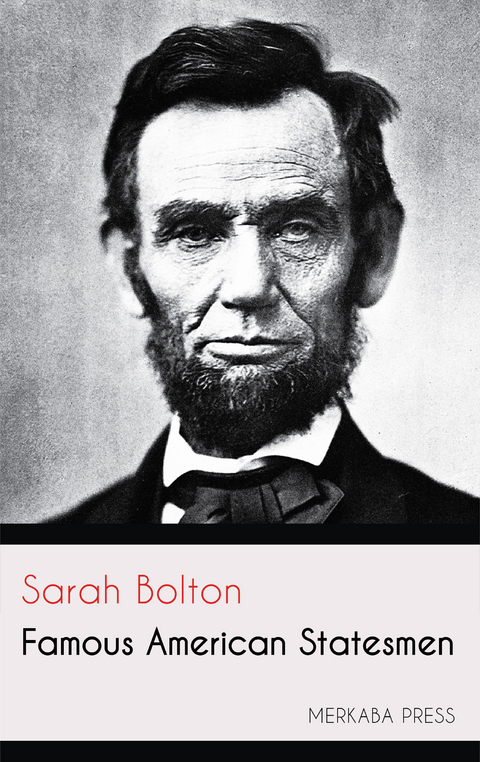
Famous American Statesmen (eBook)
117 Seiten
Merkaba Press (Verlag)
978-0-00-002287-5 (ISBN)
'With the great, one's thoughts and manners easily become great; ... what this country longs for is personalities, grand persons, to counteract its materialities,' says Emerson. Such lives as are sketched in this book are a constant inspiration, both to young and old. They teach Garfield's oft-repeated maxim, that 'the genius of success is still the genius of labor.' They teach patriotism-a deeper love for and devotion to America. They teach that life, with some definite and noble purpose, is worth living.
I have written of Abraham Lincoln, one of our greatest and best statesmen, in 'Poor Boys Who Became Famous,' which will explain its omission from this volume.
BENJAMIN FRANKLIN.
"To say that his life is the most interesting, the most uniformly successful, yet lived by any American, is bold. But it is, nevertheless, strictly true." Thus writes John Bach McMaster, in his life of the great statesman.
In the year 1706, January 6 (old style), in the small house of a tallow-chandler and soap-boiler, on Milk Street, opposite the Old South Church, Boston, was born Benjamin Franklin. Already fourteen children had come into the home of Josiah Franklin, the father, by his two wives, and now this youngest son was added to the struggling family circle. Two daughters were born later.
The home was a busy one, and a merry one withal; for the father, after the day's work, would sing to his large flock the songs he had learned in his boyhood in England, accompanying the words on his violin.
From the mother, the daughter of Peter Folger of Nantucket, "a learned and godly Englishman," Benjamin inherited an attractive face, and much of his hunger for books, which never lessened through his long and eventful life. At eight years of age, he was placed in the Boston Latin School, and in less than a year rose to the head of his class. The father had hoped to educate the boy for the ministry, but probably money was lacking, for at ten his school-life was ended, and he was in his father's shop filling candle-moulds and running on errands.
For two years he worked there, but how he hated it! not all labor, for he was always industrious, but soap and candle-making were utterly distasteful to him. So strongly was he inclined to run away to sea, as an older brother had done, that his father obtained a situation for him with a maker of knives, and later he was apprenticed to his brother James as a printer.
Now every spare moment was used in reading. The first book which he owned was Bunyan's "Pilgrim's Progress," and after reading this over and over, he sold it, and bought Burton's "Historical Collections," forty tiny books of travel, history, biography, and adventure. In his father's small library, there was nothing very soul-stirring to be found. Defoe's "Essays upon Projects," containing hints on banking, friendly societies for the relief of members, colleges for girls, and asylums for idiots, would not be very interesting to most boys of twelve, but Benjamin read every essay, and, strange to say, carried out nearly every "project" in later life. Cotton Mather's "Essays to do Good," with several leaves torn out, was so eagerly read, and so productive of good, that Franklin wrote, when he was eighty, that this volume "gave me such a turn of thinking as to have an influence on my conduct through life; for I have always set a greater value on the character of a doer of good than on any other kind of reputation; and, if I have been a useful citizen, the public owe the advantage of it to that book."
As the boy rarely had any money to buy books, he would often borrow from the booksellers' clerks, and read in his little bedroom nearly all night, being obliged to return the books before the shop was opened in the morning. Finally, a Boston merchant, who came to the printing-office, noticed the lad's thirst for knowledge, took him home to see his library, and loaned him some volumes. Blessings on those people who are willing to lend knowledge to help the world upward, despite the fact that book-borrowers proverbially have short memories, and do not always take the most tender care of what they borrow.
When Benjamin was fifteen, he wrote a few ballads, and his brother James sent him about the streets to sell them. This the father wisely checked by telling his son that poets usually are beggars, a statement not literally true, but sufficiently near the truth to produce a wholesome effect upon the young verse-maker.
The boy now devised a novel way to earn money to buy books. He had read somewhere that vegetable food was sufficient for health, and persuaded James, who paid the board of his apprentice, that for half the amount paid he could board himself.
Benjamin therefore attempted living on potatoes, hasty pudding, and rice; doing his own cooking,—not the life most boys of sixteen would choose. His dinner at the printing-office usually consisted of a biscuit, a handful of raisins, and a glass of water; a meal quickly eaten, and then, O precious thought! there was nearly a whole hour for books.
He now read Locke on "Human Understanding," and Xenophon's "Memorable Things of Socrates." In this, as he said in later years, he learned one of the great secrets of success; "never using, when I advanced anything that may possibly be disputed, the words certainly, undoubtedly, or any others that give the air of positiveness to an opinion; but rather say, I conceive or apprehend a thing to be so and so; it appears to me, or I should think it so or so, for such and such reasons; or, it is so, if I am not mistaken.... I wish well-meaning, sensible men would not lessen their power of doing good by a positive, assuming manner, that seldom fails to disgust, tends to create opposition, and to defeat every one of those purposes for which speech was given to us, to wit, giving or receiving information or pleasure.... To this habit I think it principally owing that I had early so much weight with my fellow-citizens, when I proposed new institutions or alterations in the old, and so much influence in public councils when I became a member; for I was but a bad speaker, never eloquent, subject to much hesitation in my choice of words, and yet I generally carried my points." A most valuable lesson to be learned early in life.
Coming across an odd volume of the "Spectator," Benjamin was captivated by the style, and resolved to become master of the production, by rewriting the essays from memory, and increasing his fulness of expression by turning them into verse, and then back again into prose.
James Franklin was now printing the fifth newspaper in America. It was intended to issue the first—Publick Occurrences—monthly, or oftener, "if any glut of occurrences happens." When the first number appeared, September 25, 1690, a very important "occurrence happened," which was the immediate suspension of the paper for expressions concerning those in official position. The next newspaper,—the Boston News-Letter,—a weekly, was published April 24, 1704; the third was theBoston Gazette, which James was engaged to print, but, being disappointed, started one of his own, August 17, 1721, called the New England Courant. The American Weekly Mercury was printed in Philadelphia six months before the Courant.
Benjamin's work was hard and constant. He not only set type, but distributed the paper to customers. "Why," thought he, "can I not write something for the new sheet?" Accordingly, he prepared a manuscript, slipped it under the door of the office, and the next week saw it in print before his eyes. This was joy indeed, and he wrote again and again.
The Courant at last gave offence by its plain speaking, and it ostensibly passed into Benjamin's hands, to save his brother from punishment. The position, however, soon became irksome, for the passionate brother often beat Benjamin, till at last he determined to run away. As soon as this became known, James went to every office, told his side of the story, and thus prevented Benjamin from obtaining work. Not discouraged, the boy sold a portion of his precious books, said good-bye to his beloved Boston, and went out into the world to more poverty and struggle.
Three days after this, he stood in New York, asking for work at the only printing-office in the city, owned by William Bradford. Alas! there was no work to be had, and he was advised to go to Philadelphia, nearly one hundred miles away, where Andrew Bradford, a son of the former, had established a paper. The boy could not have been very light-hearted as he started on the journey. After thirty hours by boat, he reached Amboy, and then travelled fifty miles on foot across New Jersey. It rained hard all day, but he plodded on, tired and hungry, buying some gingerbread of a poor woman, and wishing that he had never left Boston. His money was fast disappearing.
Finally he reached Philadelphia.
"I was," he says in his autobiography, "in my working dress, my best clothes being to come round by sea. I was dirty from my journey; my pockets were stuffed out with shirts and stockings, and I knew no soul nor where to look for lodging. I was fatigued with travelling, rowing, and want of rest. I was very hungry, and my whole stock of cash consisted of a Dutch dollar and about a shilling in copper. The latter I gave the people of the boat for my passage, who at first refused it, on account of my rowing, but I insisted on their taking it; a man being sometimes more generous when he has but a little money than when he has plenty, perhaps through fear of being thought to have but little.
"Then I walked up the street, gazing about, till near the Market-house I met a boy with bread. I had made many a meal on bread, and, inquiring where he got it, I went immediately to the baker's he directed me to, in Second Street, and asked for biscuit, intending such as we had in Boston; but they, it seems, were not made in Philadelphia. Then I asked for a threepenny loaf, and was told they had none such. So, not considering or knowing the difference of money, and the greater cheapness, nor the names of bread, I bade him give me threepenny-worth of any sort. He gave me, accordingly, three great puffy rolls. I was surprised at the quantity, but took it, and, having no room in my pockets, walked off with a roll under each arm, and eating the other.
"Thus...
| Erscheint lt. Verlag | 25.7.2017 |
|---|---|
| Sprache | englisch |
| Themenwelt | Literatur ► Biografien / Erfahrungsberichte |
| ISBN-10 | 0-00-002287-X / 000002287X |
| ISBN-13 | 978-0-00-002287-5 / 9780000022875 |
| Informationen gemäß Produktsicherheitsverordnung (GPSR) | |
| Haben Sie eine Frage zum Produkt? |
 EPUB (Adobe DRM)
Größe: 338 KB
Kopierschutz: Adobe-DRM
Adobe-DRM ist ein Kopierschutz, der das eBook vor Mißbrauch schützen soll. Dabei wird das eBook bereits beim Download auf Ihre persönliche Adobe-ID autorisiert. Lesen können Sie das eBook dann nur auf den Geräten, welche ebenfalls auf Ihre Adobe-ID registriert sind.
Details zum Adobe-DRM
Dateiformat: EPUB (Electronic Publication)
EPUB ist ein offener Standard für eBooks und eignet sich besonders zur Darstellung von Belletristik und Sachbüchern. Der Fließtext wird dynamisch an die Display- und Schriftgröße angepasst. Auch für mobile Lesegeräte ist EPUB daher gut geeignet.
Systemvoraussetzungen:
PC/Mac: Mit einem PC oder Mac können Sie dieses eBook lesen. Sie benötigen eine
eReader: Dieses eBook kann mit (fast) allen eBook-Readern gelesen werden. Mit dem amazon-Kindle ist es aber nicht kompatibel.
Smartphone/Tablet: Egal ob Apple oder Android, dieses eBook können Sie lesen. Sie benötigen eine
Geräteliste und zusätzliche Hinweise
Buying eBooks from abroad
For tax law reasons we can sell eBooks just within Germany and Switzerland. Regrettably we cannot fulfill eBook-orders from other countries.
aus dem Bereich


