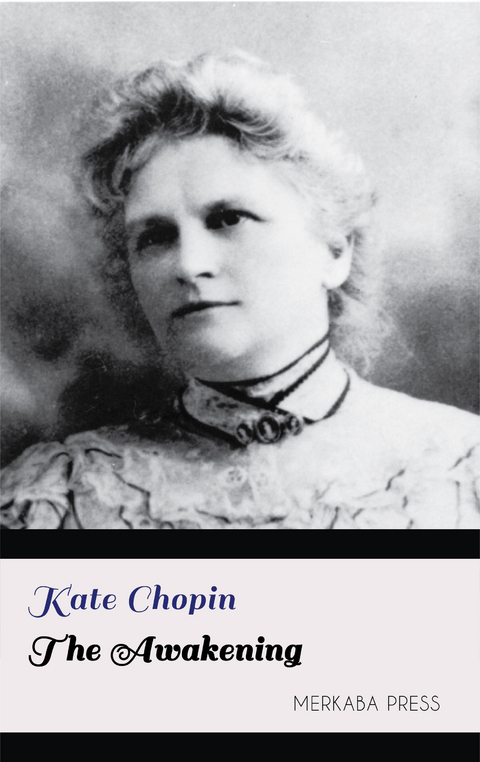
The Awakening (eBook)
139 Seiten
Merkaba Press (Verlag)
978-0-00-002209-7 (ISBN)
Edna Pontellier is a young woman living comfortably in the beautiful city of New Orleans. She is fond of her husband and proud of her sons but finds it impossible to accept that 'for women it is a holy privilege to efface themselves as individuals.' She fights back in the only way she knows, and her solution is extreme.
"I don't know whether I like you or not," replied Edna, gazing down at the little woman with a quizzical look.
The candor of Mrs. Pontellier's admission greatly pleased Mademoiselle Reisz. She expressed her gratification by repairing forthwith to the region of the gasoline stove and rewarding her guest with the promised cup of coffee. The coffee and the biscuit accompanying it proved very acceptable to Edna, who had declined refreshment at Madame Lebrun's and was now beginning to feel hungry. Mademoiselle set the tray which she brought in upon a small table near at hand, and seated herself once again on the lumpy sofa.
"I have had a letter from your friend," she remarked, as she poured a little cream into Edna's cup and handed it to her.
"My friend?"
"Yes, your friend Robert. He wrote to me from the City of Mexico."
"Wrote to YOU?" repeated Edna in amazement, stirring her coffee absently.
"Yes, to me. Why not? Don't stir all the warmth out of your coffee; drink it. Though the letter might as well have been sent to you; it was nothing but Mrs. Pontellier from beginning to end."
"Let me see it," requested the young woman, entreatingly.
"No; a letter concerns no one but the person who writes it and the one to whom it is written."
"Haven't you just said it concerned me from beginning to end?"
"It was written about you, not to you. 'Have you seen Mrs. Pontellier? How is she looking?' he asks. 'As Mrs. Pontellier says,' or 'as Mrs. Pontellier once said.' 'If Mrs. Pontellier should call upon you, play for her that Impromptu of Chopin's, my favorite. I heard it here a day or two ago, but not as you play it. I should like to know how it affects her,' and so on, as if he supposed we were constantly in each other's society."
"Let me see the letter."
"Oh, no."
"Have you answered it?"
"No."
"Let me see the letter."
"No, and again, no."
"Then play the Impromptu for me."
"It is growing late; what time do you have to be home?"
"Time doesn't concern me. Your question seems a little rude. Play the Impromptu."
"But you have told me nothing of yourself. What are you doing?"
"Painting!" laughed Edna. "I am becoming an artist. Think of it!"
"Ah! an artist! You have pretensions, Madame."
"Why pretensions? Do you think I could not become an artist?"
"I do not know you well enough to say. I do not know your talent or your temperament. To be an artist includes much; one must possess many gifts—absolute gifts—which have not been acquired by one's own effort. And, moreover, to succeed, the artist must possess the courageous soul."
"What do you mean by the courageous soul?"
"Courageous, ma foi! The brave soul. The soul that dares and defies."
"Show me the letter and play for me the Impromptu. You see that I have persistence. Does that quality count for anything in art?"
"It counts with a foolish old woman whom you have captivated," replied Mademoiselle, with her wriggling laugh.
The letter was right there at hand in the drawer of the little table upon which Edna had just placed her coffee cup. Mademoiselle opened the drawer and drew forth the letter, the topmost one. She placed it in Edna's hands, and without further comment arose and went to the piano.
Mademoiselle played a soft interlude. It was an improvisation. She sat low at the instrument, and the lines of her body settled into ungraceful curves and angles that gave it an appearance of deformity. Gradually and imperceptibly the interlude melted into the soft opening minor chords of the Chopin Impromptu.
Edna did not know when the Impromptu began or ended. She sat in the sofa corner reading Robert's letter by the fading light. Mademoiselle had glided from the Chopin into the quivering love notes of Isolde's song, and back again to the Impromptu with its soulful and poignant longing.
The shadows deepened in the little room. The music grew strange and fantastic—turbulent, insistent, plaintive and soft with entreaty. The shadows grew deeper. The music filled the room. It floated out upon the night, over the housetops, the crescent of the river, losing itself in the silence of the upper air.
Edna was sobbing, just as she had wept one midnight at Grand Isle when strange, new voices awoke in her. She arose in some agitation to take her departure. "May I come again, Mademoiselle?" she asked at the threshold.
"Come whenever you feel like it. Be careful; the stairs and landings are dark; don't stumble."
Mademoiselle reentered and lit a candle. Robert's letter was on the floor. She stooped and picked it up. It was crumpled and damp with tears. Mademoiselle smoothed the letter out, restored it to the envelope, and replaced it in the table drawer.
XXII
One morning on his way into town Mr. Pontellier stopped at the house of his old friend and family physician, Doctor Mandelet. The Doctor was a semi-retired physician, resting, as the saying is, upon his laurels. He bore a reputation for wisdom rather than skill—leaving the active practice of medicine to his assistants and younger contemporaries—and was much sought for in matters of consultation. A few families, united to him by bonds of friendship, he still attended when they required the services of a physician. The Pontelliers were among these.
Mr. Pontellier found the Doctor reading at the open window of his study. His house stood rather far back from the street, in the center of a delightful garden, so that it was quiet and peaceful at the old gentleman's study window. He was a great reader. He stared up disapprovingly over his eye-glasses as Mr. Pontellier entered, wondering who had the temerity to disturb him at that hour of the morning.
"Ah, Pontellier! Not sick, I hope. Come and have a seat. What news do you bring this morning?" He was quite portly, with a profusion of gray hair, and small blue eyes which age had robbed of much of their brightness but none of their penetration.
"Oh! I'm never sick, Doctor. You know that I come of tough fiber—of that old Creole race of Pontelliers that dry up and finally blow away. I came to consult—no, not precisely to consult—to talk to you about Edna. I don't know what ails her."
"Madame Pontellier not well," marveled the Doctor. "Why, I saw her—I think it was a week ago—walking along Canal Street, the picture of health, it seemed to me."
"Yes, yes; she seems quite well," said Mr. Pontellier, leaning forward and whirling his stick between his two hands; "but she doesn't act well. She's odd, she's not like herself. I can't make her out, and I thought perhaps you'd help me."
"How does she act?" inquired the Doctor.
"Well, it isn't easy to explain," said Mr. Pontellier, throwing himself back in his chair. "She lets the housekeeping go to the dickens."
"Well, well; women are not all alike, my dear Pontellier. We've got to consider—"
"I know that; I told you I couldn't explain. Her whole attitude—toward me and everybody and everything—has changed. You know I have a quick temper, but I don't want to quarrel or be rude to a woman, especially my wife; yet I'm driven to it, and feel like ten thousand devils after I've made a fool of myself. She's making it devilishly uncomfortable for me," he went on nervously. "She's got some sort of notion in her head concerning the eternal rights of women; and—you understand—we meet in the morning at the breakfast table."
The old gentleman lifted his shaggy eyebrows, protruded his thick nether lip, and tapped the arms of his chair with his cushioned fingertips.
"What have you been doing to her, Pontellier?"
"Doing! Parbleu!"
"Has she," asked the Doctor, with a smile, "has she been associating of late with a circle of pseudo-intellectual women—super-spiritual superior beings? My wife has been telling me about them."
"That's the trouble," broke in Mr. Pontellier, "she hasn't been associating with any one. She has abandoned her Tuesdays at home, has thrown over all her acquaintances, and goes tramping about by herself, moping in the street-cars, getting in after dark. I tell you she's peculiar. I don't like it; I feel a little worried over it."
This was a new aspect for the Doctor. "Nothing hereditary?" he asked, seriously. "Nothing peculiar about her family antecedents, is there?"
"Oh, no, indeed! She comes of sound old Presbyterian Kentucky stock. The old gentleman, her father, I have heard, used to atone for his weekday sins with his Sunday devotions. I know for a fact, that his race horses literally ran away with the prettiest bit of Kentucky farming land I ever laid eyes upon. Margaret—you know Margaret—she has all the Presbyterianism undiluted. And the youngest is something of a vixen. By the way, she gets married in a couple of weeks from now."
"Send your wife up to the wedding," exclaimed the Doctor, foreseeing a happy solution. "Let her stay among her own people for a while; it will do her good."
"That's what I want her to do. She won't go to the marriage. She says a wedding is one of the most lamentable spectacles on earth. Nice thing for a woman to say to her husband!" exclaimed Mr. Pontellier, fuming anew at the recollection.
"Pontellier," said the Doctor, after a moment's reflection, "let your wife alone for a while. Don't bother her, and don't let her bother you. Woman, my dear friend, is a very peculiar and delicate organism—a sensitive and highly organized woman, such as I know Mrs. Pontellier to be, is especially peculiar. It would require an inspired psychologist to deal successfully with them. And when ordinary fellows like you and me attempt to cope...
| Erscheint lt. Verlag | 11.7.2017 |
|---|---|
| Sprache | englisch |
| Themenwelt | Literatur ► Romane / Erzählungen |
| ISBN-10 | 0-00-002209-8 / 0000022098 |
| ISBN-13 | 978-0-00-002209-7 / 9780000022097 |
| Informationen gemäß Produktsicherheitsverordnung (GPSR) | |
| Haben Sie eine Frage zum Produkt? |
 EPUB (Adobe DRM)
Größe: 211 KB
Kopierschutz: Adobe-DRM
Adobe-DRM ist ein Kopierschutz, der das eBook vor Mißbrauch schützen soll. Dabei wird das eBook bereits beim Download auf Ihre persönliche Adobe-ID autorisiert. Lesen können Sie das eBook dann nur auf den Geräten, welche ebenfalls auf Ihre Adobe-ID registriert sind.
Details zum Adobe-DRM
Dateiformat: EPUB (Electronic Publication)
EPUB ist ein offener Standard für eBooks und eignet sich besonders zur Darstellung von Belletristik und Sachbüchern. Der Fließtext wird dynamisch an die Display- und Schriftgröße angepasst. Auch für mobile Lesegeräte ist EPUB daher gut geeignet.
Systemvoraussetzungen:
PC/Mac: Mit einem PC oder Mac können Sie dieses eBook lesen. Sie benötigen eine
eReader: Dieses eBook kann mit (fast) allen eBook-Readern gelesen werden. Mit dem amazon-Kindle ist es aber nicht kompatibel.
Smartphone/Tablet: Egal ob Apple oder Android, dieses eBook können Sie lesen. Sie benötigen eine
Geräteliste und zusätzliche Hinweise
Buying eBooks from abroad
For tax law reasons we can sell eBooks just within Germany and Switzerland. Regrettably we cannot fulfill eBook-orders from other countries.
aus dem Bereich