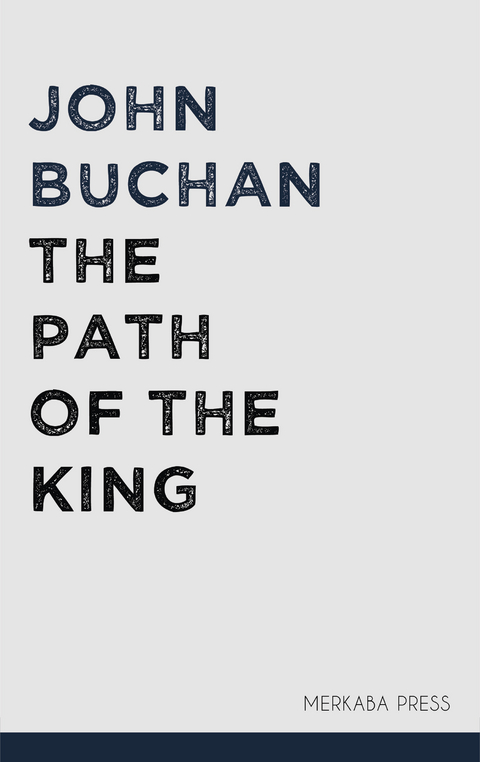
The Path of the King (eBook)
153 Seiten
Merkaba Press (Verlag)
978-0-00-002099-4 (ISBN)
The Path of the King is a 1921 novel by the Scottish author John Buchan, presented as a loosely-coupled series of short stories.
CHAPTER 1
HIGHTOWN UNDER SUNFELL
When Biorn was a very little boy in his father's stead at Hightown he had a play of his own making for the long winter nights. At the back end of the hall, where the men sat at ale, was a chamber which the thralls used of a morning—a place which smelt of hams and meal and good provender. There a bed had been made for him when he forsook his cot in the women's quarters. When the door was shut it was black dark, save for a thin crack of light from the wood fire and torches of the hall. The crack made on the earthen floor a line like a golden river. Biorn, cuddled up on a bench in his little bear-skin, was drawn like a moth to that stream of light. With his heart beating fast he would creep to it and stand for a moment with his small body bathed in the radiance. The game was not to come back at once, but to foray into the farther darkness before returning to the sanctuary of bed. That took all the fortitude in Biorn's heart, and not till the thing was dared and done could he go happily to sleep.
One night Leif the Outborn watched him at his game. Sometimes the man was permitted to sleep there when he had been making sport for the housecarls.
"Behold an image of life!" he had said in his queer outland speech. "We pass from darkness to darkness with but an instant of light between. You are born for high deeds, princeling. Many would venture from the dark to the light, but it takes a stout breast to voyage into the farther dark."
And Biorn's small heart swelled, for he detected praise, though he did not know what Leif meant.
In the long winter the sun never topped Sunfell, and when the gales blew and the snow drifted there were lights in the hall the day long. In Biorn's first recollection the winters were spent by his mother's side, while she and her maids spun the wool of the last clipping. She was a fair woman out of the Western Isles, all brown and golden as it seemed to him, and her voice was softer than the hard ringing speech of the Wick folk. She told him island stories about gentle fairies and good-humoured elves who lived in a green windy country by summer seas, and her air would be wistful as if she thought of her lost home. And she sang him to sleep with crooning songs which had the sweetness of the west wind in them. But her maids were a rougher stock, and they stuck to the Wicking lullaby which ran something like this:
"Hush thee, my bold one, a boat will I buy thee,
A boat and stout oars and a bright sword beside,
A helm of red gold and a thrall to be nigh thee,
When fair blows the wind at the next wicking-tide."
There was a second verse, but it was rude stuff, and the Queen had forbidden the maids to sing it.
As he grew older he was allowed to sit with the men in the hall, when bows were being stretched and bowstrings knotted and spear-hafts fitted. He would sit mum in a corner, listening with both ears to the talk of the old franklins , with their endless grumbles about lost cattle and ill neighbours. Better he liked the bragging of the young warriors, the Bearsarks , who were the spear-head in all the forays. At the great feasts of Yule-tide he was soon sent packing, for there were wild scenes when the ale flowed freely, though his father, King Ironbeard, ruled his hall with a strong hand. From the speech of his elders Biorn made his picture of the world beyond the firths. It was a world of gloom and terror, yet shot with a strange brightness. The High Gods might be met with in beggar's guise at any ferry, jovial fellows and good friends to brave men, for they themselves had to fight for their lives, and the End of All Things hung over them like a cloud. Yet till the day of Ragnarok there would be feasting and fine fighting and goodly fellowship, and a stout heart must live for the hour.
Leif the Outborn was his chief friend. The man was no warrior, being lame of a leg and lean and sharp as a heron. No one knew his begetting, for he had been found as a child on the high fells. Some said he was come of the Finns, and his ill-wishers would have it that his birthplace had been behind a foss, and that he had the blood of dwarves in him. Yet though he made sport for the company, he had respect from them, for he was wise in many things, a skilled leech, a maker of runes, and a crafty builder of ships. He was a master hand at riddles, and for hours the housecarls would puzzle their wits over his efforts. This was the manner of them. "Who," Leif would ask, "are the merry maids that glide above the land to the joy of their father; in winter they bear a white shield, but black in summer?" The answer was "Snowflakes and rain." Or "I saw a corpse sitting on a corpse, a blind one riding on a lifeless steed?" to which the reply was "A dead horse on an ice-floe." Biorn never guessed any of the riddles, but the cleverness of them he thought miraculous, and the others roared with glee at their own obtuseness.
But Leif had different moods, for sometimes he would tell tales, and all were hushed in a pleasant awe. The fire on the hearth was suffered to die down, and men drew closer to each other, as Leif told of the tragic love of Helgi and Sigrun, or how Weyland outwitted King Nidad, or how Thor went as bride to Thrym in Giantland, and the old sad tale of how Sigurd Fafnirsbane, noblest of men, went down to death for the love of a queen not less noble. Leif told them well, so that his hearers were held fast with the spell of wonder and then spurred to memories of their own. Tongues would be loosened, and there would be wild recollections of battles among the skerries of the west, of huntings in the hills where strange sights greeted the benighted huntsman, and of voyaging far south into the lands of the sun where the poorest thrall wore linen and the cities were all gold and jewels. Biorn's head would be in such a whirl after a night of story-telling that he could get no sleep for picturing his own deeds when he was man enough to bear a sword and launch his ship. And sometimes in his excitement he would slip outside into the darkness, and hear far up in the frosty sky the whistle of the swans as they flew southward, and fancy them the shield-maids of Odin on their way to some lost battle.
His father, Thorwald Thorwaldson, was king over all the firths and wicks between Coldness in the south and Flatness and the mountain Rauma in the north, and inland over the Uplanders as far as the highest springs of the rivers. He was king by more than blood, for he was the tallest and strongest man in all the land, and the cunningest in battle. He was for ordinary somewhat grave and silent, a dark man with hair and beard the colour of molten iron, whence came his by-name. Yet in a fight no Bearsark could vie with him for fury, and his sword Tyrfing was famed in a thousand songs. On high days the tale of his descent would be sung in the hall—not by Leif, who was low-born and of no account, but by one or other of the chiefs of the Shield-ring. Biorn was happy on such occasions, for he himself came into the songs, since it was right to honour the gentle lady, the Queen. He heard how on the distaff side he was sprung from proud western earls, Thorwolf the Black, and Halfdan and Hallward Skullsplitter. But on the spear side he was of still loftier kin, for Odin was first in his pedigree, and after him the Volsung chiefs, and Gothfred the Proud, and—that no magnificence might be wanting—one Karlamagnus, whom Biorn had never heard of before, but who seemed from his doings to have been a puissant king.
On such occasions there would follow a bragging match among the warriors, for a recital of the past was meant as an augury for the future. The time was towards the close of the Wicking-tide, and the world was becoming hard for simple folk. There were endless bickerings with the Tronds in the north and the men of More in the south, and a certain Shockhead, an upsetting king in Norland, was making trouble with his neighbours. Likewise there was one Kristni, a king of the Romans, who sought to dispute with Odin himself. This Kristni was a magic-worker, who clad his followers in white linen instead of byrnies , and gave them runes in place of swords, and sprinkled them with witch water. Biorn did not like what he heard of the warlock, and longed for the day when his father Ironbeard would make an end of him.
Each year before the coming of spring there was a lean season in Hightown. Fish were scarce in the ice-holes, the stock of meal in the meal-ark grew low, and the deep snow made poor hunting in wood or on fell-side. Belts were tightened, and there were hollow cheeks among the thralls. And then one morning the wind would blow from the south, and a strange smell come into the air. The dogs left their lair by the fire and, led by the Garm the old blind patriarch, made a tour of inspection among the outhouses to the edge of the birch woods. Presently would come a rending of the ice on the firth, and patches of inky water would show between the floes. The snow would slip from the fell-side, and leave dripping rock and clammy bent, and the river would break its frosty silence and pour a mighty grey-green flood to the sea. The swans and geese began to fly northward, and the pipits woke among the birches. And at last one day the world put on a new dress, all steel-blue and misty green, and a thousand voices woke of flashing streams and nesting birds and tossing pines, and the dwellers in Hightown knew that spring had fairly come.
Then was Biorn the happy child. All through the long day, and through much of that twilight which is the darkness of a Norland summer, he was abroad on his own errands. With Grim the Hunter he adventured far up on the fells and ate cheese and bannocks in the tents of the wandering Skridfinns, or stalked the cailzie-cock with his arrows in...
| Erscheint lt. Verlag | 16.7.2017 |
|---|---|
| Sprache | englisch |
| Themenwelt | Literatur ► Romane / Erzählungen |
| ISBN-10 | 0-00-002099-0 / 0000020990 |
| ISBN-13 | 978-0-00-002099-4 / 9780000020994 |
| Informationen gemäß Produktsicherheitsverordnung (GPSR) | |
| Haben Sie eine Frage zum Produkt? |
 EPUB (Adobe DRM)
Größe: 250 KB
Kopierschutz: Adobe-DRM
Adobe-DRM ist ein Kopierschutz, der das eBook vor Mißbrauch schützen soll. Dabei wird das eBook bereits beim Download auf Ihre persönliche Adobe-ID autorisiert. Lesen können Sie das eBook dann nur auf den Geräten, welche ebenfalls auf Ihre Adobe-ID registriert sind.
Details zum Adobe-DRM
Dateiformat: EPUB (Electronic Publication)
EPUB ist ein offener Standard für eBooks und eignet sich besonders zur Darstellung von Belletristik und Sachbüchern. Der Fließtext wird dynamisch an die Display- und Schriftgröße angepasst. Auch für mobile Lesegeräte ist EPUB daher gut geeignet.
Systemvoraussetzungen:
PC/Mac: Mit einem PC oder Mac können Sie dieses eBook lesen. Sie benötigen eine
eReader: Dieses eBook kann mit (fast) allen eBook-Readern gelesen werden. Mit dem amazon-Kindle ist es aber nicht kompatibel.
Smartphone/Tablet: Egal ob Apple oder Android, dieses eBook können Sie lesen. Sie benötigen eine
Geräteliste und zusätzliche Hinweise
Buying eBooks from abroad
For tax law reasons we can sell eBooks just within Germany and Switzerland. Regrettably we cannot fulfill eBook-orders from other countries.
aus dem Bereich