


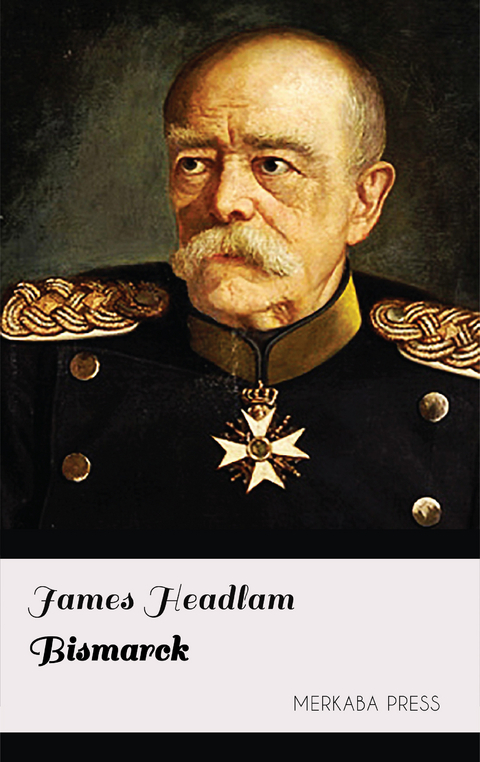
Bismarck (eBook)
198 Seiten
Merkaba Press (Verlag)
978-0-00-002028-4 (ISBN)
Otto Eduard Leopold Von Bismarck was born at the manor-house of Schoenhausen, in the Mark of Brandenburg, on April 1, 1815. Just a month before, Napoleon had escaped from Elba; and, as the child lay in his cradle, the peasants of the village, who but half a year ago had returned from the great campaign in France, were once more called to arms. A few months passed by; again the King of Prussia returned at the head of his army; in the village churches the medals won at Waterloo were hung up by those of Grossbehren and Leipzig. One more victory had been added to the Prussian flags, and then a profound peace fell upon Europe; fifty years were to go by before a Prussian army again marched out to meet a foreign foe.
The name and family of Bismarck were among the oldest in the land. Many of the great Prussian statesmen have come from other countries: Stein was from Nassau, and Hardenberg was a subject of the Elector of Hanover; even Blücher and Schwerin were Mecklenburgers, and the Moltkes belong to Holstein. The Bismarcks are pure Brandenburgers; they belong to the old Mark, the district ruled over by the first Margraves who were sent by the Emperor to keep order on the northern frontier; they were there two hundred years before the first Hohenzollern came to the north...
EARLY LIFE. 1821-1847.
Of the boy's early life we know little. His mother was ambitious for her sons; Otto from his early years she designed for the Diplomatic Service; she seems to have been one of those women who was willing to sacrifice the present happiness of her children for their future advancement. When only six years old the boy was sent away from home to a school in Berlin. He was not happy there; he pined for the free life of the country, the fields and woods and animals; when he saw a plough he would burst into tears, for it reminded him of his home. The discipline of the school was hard, not with the healthy and natural hardships of life in the open air, but with an artificial Spartanism, for it was the time when the Germans, who had suddenly awoke to feelings of patriotism and a love of war to which they had long been strangers, under the influence of a few writers, were throwing all their energies into the cultivation of physical endurance. It was probably at this time that there was laid the foundation of that dislike for the city of Berlin which Bismarck never quite overcame; and from his earliest years he was prejudiced against the exaggerated and affected Teutonism which was the fashion after the great war. A few years later his parents came to live altogether in the town; then the boy passed on to the Gymnasium, boarding in the house of one of the masters. The teaching in this school was supplemented by private tutors, and he learned at this time the facility in the use of the English and French languages which in after years was to be of great service to him. The education at school was of course chiefly in the classical languages; he acquired a sufficient mastery of Latin. There is no evidence that in later life he continued the study of classical literature. In his seventeenth year he passed the Abiturienten examination, which admitted him as a student to the university and entitled him to the privilege of serving in the army for one instead of three years. His leaving certificate tells us that his conduct and demeanour towards his comrades and teachers were admirable, his abilities considerable, and his diligence fair.
The next year he passed in the ordinary course to the university, entering at Göttingen; the choice was probably made because of the celebrity which that university had acquired in law and history. It is said that he desired to enter at Heidelberg, but his mother refused her permission, because she feared that he would learn those habits of beer-drinking in which the students of that ancient seat of learning have gained so great a proficiency; it was, however, an art which, as he found, was to be acquired with equal ease at Göttingen. The young Bismarck was at this time over six feet high, slim and well built, of great physical strength and agility, a good fencer, a bold rider, an admirable swimmer and runner, a very agreeable companion; frank, cheerful, and open-hearted, without fear either of his comrades or of his teachers. He devoted his time at Göttingen less to learning than to social life; in his second term he entered the Corps of the Hanoverians and was quickly noted for his power of drinking and fighting; he is reported to have fought twenty-six duels and was only wounded once, and that wound was caused by the breaking of his opponent's foil. He was full of wild escapades, for which he was often subjected to the ordinary punishments of the university.
To many Germans, their years at the university have been the turning-point of their life; but it was not so with Bismarck. To those who have been brought up in the narrow surroundings of civic life, student days form the single breath of freedom between the discipline of a school and the drudgery of an office. To a man who, like Bismarck, was accustomed to the truer freedom of the country, it was only a passing phase; as we shall see, it was not easy to tie him down to the drudgery of an office. He did not even form many friendships which he continued in later years; his associates in his corps must have been chiefly young Hanoverians; few of his comrades in Prussia were to be found at Göttingen; his knowledge of English enabled him to make the acquaintance of the Americans and English with whom Göttingen has always been a favourite university; among his fellow-students almost the only one with whom in after life he continued the intimacy of younger days was Motley. We hear little of his work; none of the professors seem to have left any marked influence on his mind or character; indeed they had little opportunity for doing so, for after the first term his attendance at lectures almost entirely ceased. Though never a student, he must have been at all times a considerable reader; he had a retentive memory and quick understanding; he read what interested him; absorbed, understood, and retained it. He left the university with his mind disciplined indeed but not drilled; he had a considerable knowledge of languages, law, literature, and history; he had not subjected his mind to the dominion of the dominant Hegelian philosophy, and to this we must attribute that freshness and energy which distinguishes him from so many of his ablest contemporaries; his brain was strong, and it worked as easily and as naturally as his body; his knowledge was more that of a man of the world than of a student, but in later life he was always able to understand the methods and to acquire the knowledge of the subjects he required in his official career. History was his favourite study; he never attempted, like some statesmen, to write; but if his knowledge of history was not as profound as that of a professed historian, he was afterwards to shew as a parliamentary debater that he had a truer perception of the importance of events than many great scholars who have devoted their lives to historical research, and he was never at a loss for an illustration to explain and justify the policy he had assumed. For natural science he shewed little interest, and indeed at that time it scarcely could be reckoned among the ordinary subjects of education; philosophy he pursued rather as a man than as a student, and we are not surprised to find that it was Spinoza rather than Kant or Fichte or Hegel to whom he devoted most attention, for he cared more for principles of belief and the conduct of life than the analysis of the intellect.
His university career does not seem to have left any mark on his political principles; during just those years, the agitation of which the universities had long been the scene had been forcibly repressed; it was the time of deep depression which followed the revolution of 1830, and the members of the aristocratic corps to which he belonged looked with something approaching contempt on this Burschenschaft, as the union was called, which propagated among the students the national enthusiasm.
After spending little more than a year at Göttingen, he left in September, 1833; in May of the following year he entered as a student at Berlin, where he completed his university course; we have no record as to the manner in which he spent the winter and early spring, but we find that when he applied to Göttingen for permission to enter at Berlin, it was accorded on condition that he sat out a term of imprisonment which he still owed to the university authorities. During part of his time in Berlin he shared a room with Motley. In order to prepare for the final examination he engaged the services of a crammer, and with his assistance, in 1835, took the degree of Doctor of Law and at once passed on to the public service.
He had, as we have seen, been destined for the Diplomatic Service from early life; he was well connected; his cousin Count Bismarck-Bohlen stood in high favour at Court. He was related to or acquainted with all the families who held the chief posts both in the military and civil service; with his great talents and social gifts he might therefore look forward to a brilliant career. Any hopes, however, that his mother might have had were destined to be disappointed; his early official life was varied but short. He began in the judicial department and was appointed to the office of Auscultator at Berlin, for in the German system the judicature is one department of the Civil Service. After a year he was at his own request transferred to the administrative side and to Aix-la-Chapelle; it is said that he had been extremely pained and shocked by the manner in which the officials transacted the duties of their office and especially by their management of the divorce matters which came before the court. The choice of Aix-la-Chapelle was probably owing to the fact that the president of that province was Count Arnim of Boytzenburg, the head of one of the most numerous and distinguished families of the Mark, with so many members of which Bismarck was in later years to be connected both for good and evil. Count Arnim was a man of considerable ability and moderate liberal opinions, who a few years later rose to be the first Minister-President in Prussia. Under him Bismarck was sure to receive every assistance. He had to pass a fresh examination, which he did with great success. His certificate states that he shewed thoroughly good school studies, and was well grounded in law; he had thought over what he had learnt and already had acquired independent opinions. He had admirable judgment, quickness in understanding, and a readiness in giving verbal answers to the questions laid before him; we see all the qualities by which he was to be distinguished in after life. He entered on his duties at Aix-la-Chapelle at the beginning of June; at his own request Count Arnim wrote to the heads of the department that as young Bismarck was destined for a diplomatic career they were to afford him every opportunity of becoming acquainted with all the...
| Erscheint lt. Verlag | 12.7.2017 |
|---|---|
| Sprache | englisch |
| Themenwelt | Literatur ► Biografien / Erfahrungsberichte |
| ISBN-10 | 0-00-002028-1 / 0000020281 |
| ISBN-13 | 978-0-00-002028-4 / 9780000020284 |
| Informationen gemäß Produktsicherheitsverordnung (GPSR) | |
| Haben Sie eine Frage zum Produkt? |
 EPUB (Adobe DRM)
Größe: 339 KB
Kopierschutz: Adobe-DRM
Adobe-DRM ist ein Kopierschutz, der das eBook vor Mißbrauch schützen soll. Dabei wird das eBook bereits beim Download auf Ihre persönliche Adobe-ID autorisiert. Lesen können Sie das eBook dann nur auf den Geräten, welche ebenfalls auf Ihre Adobe-ID registriert sind.
Details zum Adobe-DRM
Dateiformat: EPUB (Electronic Publication)
EPUB ist ein offener Standard für eBooks und eignet sich besonders zur Darstellung von Belletristik und Sachbüchern. Der Fließtext wird dynamisch an die Display- und Schriftgröße angepasst. Auch für mobile Lesegeräte ist EPUB daher gut geeignet.
Systemvoraussetzungen:
PC/Mac: Mit einem PC oder Mac können Sie dieses eBook lesen. Sie benötigen eine
eReader: Dieses eBook kann mit (fast) allen eBook-Readern gelesen werden. Mit dem amazon-Kindle ist es aber nicht kompatibel.
Smartphone/Tablet: Egal ob Apple oder Android, dieses eBook können Sie lesen. Sie benötigen eine
Geräteliste und zusätzliche Hinweise
Buying eBooks from abroad
For tax law reasons we can sell eBooks just within Germany and Switzerland. Regrettably we cannot fulfill eBook-orders from other countries.
aus dem Bereich


