


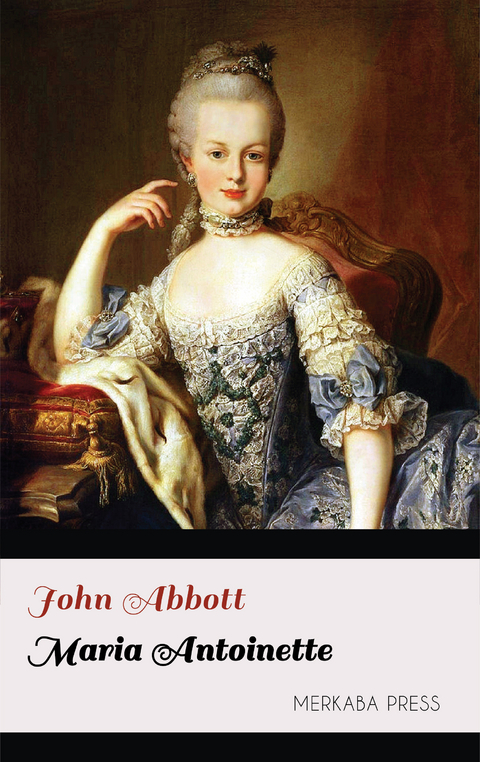
Maria Antoinette (eBook)
101 Seiten
Merkaba Press (Verlag)
978-0-00-001912-7 (ISBN)
In the year 1740, Charles VI., emperor of Austria, died. He left a daughter twenty-three years of age, Maria Theresa, to inherit the crown of that powerful empire. She had been married about four years to Francis, duke of Lorraine. The day after the death of Charles, Maria Theresa ascended the throne. The treasury of Austria was empty. A general feeling of discontent pervaded the kingdom. Several claimants to the throne rose to dispute the succession with Maria; and France, Spain, Prussia, and Bavaria took advantage of the new reign, and of the embarrassments which surrounded the youthful queen, to enlarge their own borders by wresting territory from Austria.
The young queen, harassed by dissensions at home and by the combined armies of her powerful foes, beheld, with anguish which her proud and imperious spirit could hardly endure, her troops defeated and scattered in every direction, and the victorious armies of her enemies marching almost unimpeded toward her capital. The exulting invaders, intoxicated with unanticipated success, now contemplated the entire division of the spoil. They decided to blot Austria from the map of Europe, and to partition out the conglomerated nations composing the empire among the conquerors.
Chapter II.
Bridal Days.
1770-1775
When Maria Antoinette was fifteen years of age, a light-hearted, blooming, beautiful girl, hardly yet emerging from the period of childhood, all Austria, indeed all Europe, was interested in the preparations for her nuptials with the destined King of France. Louis XV. still sat upon the throne of Charlemagne. His eldest son had died about ten years before, leaving a little boy, some twelve years of age, to inherit the crown his father had lost by death. The young Louis, grandchild of the reigning king, was mild, inoffensive, and bashful, with but little energy of mind, with no ardor of feeling, and singularly destitute of all passions. He was perfectly exemplary in his conduct, perhaps not so much from inherent strength of principle as from possessing that peculiarity of temperament, cold and phlegmatic, which feels not the power of temptation. He submitted passively to the arrangements for his marriage, never manifesting the slightest emotion of pleasure or repugnance in view of his approaching alliance with one of the most beautiful and fascinating princesses of Europe. Louis was entirely insensible to all the charms of female beauty, and seemed incapable of feeling the emotion of love.
Louis XV., a pleasure-loving, dissolute man, had surrounded his throne with all the attractions of fashionable indulgence and dissipation. There was one woman in his court, Madame du Barri, celebrated in the annals of profligacy, who had acquired an entire ascendency over the mind of the king. The disreputable connection existing between her and the monarch excluded her from respect, and yet the king loaded her with honors, received her at his table, and forced her society upon all the inmates of the palace. The court was full of jealousies and bickerings; and while one party were disposed to welcome Maria Antoinette, hoping that she would espouse and strengthen their cause, the other party looked upon her with suspicion and hostility, and prepared to meet her with all the weapons of annoyance.
Neither morals nor religion were then of any repute in the court of France. Vice did not even affect concealment. The children of Louis XV. were educated, or rather not educated, in a nunnery. The Princess Louisa, when twelve years of age, knew not the letters of her alphabet. When the children did wrong, the sacred sisters sent them, for penance, into the dark, damp, and gloomy sepulcher of the convent, where the remains of the departed nuns were moldering to decay. Here the timid and superstitious girls, in an agony of terror, were sent alone, to make expiation for some childish offense. The little Princess Victoire, who was of a very nervous temperament, was thrown into convulsions by this harsh treatment, and the injury to her nervous system was so irreparable, that during her whole life she was exposed to periodical paroxysms of panic terror.
One day the king, when sitting with Madame du Barri, received a package of letters. The petted favorite, suspecting that one of them was from an enemy of hers, snatched the packet from the king's hand. As he endeavored to regain it, she resisted, and ran two or three times around the table, which was in the center of the room, eagerly pursued by the irritated monarch. At length, in the excitement of this most strange conflict, she threw the letters into the glowing fire of the grate, where they were all consumed. The king, enraged beyond endurance, seized her by the shoulders, and thrust her violently out of the room. After a few hours, however, the weak-minded monarch called upon her. The countess, trembling in view of her dismissal, with its dreadful consequences of disgrace and beggary, threw herself at his feet, bathed in tears, and they were reconciled.
The remaining history of this celebrated woman is so remarkable that we can not refrain from briefly recording it. Her marvelous beauty had inflamed the passions of the king, and she had obtained so entire an ascendency over his mind that she was literally the monarch of France. The treasures of the empire were emptied into her lap. Notwithstanding the stigma attached to her position, the nation, accustomed to this laxity of morals, submitted to the yoke. As the idol of the king, and the dispenser of honors and powers, the clergy, the nobility, the philosophers, all did her homage. She was still young, and in all the splendor of her ravishing beauty, when the king died. For the sake of appearances, she retired for a few months into a nunnery. Soon, however, she emerged again into the gay world. Her limitless power over the voluptuous old monarch had enabled her to amass an enormous fortune. With this she reared and embellished for herself a magnificent retreat, adorned with more than regal splendor, in the vicinity of Paris—the Pavillon de Luciennes, on the borders of the forest of St. Germain. The old Duke de Brissac, who had long been an admirer of her charms, here lived with her in unsanctified union. Almost universal corruption at that time pervaded the nobility of France—one of the exciting causes of the Revolution. Though excluded from appearing at the court of Louis XVI. and Maria Antoinette, her magnificent saloons were crowded by those ever ready to worship at the shrine of wealth, and rank, and power. But, as the stormy days of the Revolution shed their gloom over France, and an infuriated populace were wrecking their vengeance upon the throne and the nobles, Madame du Barri, terrified by the scenes of violence daily occurring, prepared to fly from France. She invested enormous funds in England, and one dark night went out with the Duke de Brissac alone, and, by the dim light of a lantern, they dug a hole under the foot of a tree in the park, and buried much of the treasure which she was unable to take away with her. In disguise, she reached the coast of France, and escaped across the Channel to England. Here she devoted her immense revenue to the relief of the emigrants who were every day flying in dismay from the horrors with which they were surrounded. The Duke de Brissac, who was commander of the constitutional guard of the king, appeared at Versailles in an hour of great excitement. The mob attacked him. He was instantly assassinated. His head, covered with the white locks of age, was cut off, and planted upon one of the palisades of the palace gates, a fearful warning to all who were suspected of advocating the cause of the king.
And now no one knew of the buried treasure but Madame du Barri herself. She, anxious to regain them, ventured, in disguise, to return to France to disinter her diamonds, and take them with her to England. A young negro servant, whom she had pampered with every indulgence, and had caressed with the fondness with which a mother fondles her child, whom she had caused to be painted by her side in her portraits, saw his mistress and betrayed her. She was immediately seized by the mob, and dragged before the revolutionary tribunal of Luciennes. She was condemned as a Royalist, and was hurried along in the cart of the condemned, amid the execrations and jeers of the delirious mob, to the guillotine. Her long hair was shorn, that the action of the knife might be unimpeded; but the clustering ringlets, in beautiful profusion, fell over her brow and temples, and veiled her voluptuous features and bare bosom, from which the executioner had torn the veil. The yells of the infuriated and deriding populace filled the air, as they danced exultingly around the aristocratic courtesan. But the shrieks of the unhappy victim pierced shrilly through them all. She was frantic with terror. Her whole soul was unnerved, and not one emotion of fortitude remained to sustain the woman of pleasure through her dreadful doom. With floods of tears, and gestures of despair, and beseeching, heart-rending cries, she incessantly exclaimed, "Life—life—life! O save me! save me!" The mob jeered, and derided, and insulted her in every conceivable way. They made themselves merry with her anguish and terror. They shouted witticisms in her ear respecting the pillow of the guillotine upon which she was to repose her head. Struggling and shrieking, she was bound to the plank. Suddenly her voice was hushed. The dissevered head, dripping with blood, fell into the basket, and her soul was in eternity. Poor woman! It is easy to condemn. It is better for the heart to pity. Endowed with almost celestial beauty, living in a corrupt age, and lured, when a child, by a monarch's love, she fell. It is well to weep over her sad fate, and to remember the prayer, "Lead us not into temptation."
Such were the characters and such the state of morals of the court into which this beautiful and artless princess, Maria Antoinette, but fifteen years of age, was to be introduced. As she left the palaces of Vienna to encounter the temptations of the Tuileries and Versailles, Maria Theresa wrote the following characteristic letter to the future husband of her daughter.
"Your bride, dear dauphin, is separated from me. As she has ever been my delight, so will she be your happiness. For this purpose have I educated her; for I have long been aware that she was to be the companion of your life. I have enjoined upon her, as among her highest duties, the most tender attachment to your person, the greatest attention to every thing that can please or make you happy. Above all, I have recommended to her humility toward God, because I am convinced that it is impossible for us to contribute to the happiness of the subjects confided to us without love to Him who breaks the scepters and crushes the thrones of kings according to his will."
The great mass of the Austrian population, hating the French,...
| Erscheint lt. Verlag | 10.7.2017 |
|---|---|
| Sprache | englisch |
| Themenwelt | Literatur ► Biografien / Erfahrungsberichte |
| ISBN-10 | 0-00-001912-7 / 0000019127 |
| ISBN-13 | 978-0-00-001912-7 / 9780000019127 |
| Informationen gemäß Produktsicherheitsverordnung (GPSR) | |
| Haben Sie eine Frage zum Produkt? |
 EPUB (Adobe DRM)
Größe: 226 KB
Kopierschutz: Adobe-DRM
Adobe-DRM ist ein Kopierschutz, der das eBook vor Mißbrauch schützen soll. Dabei wird das eBook bereits beim Download auf Ihre persönliche Adobe-ID autorisiert. Lesen können Sie das eBook dann nur auf den Geräten, welche ebenfalls auf Ihre Adobe-ID registriert sind.
Details zum Adobe-DRM
Dateiformat: EPUB (Electronic Publication)
EPUB ist ein offener Standard für eBooks und eignet sich besonders zur Darstellung von Belletristik und Sachbüchern. Der Fließtext wird dynamisch an die Display- und Schriftgröße angepasst. Auch für mobile Lesegeräte ist EPUB daher gut geeignet.
Systemvoraussetzungen:
PC/Mac: Mit einem PC oder Mac können Sie dieses eBook lesen. Sie benötigen eine
eReader: Dieses eBook kann mit (fast) allen eBook-Readern gelesen werden. Mit dem amazon-Kindle ist es aber nicht kompatibel.
Smartphone/Tablet: Egal ob Apple oder Android, dieses eBook können Sie lesen. Sie benötigen eine
Geräteliste und zusätzliche Hinweise
Buying eBooks from abroad
For tax law reasons we can sell eBooks just within Germany and Switzerland. Regrettably we cannot fulfill eBook-orders from other countries.
aus dem Bereich


