


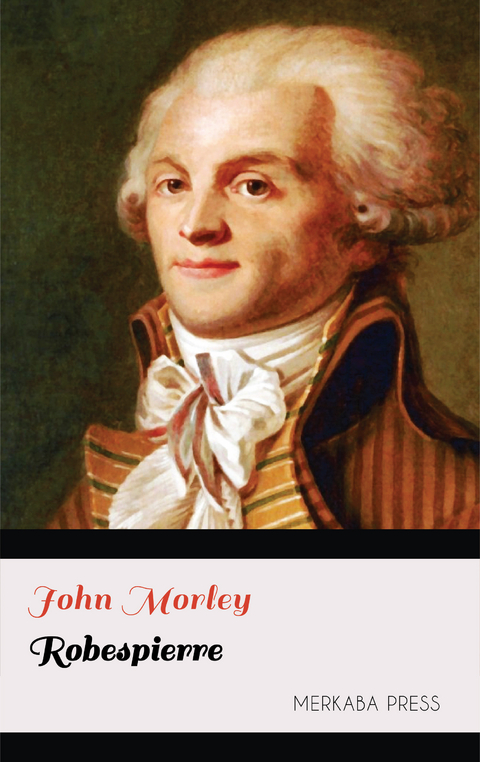
Robespierre (eBook)
117 Seiten
Merkaba Press (Verlag)
978-0-00-001967-7 (ISBN)
In the old Flemish town of Arras, known in the diplomatic history of the fifteenth century by a couple of important treaties, and famous in the industrial history of the Middle Ages for its pre-eminence in the manufacture of the most splendid kind of tapestry hangings, Maximilian Robespierre was born in May 1758. He was therefore no more than five and thirty years old when he came to his ghastly end in 1794. His father was a lawyer, and, though the surname of the family had the prefix of nobility, they belonged to the middle class. When this decorative prefix became dangerous, Maximilian Derobespierre dropped it. His great rival, Danton, was less prudent or less fortunate, and one of the charges made against him was that he had styled himself Monsieur D'Anton.
Robespierre's youth was embittered by sharp misfortune. His mother died when he was only seven years old, and his father had so little courage under the blow that he threw up his practice, deserted his children, and died in purposeless wanderings through Germany. The burden that the weak and selfish throw down, must be taken up by the brave. Friendly kinsfolk charged themselves with the maintenance of the four orphans. Maximilian was sent to the school of the town, whence he proceeded with a sizarship to the college of Louis-le-Grand in Paris. He was an apt and studious pupil, but austere, and disposed to that sombre cast of spirits which is common enough where a lad of some sensibility and much self-esteem finds himself stamped with a badge of social inferiority. Robespierre's worshippers love to dwell on his fondness for birds: with the universal passion of mankind for legends of the saints, they tell how the untimely death of a favourite pigeon afflicted him with anguish so poignant, that, even sixty long years after, it made his sister's heart ache to look back upon the pain of that tragic moment. Always a sentimentalist, Robespierre was from boyhood a devout enthusiast for the great high priest of the sentimental tribe. Rousseau was then passing the last squalid days of his life among the meadows and woods at Ermenonville. Robespierre, who could not have been more than twenty at the time, for Rousseau died in the summer of 1778, is said to have gone on a reverential pilgrimage in search of an oracle from the lonely sage, as Boswell and as Gibbon and a hundred others had gone before him. Rousseau was wont to use his real adorers as ill as he used his imaginary enemies. Robespierre may well have shared the discouragement of the enthusiastic father who informed Rousseau that he was about to bring up his son on the principles of Emilius. 'Then so much the worse,' cried the perverse philosopher, 'both for you and your son.' If he had been endowed with second sight, he would have thought at least as rude a presage due to this last and most ill-starred of a whole generation of neophytes.
II
The Girondins were driven out of the Convention by the insurgent Parisians at the beginning of June 1793. The movement may be roughly compared to that of the Independents in our own Rebellion, when the army compelled the withdrawal of eleven of the Presbyterian leaders from the parliament; or, it may recall Pride's memorable Purge of the same famous assembly. Both cases illustrate the common truth that large deliberative bodies, be they never so excellent for purposes of legislation, and even for a general control of the executive government in ordinary times, are found to be essentially unfit for directing a military crisis. If there are any historic examples that at first seem to contradict such a proposition, it will be found that the bodies in question were close aristocracies, like the Great Council of Venice, or the Senate of Rome in the strong days of the Commonwealth; they were never the creatures of popular election, with varying aims and a diversified political spirit. Modern publicists have substituted the divine right of assemblies for the old divine right of monarchies. Those who condone the violence done to the King on the Tenth of August, and even acquiesce in his execution five months afterwards, are relentless against the violence done to the Convention on the Thirty-first of May. We confess ourselves unable to follow this transfer of the superstition of sacrosanctity from a king to a chamber. No doubt, the sooner a nation acquires a settled government, the better for it, provided the government be efficient. But if it be not efficient, the mischief of actively suppressing it may well be fully outweighed by the mischief of retaining it. We have no wish to smooth over the perversities of a revolutionary time; they cost a nation very dear; but if all the elements of the state are in furious convulsion and uncontrollable effervescence, then it is childish to measure the march of events by the standard of happier days of social peace and political order. The prospect before France at the violent close of Girondin supremacy was as formidable as any nation has ever yet had to confront in the history of the world. Rome was not more critically placed when the defeat of Varro on the plain of Cannæ had broken up her alliances and ruined her army. The brave patriots of the Netherlands had no gloomier outlook at that dolorous moment when the Prince of Orange had left them, and Alva had been appointed to bring them back by rapine, conflagration, and murder, under the loathed yoke of the Spanish tyrant.
Let us realise the conditions that Robespierre and Danton and the other Jacobin leaders had now to face. In the north-west one division of the fugitive Girondins was forming an army at Caen; in the south-west another division was doing the same at Bordeaux. Marseilles and Lyons were rallying all the disaffected and reactionary elements in the south-east. La Vendée had flamed out in wild rebellion for Church and King. The strong places on the north frontier, and the strong places on the east, were in the hands of the foreign enemy. The fate of the Revolution lay in the issue of a struggle between Paris, with less than a score of departments on her side, and all the rest of France and the whole European coalition marshalled against her. And even this was not the worst. In Paris itself a very considerable proportion of its half-million of inhabitants were disaffected to the revolutionary cause. Reactionary historians dwell on the fact that such risings as that of the Tenth of August were devised by no more than half of the sections into which Paris was divided. It was common, they say, for half a dozen individuals to take upon themselves to represent the fourteen or fifteen hundred other members of a section. But what better proof can we have that if France was to be delivered from restored feudalism and foreign spoliation, the momentous task must be performed by those who had sense to discern the awful peril, and energy to encounter it?
The Girondins had made their incapacity plain. The execution of the King had filled them with alarm, and with hatred against the ruder and more robust party who had forced that startling act of vengeance upon them. Puny social disgusts prevented them from co-operating with Danton or with Robespierre. Prussia and Austria were not more redoubtable or more hateful to them than was Paris, and they wasted, in futile recriminations about the September massacres or the alleged peculations of municipal officers, the time and the energy that should have been devoted without let or interruption to the settlement of the administration and the repulse of the foe. It is impossible to think of such fine characters as Vergniaud or Madame Roland without admiration, or of their untimely fate without pity. But the deliverance of a people beset by strong and implacable enemies could not wait on mere good manners and fastidious sentiments, when these comely things were in company with the most stupendous want of foresight ever shown by a political party. How can we measure the folly of men who so missed the conditions of the problem as to cry out in the Convention itself, almost within earshot of the Jacobin Club, that if any insult were offered to the national representation, the departments would rise, 'Paris would be annihilated; and men would come to search on the banks of the Seine whether such a city had ever existed!' It was to no purpose that Danton urgently rebuked the senseless animosity with which the Right poured incessant malediction on the Left, and the wild shrieking hate with which the Left retaliated on the Right. The battle was to the death, and it was the Girondins who first menaced their political foes with vengeance and the guillotine. As it happened, the treason of Dumouriez and their own ineptitude destroyed them before revenge was within reach. Such a consummation was fortunate for their country. It was the Girondins whose want of union and energy had by the middle of 1793 brought France to distraction and imminent ruin. It was a short year of Jacobin government that by the summer of 1794 had welded the nation together again, and finally conquered the invasion. The city of the Seine had once more shown itself what it had been for nine centuries, ever since the days of Odo, Count of Paris and first King of the French, not merely a capital, but France itself, 'its living heart and surest bulwark.'
The immediate instrument of so rapid and extraordinary an achievement was the Committee of Public Safety. The French have never shown their quick genius for organisation with more triumphant vigour. While the Girondins were still powerful, nine members of the Convention had been constituted an executive committee, April 6, 1793. They were in fact a kind of permanent cabinet, with practical irresponsibility. In the summer of 1793 the number was increased from nine to twelve, and these twelve were the centre of the revolutionary government. They fell into three groups. First, there were the scientific or practical administrators, of whom the most eminent was Carnot. Next came the directors of internal policy, the pure revolutionists, headed by Billaud de Varennes. Finally, there was a trio whose business it was to translate action into the phrases of revolutionary policy. This famous group was Robespierre, Couthon, and Saint Just.
Besides the Committee of Public Safety there was another chief governmental committee, that of General Security. Its functions were mainly connected with the police, the arrests, and the prisons, but in all serious affairs the two Committees deliberated in common. There were also fourteen other groups of various size, taken from the Convention; they applied themselves with admirable zeal, and usually not with more zeal than skill, to schemes of public instruction, of finance, of legislation, of the administration of justice, and a host of other civil reforms, of all of which Napoleon Bonaparte was by and by to reap the credit. These bodies completed the civil revolution, which the Constituent and the Legislative Assemblies had left so mischievously incomplete that, as soon as ever the Convention had assembled, it was besieged by a host of petitioners praying them to explain and to pursue the abolition of the old feudal rights. Everything had still been left uncertain in men's minds, even upon that greatest of all the revolutionary questions. The feudal division of the committee of general legislation had in this eleventh hour to decide innumerable issues, from those of the widest practical importance, down to the prayer of a remote commune to be relieved from the charge of maintaining a certain mortuary lamp which had been a matter of seignorial obligation. The work done by the radical jurisconsults was never undone. It was the great and durable reward of the struggle. And we have to remember that these industrious and efficient bodies, as well as all other public bodies and functionaries whatever, were placed by the definite revolutionary constitution of 1793 under the direct orders of the Committee of Public Safety.
It is hardly possible even now for any one who exults in the memory of the great deliverance of a brilliant and sociable people, to stand unmoved before the walls of that palace which Philibert Delorme reared for Catherine de' Medici, and which was thrown into ruin by the madness of a band of desperate men in our own days. Lewis had walked forth from the Tuileries on the fatal morning of the Tenth of August, holding his children by the hand, and lightly noticing, as he traversed the gardens, how early that year the leaves were falling. Lewis had by this time followed the fallen...
| Erscheint lt. Verlag | 10.7.2017 |
|---|---|
| Sprache | englisch |
| Themenwelt | Literatur ► Biografien / Erfahrungsberichte |
| ISBN-10 | 0-00-001967-4 / 0000019674 |
| ISBN-13 | 978-0-00-001967-7 / 9780000019677 |
| Informationen gemäß Produktsicherheitsverordnung (GPSR) | |
| Haben Sie eine Frage zum Produkt? |
 EPUB (Adobe DRM)
Größe: 145 KB
Kopierschutz: Adobe-DRM
Adobe-DRM ist ein Kopierschutz, der das eBook vor Mißbrauch schützen soll. Dabei wird das eBook bereits beim Download auf Ihre persönliche Adobe-ID autorisiert. Lesen können Sie das eBook dann nur auf den Geräten, welche ebenfalls auf Ihre Adobe-ID registriert sind.
Details zum Adobe-DRM
Dateiformat: EPUB (Electronic Publication)
EPUB ist ein offener Standard für eBooks und eignet sich besonders zur Darstellung von Belletristik und Sachbüchern. Der Fließtext wird dynamisch an die Display- und Schriftgröße angepasst. Auch für mobile Lesegeräte ist EPUB daher gut geeignet.
Systemvoraussetzungen:
PC/Mac: Mit einem PC oder Mac können Sie dieses eBook lesen. Sie benötigen eine
eReader: Dieses eBook kann mit (fast) allen eBook-Readern gelesen werden. Mit dem amazon-Kindle ist es aber nicht kompatibel.
Smartphone/Tablet: Egal ob Apple oder Android, dieses eBook können Sie lesen. Sie benötigen eine
Geräteliste und zusätzliche Hinweise
Buying eBooks from abroad
For tax law reasons we can sell eBooks just within Germany and Switzerland. Regrettably we cannot fulfill eBook-orders from other countries.
aus dem Bereich


