


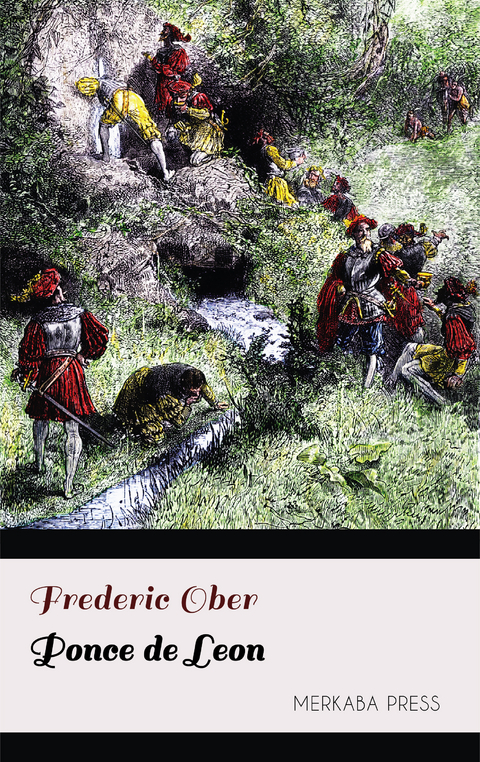
Ponce de Leon (eBook)
97 Seiten
Merkaba Press (Verlag)
978-0-00-001961-5 (ISBN)
That great deeds and a broad field of action are not always commensurate is exemplified in the lives of the Ponces de Leon, Juan and Rodrigo, noteworthy names of a family famed in the annals of America and Spain. Of the two, doubtless the latter was the more distinguished in the land of his birth for bravery and military skill; but the former achieved a still wider celebrity by linking his name with the discovery of Florida and the search for the fountain of youth.
These two famous sons of Spain were not closely related, although they bore the same patronymic, as Juan came from an ancient family of Aragon, and Rodrigo from an equally ancient, and in the fifteenth century more flourishing, house of Andalusia, or the south of Spain. Both belonged to the hidalguia, or Spanish nobility; but the northern, or Aragon branch, was in decadence at the time Juan was born, in or about the year 1460, while the Andalusian was then rapidly approaching the zenith of its glory. This, indeed, culminated with the career of Rodrigo Ponce de Leon (born 1443, died 1492), who, while possessing vast territory in Spain, with scores of castles, towns, and villages, passed the greater part of his life in camp.
Soldiers were they both, trained almost from infancy in the profession of arms; but while Juan was still a page at the court of Pero Nunez de Guzman, Senor of Toral, Rodrigo could raise an army of his own retainers and vassals. For he was then the most illustrious of the Ponces, and, having in youth come into the ownership of title and estates, was well and widely known as the powerful Marquis of Cadiz. As his territory, at the time this story opens, lay contiguous to the region then occupied by the Moors, with whom for centuries the Spaniards had been engaged in deadly warfare, he had been, as it were, cradled beneath the canopies of tents, nurtured upon the traditions of his ancestors, and matured with Spain's seasoned veterans in the field. Thus it came to pass that he was regarded by the king and the queen, Ferdinand of Aragon and Isabella of Castile, as their most doughty champion, defender of the faith, and implacable antagonist of the Mahometan Moors.
The Valiant Exemplar
1443–1482
That great deeds and a broad field of action are not always commensurate is exemplified in the lives of the Ponces de Leon, Juan and Rodrigo, noteworthy names of a family famed in the annals of America and Spain. Of the two, doubtless the latter was the more distinguished in the land of his birth for bravery and military skill; but the former achieved a still wider celebrity by linking his name with the discovery of Florida and the search for the fountain of youth.
These two famous sons of Spain were not closely related, although they bore the same patronymic, as Juan came from an ancient family of Aragon, and Rodrigo from an equally ancient, and in the fifteenth century more flourishing, house of Andalusia, or the south of Spain. Both belonged to the hidalguia, or Spanish nobility; but the northern, or Aragon branch, was in decadence at the time Juan was born, in or about the year 1460, while the Andalusian was then rapidly approaching the zenith of its glory. This, indeed, culminated with the career of Rodrigo Ponce de Leon (born 1443, died 1492), who, while possessing vast territory in Spain, with scores of castles, towns, and villages, passed the greater part of his life in camp.
Soldiers were they both, trained almost from infancy in the profession of arms; but while Juan was still a page at the court of Pero Nunez de Guzman, Senor of Toral, Rodrigo could raise an army of his own retainers and vassals. For he was then the most illustrious of the Ponces, and, having in youth come into the ownership of title and estates, was well and widely known as the powerful Marquis of Cadiz. As his territory, at the time this story opens, lay contiguous to the region then occupied by the Moors, with whom for centuries the Spaniards had been engaged in deadly warfare, he had been, as it were, cradled beneath the canopies of tents, nurtured upon the traditions of his ancestors, and matured with Spain's seasoned veterans in the field. Thus it came to pass that he was regarded by the king and the queen, Ferdinand of Aragon and Isabella of Castile, as their most doughty champion, defender of the faith, and implacable antagonist of the Mahometan Moors.
For more than seven centuries the Moors from Africa had held possession of some portion of the Iberian peninsula; but at the period in which Juan and Rodrigo Ponce de Leon appeared upon the scene they were restricted to a mountainous region bordering upon the Mediterranean Sea. A thousand years ago, indeed, the Mahometans had taken as their own the best part of Spain; they had even crossed the French frontier and threatened to invade all Europe. Turned about by the blows of Charles Martel, in that fierce battle of the year 732, the Saracens began their century-long retreat southward; but nearly five hundred years elapsed before their power was shattered on the field of Tolosa. After that the Spaniards gathered courage to attack the Moors at every opportunity; still, it was not till the end of the fifteenth century that they were practically driven from Spain. The refluent wave to Africa was a very long time in reaching its shores.
It remained for Isabella and Ferdinand to reap the reward of persistent effort by other sovereigns through the centuries preceding. They fell heirs to what had been accomplished, what had been garnered, what achieved by their predecessors, and by their union they welded together the chain of little kingdoms—of Spanish provinces—that stretched across the peninsula from the Mediterranean to Portugal's frontiers. Behind the retreating Moors the Spaniards erected impregnable barriers: one year they took and refortified a city, another a province, a mountain range, a river and its banks; but whatever was taken they held. Broader and broader became the region that lay north of the Moors, from which they were banished forever; narrower and narrower the territory that lay between it and the Mediterranean, until, in the last quarter of the fifteenth century, they held only the Sierra Nevada and the country skirting it. But this territory comprised the most fertile, the most beautiful region of Spain, where the climate was perfect, the scenery perfection. Trickling rivulets from the Nevadas, or Snowy Mountains, fed sparkling streams that descended through picturesque valleys, nourishing an exuberant vegetation which supported a large population without toilsome effort on their part.
The Moors were still numerous in that portion of Spain to which the exigencies of war had driven their ancestors; they were yet fierce and warlike, and now and again, like hawks swooping from their aeries, they descended from their mountain valleys and ravished Christian territory. But they could make no head against the encroachments of the Spaniards, and were fortunate if they could hold what they had: the towns and villages embosomed within rock-walled valleys; cities like Loja and Granada, with beautiful mosques and teeming market-places; castles like the Alhambra, with its impregnable fortifications girdling the Hill of the Sun, that towered above the "city of the faithful" in Spain.
Within the Alhambra, at the opening of the year 1580, dwelt the powerful Moorish sovereign Muley Aben Hassan, who had succeeded to the throne in 1465. Granada was his capital, the glorious Alhambra his palace of delights, while his sway extended over six-score fortified cities and towns. Still, he was expected by the Christian sovereigns to pay them annual tribute, in default of which his territory was subject to invasion. He had not paid it, then, these many years; but only a few months before King Ferdinand had sent an embassy with a demand for the tribute, in money and captives, which was customary in the time of Muley's father, Ismael. The embassy was received with courtesy, and sumptuously entertained in the palace of the Alhambra, but when Muley Hassan heard the message he is said to have returned the haughty answer: "The kings of Granada who used to pay tribute to the Castilians are dead—tell your sovereigns. Our mints coin now nothing but lance-heads and scimitar-blades; but these are at their service!"
An armed truce had existed for years between the Spaniards and the Moors, but, as was perfectly apparent to both Mahometans and Christians, a crucial conflict in the very near future was inevitable. The insolent reply of the Moorish king rendered it so, even if existing conditions had not; but at the time King Ferdinand was unable to proceed against his mortal enemy, owing to a war with Portugal and dissensions in his kingdom. Muley Hassan was very well aware of this fact, else he might not have proceeded so far as, in effect, to throw the gauntlet at his rival's feet. It was too late to retreat, even though too early to begin a war; but he deliberately chose the dread alternative, and cast the die that determined his fate and doomed his people to destruction.
Taking advantage of King Ferdinand's preoccupation in Portugal, the wily Muley Hassan suddenly descended upon Zahara, a Spanish post on his western frontier. In itself, Zahara was not a very desirable acquisition; but its castle-fortress, perched as it was upon a great cliff overlooking a fertile stretch of Spanish territory, gave it vast strategic importance. One stormy winter's night, in Christmas week of 1481, a band of Moorish soldiery scaled the battlements and fell upon the unsuspecting garrison as if from the clouds. The long period of peace had rendered the Spaniards negligent, and the fierce tempest had driven the sentinels to shelter, so that the Moors took them entirely by surprise. Aroused from their slumbers by fiendish yells and war-cries, the soldiers of the garrison rushed to arms; but only to be cut down by Moorish scimitars, and in a short time the fortress was in possession of the foe. With its fall also fell the town of which it was the citadel, and the wretched inhabitants, assembled in the great square by call of trumpet, were quickly made captive, and at daybreak driven off in gangs to Granada. After garrisoning the fortress with his own soldiers, and placing it in a posture of defence, Muley Hassan returned to his capital, flushed with victory, and carrying an immense amount of spoil.
When King Ferdinand heard of this exploit his rage was great, his indignation intense; for, though he himself was merely biding the time to strike a telling blow at his adversary, he did not relish the idea of being forestalled. Still, the Moor had done for him what all his diplomacy had thus far failed to accomplish: he had united, at a stroke, the various factions of the Spanish nobility, who came pouring into camp with offers of immediate assistance.
Now, while the king believed in fighting fire with fire, as the Spanish proverb has it: Sacar fuego con otro fuego (quenching one fire with another)—he was not then in position to act. He was laying his plans for an invasion of Moorish territory on such a scale that, once undertaken, not merely detached outposts should be reduced, but eventually the entire kingdom. He was already assembling the forces of Spain for a siege that was eventually protracted over ten years' time, and he must necessarily proceed cautiously and slowly, taking one sure step at a time.
It was at this juncture, while the king was planning moves of magnitude on the martial chess-board, which he was fearful of deranging by a petty play, yet burning with a desire for revenge upon his foe for the taking of Zahara, that the Marquis of Cadiz came to the rescue. By a sudden foray into the enemy's territory, and by a feat of arms unsurpassed in any age for dash and gallantry, he...
| Erscheint lt. Verlag | 10.7.2017 |
|---|---|
| Sprache | englisch |
| Themenwelt | Literatur ► Biografien / Erfahrungsberichte |
| ISBN-10 | 0-00-001961-5 / 0000019615 |
| ISBN-13 | 978-0-00-001961-5 / 9780000019615 |
| Informationen gemäß Produktsicherheitsverordnung (GPSR) | |
| Haben Sie eine Frage zum Produkt? |
 EPUB (Adobe DRM)
Größe: 306 KB
Kopierschutz: Adobe-DRM
Adobe-DRM ist ein Kopierschutz, der das eBook vor Mißbrauch schützen soll. Dabei wird das eBook bereits beim Download auf Ihre persönliche Adobe-ID autorisiert. Lesen können Sie das eBook dann nur auf den Geräten, welche ebenfalls auf Ihre Adobe-ID registriert sind.
Details zum Adobe-DRM
Dateiformat: EPUB (Electronic Publication)
EPUB ist ein offener Standard für eBooks und eignet sich besonders zur Darstellung von Belletristik und Sachbüchern. Der Fließtext wird dynamisch an die Display- und Schriftgröße angepasst. Auch für mobile Lesegeräte ist EPUB daher gut geeignet.
Systemvoraussetzungen:
PC/Mac: Mit einem PC oder Mac können Sie dieses eBook lesen. Sie benötigen eine
eReader: Dieses eBook kann mit (fast) allen eBook-Readern gelesen werden. Mit dem amazon-Kindle ist es aber nicht kompatibel.
Smartphone/Tablet: Egal ob Apple oder Android, dieses eBook können Sie lesen. Sie benötigen eine
Geräteliste und zusätzliche Hinweise
Buying eBooks from abroad
For tax law reasons we can sell eBooks just within Germany and Switzerland. Regrettably we cannot fulfill eBook-orders from other countries.
aus dem Bereich


