


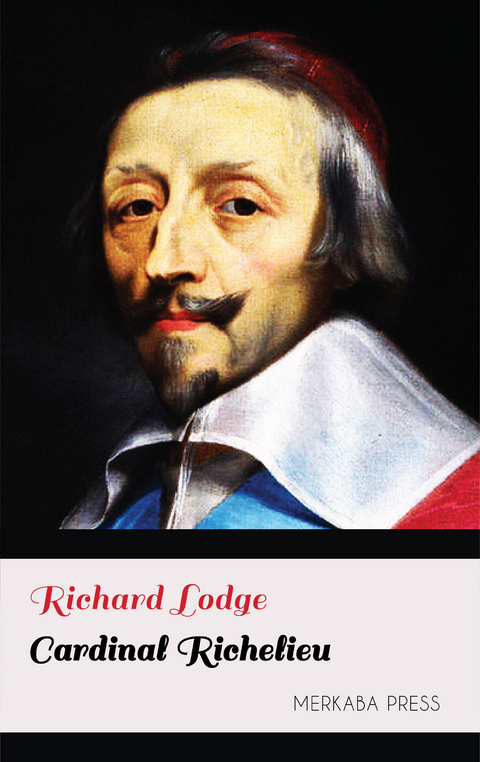
Cardinal Richelieu (eBook)
95 Seiten
Merkaba Press (Verlag)
978-0-00-002034-5 (ISBN)
THE family of du Plessis has no history. For generations it had lived in provincial obscurity on the borders of Poitou. In the fifteenth century François du Plessis, a younger member of the family, inherited the estate of Richelieu from his maternal uncle, Louis de Clérembault. His descendants were the du Plessis de Richelieu, and their chief residence was the castle of that name, situated on the Mable, near the frontier of Poitou and Touraine.
The first member of the family who played any notable part in history was François du Plessis, great-grandson of the inheritor of Richelieu. He rendered valuable services to Henry of Anjou during his brief tenure of the crown of Poland, and retained his favour when he returned to France as Henry III. Raised to the dignity of grand provost of France, François du Plessis became one of the most prominent and loyal servants of the last of the Valois. When his master died under the dagger of Jacques Clément, it was he who arrested the assassin and took down the depositions of the eye-witnesses.
The death of Henry III. left his Catholic followers in a difficult position. The traditions of his family seemed to impel François du Plessis to join the League. But he showed on this occasion a practical foresight worthy of his great son, and at once espoused the cause of Henry of Navarre. He had already gained the confidence of the new king by his bravery at Arques and at Ivry, and had just been appointed captain of the guard, when he was carried off by a fever during the siege of Paris on July 10, 1590...
THE STATES-GENERAL--RICHELIEU'S FIRST MINISTRY 1614-1617
Questions before the States--General--The paulette--Quarrels of clergy and third estate--Richelieuorator of the clergy—Concini and the ministers--Condé and the Huguenots oppose Mary de Medici--Treaty of Loudun--Fall of the old ministers-- Richelieu rises to prominence--Conspiracy of the nobles-- Arrest of Condé and flight of his associates--Richelieu receives office--His difficulties-- Measures against the nobles-- Assassination of Concini--Fall of the ministers--Richelieu at the Louvre--He quits the court.
THE States-General, which met on October 27, 1614, are interesting as the last assembly held before the famous meeting of 1789. In itself, however, it was of very slight importance. The essential weakness of these assemblies lay in the deeply-rooted class divisions which ruined all prospect of constitutional government in France, in the want of any practical check upon the executive, such as is given in England by the control of supply and expenditure, and in the tradition that their only function was to formulate grievances. The great questions raised at this meeting were the paulette and the sale of offices, and the relations of the spiritual and temporal powers. The nobles and clergy agreed to demand the abolition of the paulette. The deputies of the third estate, most of whom belonged to the official class, were by no means eager for a change which would have deprived them of a valuable property. The instructions of their constituents, however, were too distinct for them to refuse their co-operation to the other estates, but they insisted upon complicating the question by demanding at the same time a diminution of the taille and a reduction of the lavish pensions granted by the crown. This last request was a direct attack upon the nobles, and a quarrel was imminent between the two estates, when attention was diverted to a new question.
The third estate demanded the recognition as a fundamental law that the king holds his crown from God alone, and that no power, whether spiritual or temporal, has the right to dispense subjects from their oath of allegiance. This at once raised all the thorny questions about the power of the papacy, which had been discussed with such vehemence in France for the last sixty years. The clergy hastened to resent the introduction of such a subject by a body of laymen, and to point out that the acceptance of the resolution would produce a schism in the Church. The support of the court secured them a complete victory. Mary de Medici had committed herself entirely to an ultramontane policy which was involved in the alliance with Spain. She had, moreover, a personal interest in the matter. An attack upon the supremacy of the pope would cast a slur upon the legitimacy of her own marriage, which rested upon a papal dispensation, and consequently upon the right of her son to wear the crown. The king evoked the matter to his own consideration, and the proposition was ultimately erased from the cahier of the third estate.
Emboldened by this victory, the clergy proceeded to demand the acceptance in France of the decrees of the Council of Trent, reserving the liberties of the Gallican Church. The nobles, irritated by the attitude of the third estate on the subject of royal pensions, hastened to support them. But the obstinacy of the third estate, more royalist than the court, succeeded in preventing the carrying through of a measure which France had persistently avoided for sixty years.
At last the cahiers of the three orders were completed, and were presented to the king in a formal session on February 23, 1615. We have, unfortunately, no record of the part played by Richelieu in the preceding debates, but that it must have been a distinguished one is proved by the fact that he was chosen on this occasion as the orator of his order. His harangue, which lasted more than an hour, is said to have attracted great attention. That it expressed his own personal views is improbable; many of its sentiments are in opposition to the whole tenor of his subsequent career. He seems to have conceived that his duty or his interest compelled him to act as the mere mouthpiece of the dominant majority, and to express opinions which he knew would be favourably received by the court. His whole argument is based upon the premises of ultramontanism. He condemns the practice of lay investiture, the attempt to levy taxes upon the clergy, whose only contributions ought to be their prayers, the interference with clerical jurisdiction, and the non-recognition of the Council of Trent. Only two passages seem to express the personal convictions of the orator-- his vigorous denunciation of the exclusion of ecclesiastics from the control of affairs, and his lavish praises of the government of the regent.
From this time Richelieu was a man of mark; both Mary de Medici and Concini realised the value of the services which he might render to them, and his admission to political employment was assured. Henceforth his residence in Paris becomes more continuous, and his diocese occupies less and less of his attention. For a long time Concini had been kept in the background by the close union among the ministers of the late king, whom the regent had never ventured to dismiss. But this union had lately been weakened by a growing jealousy between Villeroy and the chancellor Sillery; and the chief link between them was broken in November 1613, by the death of Villeroy's granddaughter, who had married Sillery's son, de Puisieux. The discord among the ministers was Concini's opportunity, and he determined to make use of it to get rid first of one section and then of the other. His rise to power was accompanied by that of Richelieu.
In the autumn of 1615 it was decided that the court should travel to the Spanish frontier to complete the double marriage which had been formally agreed to three years before. Condé and the other malcontent princes had given their approval to the marriages, but they now refused to accompany the court, and set to work to raise troops in their respective provinces. Regardless of the danger, Mary de Medici insisted upon continuing her journey to Bayonne. Her eldest daughter was sent to Spain to become the wife of the future Philip IV., and Louis XIII. was formally married to the infanta, Anne of Austria. Meanwhile Condé had collected an army, had evaded the royal troops under marshal Bois-Dauphin, and had crossed the Loire into Poitou. At Parthenay he was met by deputies of the extreme party of the Huguenots, who had already defied the royal authority, and the advice of their more moderate leaders, by transferring their assembly from Grenoble to Nîmes. They now concluded a close alliance with the oligarchical party, which pledged itself to prevent the recognition of the Council of Trent, to oppose the probable results of the Spanish alliance, and to maintain the Edict of Nantes. Thus the monarchy was once more face to face with the forces of disunion.
Neither Concini nor Richelieu had accompanied the court, and Mary de Medici was still surrounded by her old advisers. After some discussion in the council it was decided to adhere to the well-worn policy of negotiation and concession. The office of mediator was undertaken by the duke of Nevers and the English ambassador, and their exertions resulted in the treaty of Loudun, which was concluded in the spring of 1616. The treaty marks a complete momentary victory for the aristocratic party over the alliance between the crown and the clergy, which had signalised the close of the States-General. The king promised to give a favourable consideration to the demands of the third estate, to reject the decrees of the Council of Trent, to maintain the freedom of the Gallican Church, to respect the privileges of the parliaments and other sovereign courts, to uphold the existing alliance of France, many of which were opposed to Spanish interests, and finally to continue to the Huguenots all the concessions which had been granted to them by his predecessors. Secret articles stipulated for concessions to the individual princes, and the peace is said to have cost the king more than six million livres. Condé, who exchanged the government of Guienne for the more central province of Berri, was to be chief of the council, and was to sign all royal edicts.
The treaty of Loudun was followed by the fall of Sillery. As the chancellorship was, like so many other offices, a property for life, it was impossible to deprive him of it. All that could be done was to exile him from the court, and to intrust the seals to a keeper, du Vair, who had acquired a reputation as president of the parliament of Provence. But this first ministerial change was not enough to satisfy Mary de Medici or Concini. Before long Jeannin was deprived of the control of the finances, which was entrusted to Barbin. Villeroy was not absolutely dismissed, but he lost all influence. His colleague in the secretaryship of state, de Puisieux, shared the disgrace of his father, and his office was now given to Mangot, an ally of Barbin. Concini was prudent enough not to attempt to secure office for himself, but the ministers were in the habit of visiting him in his own apartments, and his vanity led him to magnify the extent of his influence over affairs.
The queen-mother had succeeded in freeing herself from the tutelage in which she had hitherto been kept by the veteran ministers of her husband, but her position was by no means secure nor satisfactory. Since the majority of her son she had been far more eager for power than she had been during the regency. One of her most darling schemes, the Spanish marriages, had been successfully...
| Erscheint lt. Verlag | 12.7.2017 |
|---|---|
| Sprache | englisch |
| Themenwelt | Literatur ► Biografien / Erfahrungsberichte |
| ISBN-10 | 0-00-002034-6 / 0000020346 |
| ISBN-13 | 978-0-00-002034-5 / 9780000020345 |
| Informationen gemäß Produktsicherheitsverordnung (GPSR) | |
| Haben Sie eine Frage zum Produkt? |
 EPUB (Adobe DRM)
Größe: 208 KB
Kopierschutz: Adobe-DRM
Adobe-DRM ist ein Kopierschutz, der das eBook vor Mißbrauch schützen soll. Dabei wird das eBook bereits beim Download auf Ihre persönliche Adobe-ID autorisiert. Lesen können Sie das eBook dann nur auf den Geräten, welche ebenfalls auf Ihre Adobe-ID registriert sind.
Details zum Adobe-DRM
Dateiformat: EPUB (Electronic Publication)
EPUB ist ein offener Standard für eBooks und eignet sich besonders zur Darstellung von Belletristik und Sachbüchern. Der Fließtext wird dynamisch an die Display- und Schriftgröße angepasst. Auch für mobile Lesegeräte ist EPUB daher gut geeignet.
Systemvoraussetzungen:
PC/Mac: Mit einem PC oder Mac können Sie dieses eBook lesen. Sie benötigen eine
eReader: Dieses eBook kann mit (fast) allen eBook-Readern gelesen werden. Mit dem amazon-Kindle ist es aber nicht kompatibel.
Smartphone/Tablet: Egal ob Apple oder Android, dieses eBook können Sie lesen. Sie benötigen eine
Geräteliste und zusätzliche Hinweise
Buying eBooks from abroad
For tax law reasons we can sell eBooks just within Germany and Switzerland. Regrettably we cannot fulfill eBook-orders from other countries.
aus dem Bereich


