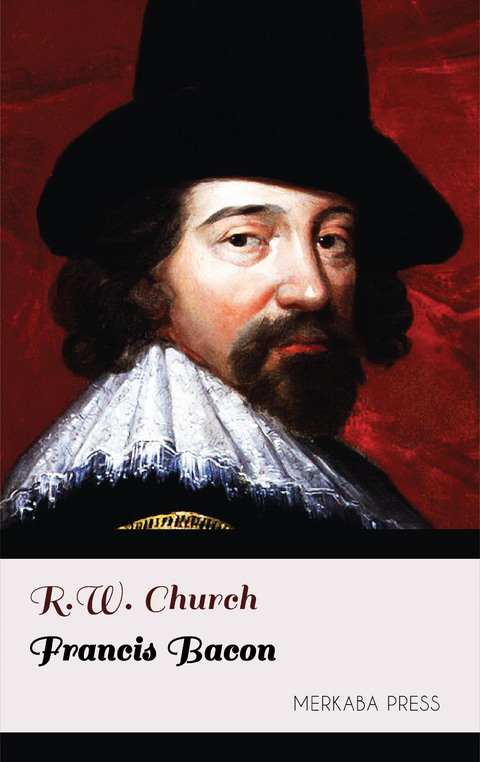
Francis Bacon (eBook)
76 Seiten
Merkaba Press (Verlag)
978-0-00-001935-6 (ISBN)
The life of Francis Bacon is one which it is a pain to write or to read. It is the life of a man endowed with as rare a combination of noble gifts as ever was bestowed on a human intellect; the life of one with whom the whole purpose of living and of every day's work was to do great things to enlighten and elevate his race, to enrich it with new powers, to lay up in store for all ages to come a source of blessings which should never fail or dry up; it was the life of a man who had high thoughts of the ends and methods of law and government, and with whom the general and public good was regarded as the standard by which the use of public power was to be measured; the life of a man who had struggled hard and successfully for the material prosperity and opulence which makes work easy and gives a man room and force for carrying out his purposes. All his life long his first and never-sleeping passion was the romantic and splendid ambition after knowledge, for the conquest of nature and for the service of man; gathering up in himself the spirit and longings and efforts of all discoverers and inventors of the arts, as they are symbolised in the mythical Prometheus. He rose to the highest place and honour; and yet that place and honour were but the fringe and adornment of all that made him great. It is difficult to imagine a grander and more magnificent career; and his name ranks among the few chosen examples of human achievement. And yet it was not only an unhappy life; it was a poor life. We expect that such an overwhelming weight of glory should be borne up by a character corresponding to it in strength and nobleness. But that is not what we find. No one ever had a greater idea of what he was made for, or was fired with a greater desire to devote himself to it. He was all this. And yet being all this, seeing deep into man's worth, his capacities, his greatness, his weakness, his sins, he was not true to what he knew. He cringed to such a man as Buckingham. He sold himself to the corrupt and ignominious Government of James I. He was willing to be employed to hunt to death a friend like Essex, guilty, deeply guilty, to the State, but to Bacon the most loving and generous of benefactors. With his eyes open he gave himself up without resistance to a system unworthy of him; he would not see what was evil in it, and chose to call its evil good; and he was its first and most signal victim.
BACON AND ELIZABETH.
The last decade of the century, and almost of Elizabeth's reign (1590-1600), was an eventful one to Bacon's fortunes. In it the vision of his great design disclosed itself more and more to his imagination and hopes, and with more and more irresistible fascination. In it he made his first literary venture, the first edition of his Essays (1597), ten in number, the first-fruits of his early and ever watchful observation of men and affairs. These years, too, saw his first steps in public life, the first efforts to bring him into importance, the first great trials and tests of his character. They saw the beginning and they saw the end of his relations with the only friend who, at that time, recognised his genius and his purposes, certainly the only friend who ever pushed his claims; they saw the growth of a friendship which was to have so tragical a close, and they saw the beginnings and causes of a bitter personal rivalry which was to last through life, and which was to be a potent element hereafter in Bacon's ruin. The friend was the Earl of Essex. The competitor was the ablest, and also the most truculent and unscrupulous of English lawyers, Edward Coke.
While Bacon, in the shade, had been laying the foundations of his philosophy of nature, and vainly suing for legal or political employment, another man had been steadily rising in the Queen's favour and carrying all before him at Court—Robert Devereux, Lord Essex; and with Essex Bacon had formed an acquaintance which had ripened into an intimate and affectionate friendship. We commonly think of Essex as a vain and insolent favourite, who did ill the greatest work given him to do—the reduction of Ireland; who did it ill from some unexplained reason of spite and mischief; and who, when called to account for it, broke out into senseless and idle rebellion. This was the end. But he was not always thus. He began life with great gifts and noble ends; he was a serious, modest, and large-minded student both of books and things, and he turned his studies to full account. He had imagination and love of enterprise, which gave him an insight into Bacon's ideas such as none of Bacon's contemporaries had. He was a man of simple and earnest religion; he sympathized most with the Puritans, because they were serious and because they were hardly used. Those who most condemn him acknowledge his nobleness and generosity of nature. Bacon in after days, when all was over between them, spoke of him as a man always patientissimus veri; "the more plainly and frankly you shall deal with my lord," he writes elsewhere, "not only in disclosing particulars, but in giving him caveats and admonishing him of any error which in this action he may commit (such is his lordship's nature), the better he will take it." "He must have seemed," says Mr. Spedding, a little too grandly, "in the eyes of Bacon like the hope of the world." The two men, certainly, became warmly attached. Their friendship came to be one of the closest kind, full of mutual services, and of genuine affection on both sides. It was not the relation of a great patron and useful dependant; it was, what might be expected in the two men, that of affectionate equality. Each man was equally capable of seeing what the other was, and saw it. What Essex's feelings were towards Bacon the results showed. Bacon, in after years, repeatedly claimed to have devoted his whole time and labour to Essex's service. Holding him, he says, to be "the fittest instrument to do good to the State, I applied myself to him in a manner which I think rarely happeneth among men; neglecting the Queen's service, mine own fortune, and, in a sort, my vocation, I did nothing but advise and ruminate with myself ... anything that might concern his lordship's honour, fortune, or service." The claim is far too wide. The "Queen's service" had hardly as yet come much in Bacon's way, and he never neglected it when it did come, nor his own fortune or vocation; his letters remain to attest his care in these respects. But no doubt Bacon was then as ready to be of use to Essex, the one man who seemed to understand and value him, as Essex was desirous to be of use to Bacon.
And it seemed as if Essex would have the ability as well as the wish. Essex was, without exception, the most brilliant man who ever appeared at Elizabeth's Court, and it seemed as if he were going to be the most powerful. Leicester was dead. Burghley was growing old, and indisposed for the adventures and levity which, with all her grand power of ruling, Elizabeth loved. She needed a favourite, and Essex was unfortunately marked out for what she wanted. He had Leicester's fascination, without his mean and cruel selfishness. He was as generous, as gallant, as quick to descry all great things in art and life, as Philip Sidney, with more vigour and fitness for active life than Sidney. He had not Raleigh's sad, dark depths of thought, but he had a daring courage equal to Raleigh's, without Raleigh's cynical contempt for mercy and honour. He had every personal advantage requisite for a time when intellect, and ready wit, and high-tempered valour, and personal beauty, and skill in affairs, with equal skill in amusements, were expected to go together in the accomplished courtier. And Essex was a man not merely to be courted and admired, to shine and dazzle, but to be loved. Elizabeth, with her strange and perverse emotional constitution, loved him, if she ever loved any one. Every one who served him loved him; and he was, as much as any one could be in those days, a popular favourite. Under better fortune he might have risen to a great height of character; in Elizabeth's Court he was fated to be ruined.
For in that Court all the qualities in him which needed control received daily stimulus, and his ardour and high-aiming temper turned into impatience and restless irritability. He had a mistress who was at one time in the humour to be treated as a tender woman, at another as an outrageous flirt, at another as the haughtiest and most imperious of queens; her mood varied, no one could tell how, and it was most dangerous to mistake it. It was part of her pleasure to find in her favourite a spirit as high, a humour as contradictory and determined, as her own; it was the charming contrast to the obsequiousness or the prudence of the rest; but no one could be sure at what unlooked-for moment, and how fiercely, she might resent in earnest a display of what she had herself encouraged. Essex was ruined for all real greatness by having to suit himself to this bewildering and most unwholesome and degrading waywardness. She taught him to think himself irresistible in opinion and in claims; she amused herself in teaching him how completely he was mistaken. Alternately spoiled and crossed, he learned to be exacting, unreasonable, absurd in his pettish resentments or broodingsullenness. He learned to think that she must be dealt with by the same methods which she herself employed. The effect was not produced in a moment; it was the result of a courtiership of sixteen years. But it ended in corrupting a noble nature. Essex came to believe that she who cowed others must be frightened herself; that the stinging injustice which led a proud man to expect, only to see how he would behave when refused, deserved to be brought to reason by a counter-buffet as rough as her own insolent caprice. He drifted into discontent, into disaffection, into neglect of duty, into questionable schemings for the future of a reign that must shortly end, into criminal methods of guarding himself, of humbling his rivals and regaining influence. A "fatal impatience," as Bacon calls it, gave his rivals an advantage which, perhaps in self-defence, they could not fail to take; and that career, so brilliant, so full of promise of good, ended in misery, in dishonour, in remorse, on the scaffold of the Tower.
With this attractive and powerful person Bacon's fortunes, in the last years of the century, became more and more knit up. Bacon was now past thirty, Essex a few years younger. In spite of Bacon's apparent advantage and interest at Court, in spite of abilities, which, though his genius was not yet known, his contemporaries clearly recognised, he was still a struggling and unsuccessful man: ambitious to rise, for no unworthy reasons, but needy, in weak health, with careless and expensive habits, and embarrassed with debt. He had hoped to rise by the favour of the Queen and for the sake of his father. For some ill-explained reason he was to the last disappointed. Though she used him "for matters of state and revenue," she either did not like him, or did not see in him the servant she wanted to advance. He went on to the last pressing his uncle, Lord Burghley. He applied in the humblest terms, he made himself useful with his pen, he got his mother to write for him; but Lord Burghley, probably because he thought his nephew more of a man of letters than a sound lawyer and practical public servant, did not care to bring him forward. From his cousin, Robert Cecil, Bacon received polite words and friendly assurances. Cecil may have undervalued him, or have been jealous of him, or suspected him as a friend of Essex; he certainly gave Bacon good reason to think that his words meant nothing. Except Essex, and perhaps his brother Antony—the most affectionate and devoted of brothers—no one had yet recognised all that Bacon was. Meanwhile time was passing. The vastness, the difficulties, the attractions of that conquest of all knowledge which he dreamed of, were becoming greater every day to his thoughts. The law, without which he could not live, took up time and brought in little. Attendance on the Court was expensive, yet indispensable, if he wished for place. His...
| Erscheint lt. Verlag | 10.7.2017 |
|---|---|
| Sprache | englisch |
| Themenwelt | Literatur ► Biografien / Erfahrungsberichte |
| ISBN-10 | 0-00-001935-6 / 0000019356 |
| ISBN-13 | 978-0-00-001935-6 / 9780000019356 |
| Informationen gemäß Produktsicherheitsverordnung (GPSR) | |
| Haben Sie eine Frage zum Produkt? |
 EPUB (Adobe DRM)
Größe: 230 KB
Kopierschutz: Adobe-DRM
Adobe-DRM ist ein Kopierschutz, der das eBook vor Mißbrauch schützen soll. Dabei wird das eBook bereits beim Download auf Ihre persönliche Adobe-ID autorisiert. Lesen können Sie das eBook dann nur auf den Geräten, welche ebenfalls auf Ihre Adobe-ID registriert sind.
Details zum Adobe-DRM
Dateiformat: EPUB (Electronic Publication)
EPUB ist ein offener Standard für eBooks und eignet sich besonders zur Darstellung von Belletristik und Sachbüchern. Der Fließtext wird dynamisch an die Display- und Schriftgröße angepasst. Auch für mobile Lesegeräte ist EPUB daher gut geeignet.
Systemvoraussetzungen:
PC/Mac: Mit einem PC oder Mac können Sie dieses eBook lesen. Sie benötigen eine
eReader: Dieses eBook kann mit (fast) allen eBook-Readern gelesen werden. Mit dem amazon-Kindle ist es aber nicht kompatibel.
Smartphone/Tablet: Egal ob Apple oder Android, dieses eBook können Sie lesen. Sie benötigen eine
Geräteliste und zusätzliche Hinweise
Buying eBooks from abroad
For tax law reasons we can sell eBooks just within Germany and Switzerland. Regrettably we cannot fulfill eBook-orders from other countries.
aus dem Bereich