


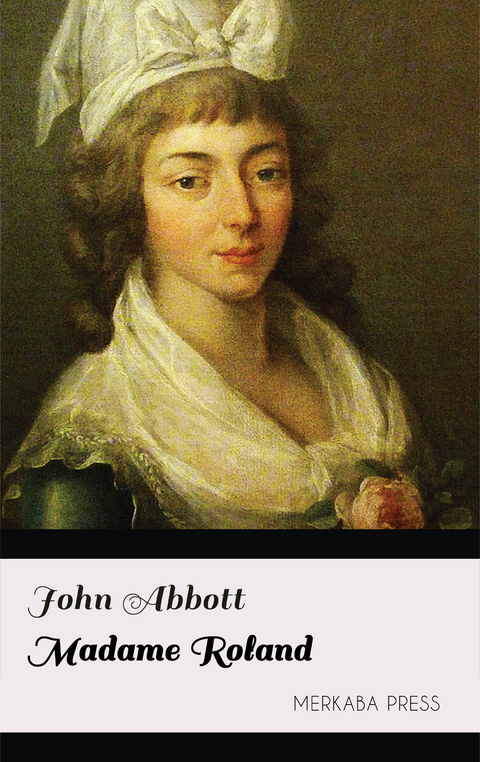
Madame Roland (eBook)
86 Seiten
Merkaba Press (Verlag)
978-0-00-001911-0 (ISBN)
Many characters of unusual grandeur were developed by the French Revolution. Among them all, there are few more illustrious, or more worthy of notice, than that of Madame Roland. The eventful story of her life contains much to inspire the mind with admiration and with enthusiasm, and to stimulate one to live worthily of those capabilities with which every human heart is endowed. No person can read the record of her lofty spirit and of her heroic acts without a higher appreciation of woman's power, and of the mighty influence one may wield, who combines the charms of a noble and highly-cultivated mind with the fascinations of female delicacy and loveliness. To understand the secret of the almost miraculous influence she exerted, it is necessary to trace her career, with some degree of minuteness, from the cradle to the hour of her sublime and heroic death.
Chapter II.
Youth.
The influence of those intense emotions which were excited in the bosom of Jane by the scenes which she witnessed in her childhood in the nunnery were never effaced from her imaginative mind. Nothing can be conceived more strongly calculated to impress the feelings of a romantic girl, than the poetic attractions which are thrown around the Roman Catholic religion by nuns, and cloisters, and dimly-lighted chapels, and faintly-burning tapers, and matins, and vespers, and midnight dirges. Jane had just the spirit to be most deeply captivated by such enchantments. She reveled in those imaginings which clustered in the dim shades of the cloister, in an ecstasy of luxurious enjoyment. The ordinary motives which influence young girls of her age seem to have had no control over her. Her joys were most highly intellectual and spiritual, and her aspirations were far above the usual conceptions of childhood. She, for a time, became entirely fascinated by the novel scenes around her, and surrendered her whole soul to the dominion of the associations with which she was engrossed. In subsequent years, by the energies of a vigorous philosophy, she disenfranchised her intellect from these illusions, and, proceeding to another extreme, wandered in the midst of the cheerless mazes of unbelief; but her fancy retained the traces of these early impressions until the hour of her death. Christianity, even when most heavily encumbered with earthly corruption, is infinitely preferable to no religion at all. Even papacy has never swayed so bloody a scepter as infidelity.
Jane remained in the convent one year, and then, with deep regret, left the nuns, to whom she had become extremely attached. With one of the sisters, who was allied to the nobility, she formed a strong friendship, which continued through life. For many years she kept up a constant correspondence with this friend, and to this correspondence she attributes, in a great degree, that facility in writing which contributed so much to her subsequent celebrity. This letter-writing is one of the best schools of composition, and the parent who is emulous of the improvement of his children in that respect, will do all in his power to encourage the constant use of the pen in these familiar epistles. Thus the most important study, the study of the power of expression, is converted into a pleasure, and is pursued with an avidity which will infallibly secure success. It is a sad mistake to frown upon such efforts as a waste of time.
While in the convent, she, for the first time, partook of the sacrament of the Lord's Supper. Her spirit was most deeply impressed and overawed by the sacredness of the ceremony. During several weeks previous to her reception of this solemn ordinance, by solitude, self-examination, and prayer, she endeavored to prepare herself for that sacred engagement, which she deemed the pledge of her union to God, and of her eternal felicity. When the hour arrived, her feelings were so intensely excited that she wept convulsively, and she was entirely incapable of walking to the altar. She was borne in the arms of two of the nuns. This depth of emotion was entirely unaffected, and secured for her the peculiar reverence of the sacred sisters.
That spirit of pensive reverie, so dangerous and yet so fascinating, to which she loved to surrender herself, was peculiarly in harmony with all the influences with which she was surrounded in the convent, and constituted the very soul of the piety of its inmates. She was encouraged by the commendations of all the sisters to deliver her mind up to the dominion of these day-dreams, with whose intoxicating power every heart is more or less familiar. She loved to retire to the solitude of the cloisters, when the twilight was deepening into darkness, and alone, with measured steps, to pace to and fro, listening to the monotonous echoes of her own footfall, which alone disturbed the solemn silence. At the tomb of a departed sister she would often linger, and, indulging in those melancholy meditations which had for her so many charms, long for her own departure to the bosom of her heavenly Father, where she might enjoy that perfect happiness for which, at times, her spirit glowed with such intense aspirations.
At the close of the year Jane left the peaceful retreat where she had enjoyed so much, and where she had received so many impressions never to be effaced. Her parents, engrossed with care, were unable to pay that attention to their child which her expanding mind required, and she was sent to pass her thirteenth year with her paternal grandmother and her aunt Angelieu. Her grandmother was a dignified lady of much refinement of mind and gracefulness of demeanor, who laid great stress upon all the courtesies of life and the elegances of manners and address. Her aunt was gentle and warm-hearted, and her spirit was deeply imbued with that humble and docile piety, which has so often shone out with pure luster even through all the encumbrances of the Roman Catholic Church. With them she spent a year, in a seclusion from the world almost as entire as that which she found in the solitude of the convent. An occasional visit to her parents, and to her old friends the nuns, was all that interrupted the quiet routine of daily duties. Books continued still her employment and her delight. Her habits of reverie continued unbroken. Her lofty dreams gained a daily increasing ascendency over her character.
She thus continued to dwell in the boundless regions of the intellect and the affections. Even the most commonplace duties of life were rendered attractive to her by investing them with a mysterious connection with her own limitless being. Absorbed in her own thoughts, ever communing with herself, with nature, with the Deity, as the object of her highest sentiment and aspirations, though she did not despise those of a more humble mental organization, she gave them not a thought. The evening twilight of every fine day still found her at her chamber window, admiring the glories of the setting sun, and feeding her impassioned spirit with those visions of future splendor and happiness which the scene appeared to reveal. She fancied she could almost see the wings of angels gleaming in the purple sunlight. Through those gorgeous avenues, where clouds were piled on golden clouds, she imagined, far away, the mansions of the blessed. These emotions glowing within her, gave themselves utterance in prayers earnest and ardent, while the tears of irrepressible feeling filled her eyes as she thought of that exalted Being, so worthy of her pure and intensest homage.
The father of Jane was delighted with all these indications of a marked and elevated character, and did all in his power to stimulate her to greater zeal in her lofty studies and meditations. Jane became his idol, and the more her imaginative mind became imbued with the spirit of romantic aspirations, the better was he pleased. The ardor of her zeal enabled her to succeed in every thing which she undertook. Invincible industry and energy were united with these dreams. She was ambitious of knowing every thing; and when her father placed in her hands the burin, wishing to teach her to engrave, she immediately acquired such skill as to astonish both of her parents. And she afterward passed many pleasant hours in engraving, on highly-polished plates of brass, beautiful emblems of flowers as tokens of affection for her friends.
The mother of Jane, with far better judgment, endeavored to call back her daughter from that unreal world in which she loved to dwell, and to interest her in the practical duties of life. She began to be impatient for her return home, that she might introduce her to those household employments, the knowledge of which is of such unspeakable importance to every lady. In this she was far from being unsuccessful; for while Jane continued to dream in accordance with the encouragement of her father, she also cordially recognized the good sense of her mother's counsels, and held herself ever in readiness to co-operate with her in all her plans.
A little incident which took place at this time strikingly illustrates the reflective maturity which her character had already acquired. Before the French Revolution, the haughty demeanor of the nobility of France assumed such an aspect as an American, at the present day, can but feebly conceive. One morning, the grandmother of Jane, a woman of dignity and cultivated mind, took her to the house of Madame De Boismorel, a lady of noble rank, whose children she had partly educated. It was a great event, and Jane was dressed with the utmost care to visit the aristocratic mansion. The aspiring girl, with no disposition to come down to the level of those beneath her, and with still less willingness to do homage to those above her, was entirely unconscious of the mortifying condescension with which she was to be received. The porter at the door saluted Madame Phlippon with politeness, and all the servants whom she met in the hall addressed her with civility. She replied to each with courtesy and with dignity. The grandmother was proud of her grand-daughter, and the servants paid the young lady many compliments. The instinctive pride of Jane took instant alarm. She felt that servants had no right to presume to pay her compliments—that they were thus assuming that she was upon their level. Alas! for poor human nature. All love to ascend. Few are willing to favor equality by stepping down. A tall footman announced them at the door of the magnificent saloon. All the furnishing and arrangements of this aristocratic apartment were calculated to dazzle the eye and bewilder the mind of one...
| Erscheint lt. Verlag | 10.7.2017 |
|---|---|
| Sprache | englisch |
| Themenwelt | Literatur ► Biografien / Erfahrungsberichte |
| ISBN-10 | 0-00-001911-9 / 0000019119 |
| ISBN-13 | 978-0-00-001911-0 / 9780000019110 |
| Informationen gemäß Produktsicherheitsverordnung (GPSR) | |
| Haben Sie eine Frage zum Produkt? |
 EPUB (Adobe DRM)
Größe: 228 KB
Kopierschutz: Adobe-DRM
Adobe-DRM ist ein Kopierschutz, der das eBook vor Mißbrauch schützen soll. Dabei wird das eBook bereits beim Download auf Ihre persönliche Adobe-ID autorisiert. Lesen können Sie das eBook dann nur auf den Geräten, welche ebenfalls auf Ihre Adobe-ID registriert sind.
Details zum Adobe-DRM
Dateiformat: EPUB (Electronic Publication)
EPUB ist ein offener Standard für eBooks und eignet sich besonders zur Darstellung von Belletristik und Sachbüchern. Der Fließtext wird dynamisch an die Display- und Schriftgröße angepasst. Auch für mobile Lesegeräte ist EPUB daher gut geeignet.
Systemvoraussetzungen:
PC/Mac: Mit einem PC oder Mac können Sie dieses eBook lesen. Sie benötigen eine
eReader: Dieses eBook kann mit (fast) allen eBook-Readern gelesen werden. Mit dem amazon-Kindle ist es aber nicht kompatibel.
Smartphone/Tablet: Egal ob Apple oder Android, dieses eBook können Sie lesen. Sie benötigen eine
Geräteliste und zusätzliche Hinweise
Buying eBooks from abroad
For tax law reasons we can sell eBooks just within Germany and Switzerland. Regrettably we cannot fulfill eBook-orders from other countries.
aus dem Bereich


