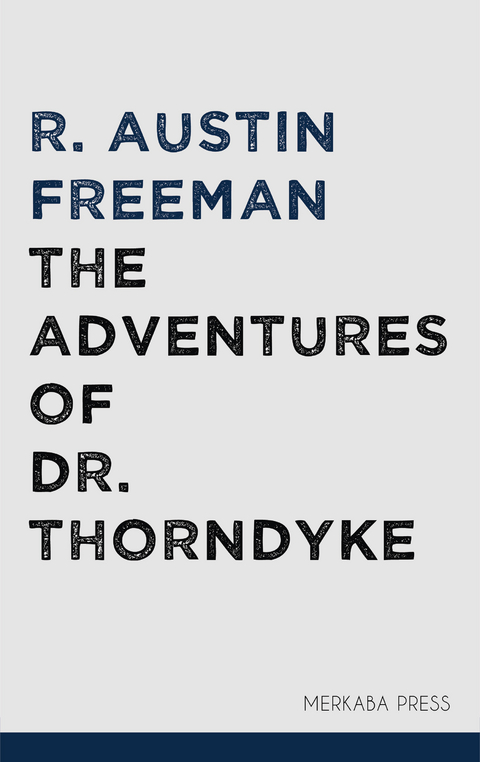
The Adventures of Dr. Thorndyke (eBook)
129 Seiten
Merkaba Press (Verlag)
978-0-00-001872-4 (ISBN)
A German folk story tells of a peasant who fashioned a flute from the bone of a murdered man but when he tried to play it, it burst into a song identifying the murderer. In this collection of seven cases, that eminent lecturer on medical jurisprudence, Dr. John Thorndyke, makes bones, and blood, fingerprints, and tobacco sing out to proclaim the guilt or innocence of those involved. Using techniques as rigorous as they are scientific, Dr. Thorndyke, the original forensic detective, proves the scourge of the criminals of Edwardian England in...the Singing Bone...
II. — A CASE OF PREMEDITATION
PART I. — THE ELIMINATION OF MR. PRATT
THE wine merchant who should supply a consignment of petit vin to a customer who had ordered, and paid for, a vintage wine, would render himself subject to unambiguous comment. Nay! more; he would be liable to certain legal penalties. And yet his conduct would be morally indistinguishable from that of the railway company which, having accepted a first-class fare, inflicts upon the passenger that kind of company which he has paid to avoid. But the corporate conscience, as Herbert Spencer was wont to explain, is an altogether inferior product to that of the individual.
Such were the reflections of Mr. Rufus Pembury when, as the train was about to move out of Maidstone (West) station, a coarse and burly man (clearly a denizen of the third-class) was ushered into his compartment by the guard. He had paid the higher fare, not for cushioned seats, but for seclusion or, at least, select companionship. The man's entry had deprived him of both, and he resented it.
But if the presence of this stranger involved a breach of contract, his conduct was a positive affront—an indignity; for, no sooner had the train started than he fixed upon Mr. Pembury a gaze of impertinent intensity, and continued thereafter to regard him with a stare as steady and unwinking as that of a Polynesian idol.
It was offensive to a degree, and highly disconcerting withal. Mr. Pembury fidgeted in his seat with increasing discomfort and rising temper. He looked into his pocket-book, read one or two letters and sorted a collection of visiting-cards. He even thought of opening his umbrella. Finally, his patience exhausted and his wrath mounting to boiling-point, he turned to the stranger with frosty remonstrance.
"I imagine, sir, that you will have no difficulty in recognizing me, should we ever meet again—which God forbid."
"I should recognize you among ten thousand," was the reply, so unexpected as to leave Mr. Pembury speechless.
"You see," the stranger continued impressively, "I've got the gift of faces. I never forget."
"That must be a great consolation," said Pembury.
"It's very useful to me," said the stranger, "at least, it used to be, when I was a warder at Portland—you remember me, I dare say: my name is Pratt. I was assistant-warder in your time. God-forsaken hole, Portland, and mighty glad I was when they used to send me up to town on reckernizing duty. Holloway was the house of detention then, you remember; that was before they moved to Brixton."
Pratt paused in his reminiscences, and Pembury, pale and gasping with astonishment, pulled himself together.
"I think," said he, "you must be mistaking me for someone else."
"I don't," replied Pratt. "You're Francis Dobbs, that's who you are. Slipped away from Portland one evening about twelve years ago. Clothes washed up on the Bill next day. No trace of fugitive. As neat a mizzle as ever I heard of. But there are a couple of photographs and a set of fingerprints at the Habitual Criminals Register. P'r'aps you'd like to come and see 'em?"
"Why should I go to the Habitual Criminals Register?" Pembury demanded faintly.
"Ah! Exactly. Why should you? When you are a man of means, and a little judiciously invested capital would render it unnecessary?"
Pembury looked out of the window, and for a minute or more preserved a stony silence. At length he turned suddenly to Pratt. "How much?" he asked.
"I shouldn't think a couple of hundred a year would hurt you," was the calm reply.
Pembury reflected awhile. "What makes you think I am a man of means?" he asked presently.
Pratt smiled grimly. "Bless you, Mr. Pembury," said he, "I know all about you. Why, for the last six months I have been living within half-a-mile of your house."
"The devil you have!"
"Yes. When I retired from the service, General O'Gorman engaged me as a sort of steward or caretaker of his little place at Baysford—he's very seldom there himself—and the very day after I came down, I met you and spotted you, but, naturally, I kept out of sight myself. Thought I'd find out whether you were good for anything before I spoke, so I've been keeping my ears open and I find you are good for a couple of hundred."
There was an interval of silence, and then the ex-warder resumed—"That's what comes of having a memory for faces. Now there's Jack Ellis, on the other hand; he must have had you under his nose for a couple of years, and yet he's never twigged—he never will either," added Pratt, already regretting the confidence into which his vanity had led him.
"Who is Jack Ellis?" Pembury demanded sharply.
"Why, he's a sort of supernumerary at the Baysford Police Station; does odd jobs; rural detective, helps in the office and that sort of thing. He was in the Civil Guard at Portland, in your time, but he got his left forefinger chopped off, so they pensioned him, and, as he was a Baysford man, he got this billet. But he'll never reckernize you, don't you fear."
"Unless you direct his attention to me," suggested Pembury.
"There's no fear of that," laughed Pratt. "You can trust me to sit quiet on my own nest-egg. Besides, we're not very friendly. He came nosing round our place after the parlourmaid—him a married man, mark you! But I soon boosted him out, I can tell you; and Jack Ellis don't like me now."
"I see," said Pembury reflectively; then, after a pause, he asked: "Who is this General O'Gorman? I seem to know the name."
"I expect you do," said Pratt. "He was governor of Dartmoor when I was there—that was my last billet—and, let me tell you, if he'd been at Portland in your time, you'd never have got away."
"How is that?"
"Why, you see, the general is a great man on bloodhounds. He kept a pack at Dartmoor and, you bet, those lags knew it. There were no attempted escapes in those days. They wouldn't have had a chance."
"He has the pack still, hasn't he?" asked Pembury.
"Rather. Spends any amount of time on training 'em, too. He's always hoping there'll be a burglary or a murder in the neighbourhood so as he can try 'em, but he's never got a chance yet. P'r'aps the crooks have heard about 'em. But, to come back to our little arrangement: what do you say to a couple of hundred, paid quarterly, if you like?"
"I can't settle the matter off-hand," said Pembury. "You must give me time to think it over."
"Very well," said Pratt. "I shall be back at Baysford to-morrow evening. That will give you a clear day to think it over. Shall I look in at your place to-morrow night?"
"No," replied Pembury; "you'd better not be seen at my house, nor I at yours. If I meet you at some quiet spot, where we shan't be seen, we can settle our business without any one knowing that we have met. It won't take long, and we can't be too careful."
"That's true," agreed Pratt. "Well, I'll tell you what. There's an avenue leading up to our house; you know it, I expect. There's no lodge, and the gates are always ajar, excepting at night. Now I shall be down by the six-thirty at Baysford. Our place is a quarter of an hour from the station. Say you meet me in the avenue at a quarter to seven."
"That will suit me," said Pembury; "that is, if you are sure the bloodhounds won't be straying about the grounds."
"Lord bless you, no!" laughed Pratt. "D'you suppose the general lets his precious hounds stray about for any casual crook to feed with poisoned sausage? No, they're locked up safe in the kennels at the back of the house. Hallo! This'll be Swanley, I expect. I'll change into a smoker here and leave you time to turn the matter over in your mind. So long. To-morrow evening in the avenue at a quarter to seven. And, I say, Mr. Pembury, you might as well bring the first installment with you—fifty, in small notes or gold."
"Very well," said Mr. Pembury. He spoke coldly enough, but there was a flush on his cheeks and an angry light in his eyes, which, perhaps, the ex-warder noticed; for when he had stepped out and shut the door, he thrust his head in at the window and said threateningly—
"One more word, Mr. Pembury-Dobbs: no hanky-panky, you know. I'm an old hand and pretty fly, I am. So don't you try any chickery-pokery on me. That's all." He withdrew his head and disappeared, leaving Pembury to his reflections.
The nature of those reflections—if some telepathist transferring his attention for the moment from hidden courtyards or missing thimbles to more practical matters—could have conveyed them into the mind of Mr. Pratt, would have caused that quondam official some surprise and, perhaps, a little disquiet. For long experience of the criminal, as he appears when in durance, had produced some rather misleading ideas as to his behaviour when at large. In fact, the ex-warder had considerably under-estimated the ex-convict.
Rufus Pembury, to give his real name—for Dobbs was literally a nom de guerre—was a man of strong character and intelligence. So much so that, having tried the criminal career and found it not worth pursuing, he had definitely abandoned it. When the cattle-boat that picked him up off Portland Bill had landed him at an American port, he brought his entire ability and energy to bear on legitimate commercial pursuits, and with such success that, at the end of ten years, he was able to return to England with a moderate competence. Then he had taken a modest house near the little town of Baysford, where he had lived quietly on his savings for the last two years, holding aloof without much difficulty from the rather exclusive local society; and here he might have lived out the rest of his life in peace but for the unlucky chance that...
| Erscheint lt. Verlag | 6.7.2017 |
|---|---|
| Sprache | englisch |
| Themenwelt | Literatur ► Romane / Erzählungen |
| ISBN-10 | 0-00-001872-4 / 0000018724 |
| ISBN-13 | 978-0-00-001872-4 / 9780000018724 |
| Informationen gemäß Produktsicherheitsverordnung (GPSR) | |
| Haben Sie eine Frage zum Produkt? |
 EPUB (Adobe DRM)
Größe: 208 KB
Kopierschutz: Adobe-DRM
Adobe-DRM ist ein Kopierschutz, der das eBook vor Mißbrauch schützen soll. Dabei wird das eBook bereits beim Download auf Ihre persönliche Adobe-ID autorisiert. Lesen können Sie das eBook dann nur auf den Geräten, welche ebenfalls auf Ihre Adobe-ID registriert sind.
Details zum Adobe-DRM
Dateiformat: EPUB (Electronic Publication)
EPUB ist ein offener Standard für eBooks und eignet sich besonders zur Darstellung von Belletristik und Sachbüchern. Der Fließtext wird dynamisch an die Display- und Schriftgröße angepasst. Auch für mobile Lesegeräte ist EPUB daher gut geeignet.
Systemvoraussetzungen:
PC/Mac: Mit einem PC oder Mac können Sie dieses eBook lesen. Sie benötigen eine
eReader: Dieses eBook kann mit (fast) allen eBook-Readern gelesen werden. Mit dem amazon-Kindle ist es aber nicht kompatibel.
Smartphone/Tablet: Egal ob Apple oder Android, dieses eBook können Sie lesen. Sie benötigen eine
Geräteliste und zusätzliche Hinweise
Buying eBooks from abroad
For tax law reasons we can sell eBooks just within Germany and Switzerland. Regrettably we cannot fulfill eBook-orders from other countries.
aus dem Bereich