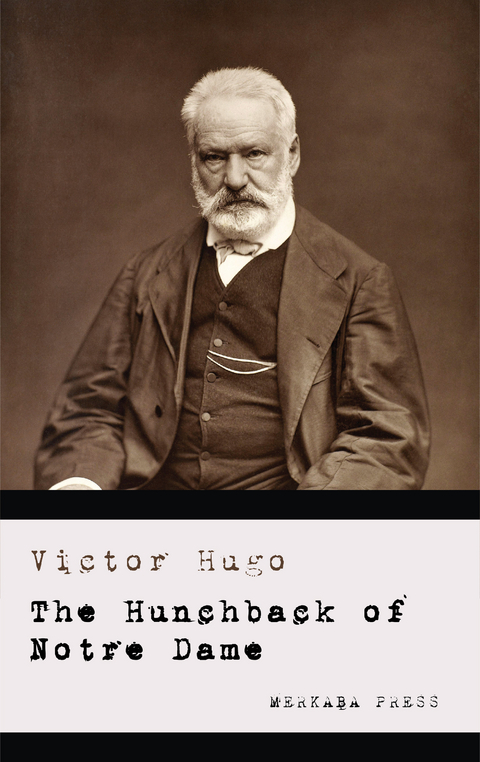
The Hunchback of Notre Dame (eBook)
421 Seiten
Merkaba Press (Verlag)
978-0-00-001881-6 (ISBN)
A few years ago, while visiting or, rather, rummaging about Notre-Dame, the author of this book found, in an obscure nook of one of the towers, the following word, engraved by hand upon the wall:-
ANANKE.
These Greek capitals, black with age, and quite deeply graven in the stone, with I know not what signs peculiar to Gothic caligraphy imprinted upon their forms and upon their attitudes, as though with the purpose of revealing that it had been a hand of the Middle Ages which had inscribed them there, and especially the fatal and melancholy meaning contained in them, struck the author deeply.
He questioned himself; he sought to divine who could have been that soul in torment which had not been willing to quit this world without leaving this stigma of crime or unhappiness upon the brow of the ancient church.
Afterwards, the wall was whitewashed or scraped down, I know not which, and the inscription disappeared. For it is thus that people have been in the habit of proceeding with the marvellous churches of the Middle Ages for the last two hundred years. Mutilations come to them from every quarter, from within as well as from without. The priest whitewashes them, the archdeacon scrapes them down; then the populace arrives and demolishes them.
Thus, with the exception of the fragile memory which the author of this book here consecrates to it, there remains to-day nothing whatever of the mysterious word engraved within the gloomy tower of Notre-Dame,-nothing of the destiny which it so sadly summed up. The man who wrote that word upon the wall disappeared from the midst of the generations of man many centuries ago; the word, in its turn, has been effaced from the wall of the church; the church will, perhaps, itself soon disappear from the face of the earth.
It is upon this word that this book is founded.
March, 1831.
CHAPTER II. PIERRE GRINGOIRE.
Nevertheless, as be harangued them, the satisfaction and admiration unanimously excited by his costume were dissipated by his words; and when he reached that untoward conclusion: “As soon as his illustrious eminence, the cardinal, arrives, we will begin,” his voice was drowned in a thunder of hooting.
“Begin instantly! The mystery! the mystery immediately!” shrieked the people. And above all the voices, that of Johannes de Molendino was audible, piercing the uproar like the fife’s derisive serenade: “Commence instantly!” yelped the scholar.
“Down with Jupiter and the Cardinal de Bourbon!” vociferated Robin Poussepain and the other clerks perched in the window.
“The morality this very instant!” repeated the crowd; “this very instant! the sack and the rope for the comedians, and the cardinal!”
Poor Jupiter, haggard, frightened, pale beneath his rouge, dropped his thunderbolt, took his cap in his hand; then he bowed and trembled and stammered: “His eminence—the ambassadors—Madame Marguerite of Flanders—.” He did not know what to say. In truth, he was afraid of being hung.
Hung by the populace for waiting, hung by the cardinal for not having waited, he saw between the two dilemmas only an abyss; that is to say, a gallows.
Luckily, some one came to rescue him from his embarrassment, and assume the responsibility.
An individual who was standing beyond the railing, in the free space around the marble table, and whom no one had yet caught sight of, since his long, thin body was completely sheltered from every visual ray by the diameter of the pillar against which he was leaning; this individual, we say, tall, gaunt, pallid, blond, still young, although already wrinkled about the brow and cheeks, with brilliant eyes and a smiling mouth, clad in garments of black serge, worn and shining with age, approached the marble table, and made a sign to the poor sufferer. But the other was so confused that he did not see him. The new comer advanced another step.
“Jupiter,” said he, “my dear Jupiter!”
The other did not hear.
At last, the tall blond, driven out of patience, shrieked almost in his face,—
“Michel Giborne!”
“Who calls me?” said Jupiter, as though awakened with a start.
“I,” replied the person clad in black.
“Ah!” said Jupiter.
“Begin at once,” went on the other. “Satisfy the populace; I undertake to appease the bailiff, who will appease monsieur the cardinal.”
Jupiter breathed once more.
“Messeigneurs the bourgeois,” he cried, at the top of his lungs to the crowd, which continued to hoot him, “we are going to begin at once.”
“Evoe Jupiter! Plaudite cives! All hail, Jupiter! Applaud, citizens!” shouted the scholars.
“Noel! Noel! good, good,” shouted the people.
The hand clapping was deafening, and Jupiter had already withdrawn under his tapestry, while the hall still trembled with acclamations.
In the meanwhile, the personage who had so magically turned the tempest into dead calm, as our old and dear Corneille puts it, had modestly retreated to the half-shadow of his pillar, and would, no doubt, have remained invisible there, motionless, and mute as before, had he not been plucked by the sleeve by two young women, who, standing in the front row of the spectators, had noticed his colloquy with Michel Giborne-Jupiter.
“Master,” said one of them, making him a sign to approach. “Hold your tongue, my dear Liénarde,” said her neighbor, pretty, fresh, and very brave, in consequence of being dressed up in her best attire. “He is not a clerk, he is a layman; you must not say master to him, but messire.”
“Messire,” said Liénarde.
The stranger approached the railing.
“What would you have of me, damsels?” he asked, with alacrity.
“Oh! nothing,” replied Liénarde, in great confusion; “it is my neighbor, Gisquette la Gencienne, who wishes to speak with you.”
“Not so,” replied Gisquette, blushing; “it was Liénarde who called you master; I only told her to say messire.”
The two young girls dropped their eyes. The man, who asked nothing better than to enter into conversation, looked at them with a smile.
“So you have nothing to say to me, damsels?”
“Oh! nothing at all,” replied Gisquette.
“Nothing,” said Liénarde.
The tall, light-haired young man retreated a step; but the two curious maidens had no mind to let slip their prize.
“Messire,” said Gisquette, with the impetuosity of an open sluice, or of a woman who has made up her mind, “do you know that soldier who is to play the part of Madame the Virgin in the mystery?”
“You mean the part of Jupiter?” replied the stranger.
“Hé! yes,” said Liénarde, “isn’t she stupid? So you know Jupiter?”
“Michel Giborne?” replied the unknown; “yes, madam.”
“He has a fine beard!” said Liénarde.
“Will what they are about to say here be fine?” inquired Gisquette, timidly.
“Very fine, mademoiselle,” replied the unknown, without the slightest hesitation.
“What is it to be?” said Liénarde.
“‘The Good Judgment of Madame the Virgin,’—a morality, if you please, damsel.”
“Ah! that makes a difference,” responded Liénarde.
A brief silence ensued—broken by the stranger.
“It is a perfectly new morality, and one which has never yet been played.”
“Then it is not the same one,” said Gisquette, “that was given two years ago, on the day of the entrance of monsieur the legate, and where three handsome maids played the parts—”
“Of sirens,” said Liénarde.
“And all naked,” added the young man.
Liénarde lowered her eyes modestly. Gisquette glanced at her and did the same. He continued, with a smile,—
“It was a very pleasant thing to see. To-day it is a morality made expressly for Madame the Demoiselle of Flanders.”
“Will they sing shepherd songs?” inquired Gisquette.
“Fie!” said the stranger, “in a morality? you must not confound styles. If it were a farce, well and good.”
“That is a pity,” resumed Gisquette. “That day, at the Ponceau Fountain, there were wild men and women, who fought and assumed many aspects, as they sang little motets and bergerettes.”
“That which is suitable for a legate,” returned the stranger, with a good deal of dryness, “is not suitable for a princess.”
“And beside them,” resumed Liénarde, “played many brass instruments, making great melodies.”
“And for the refreshment of the passers-by,” continued Gisquette, “the fountain spouted through three mouths, wine, milk, and hippocrass, of which every one drank who wished.”
“And a little below the Ponceau, at the Trinity,” pursued Liénarde, “there was a passion performed, and without any speaking.”
“How well I remember that!” exclaimed Gisquette; “God on the cross, and the two thieves on the right and the left.” Here the young gossips, growing warm at the memory of the entrance of monsieur the legate, both began to talk at once.
“And, further on, at the Painters’ Gate, there were other personages, very richly clad.”
“And at the fountain of Saint-Innocent, that huntsman, who was chasing a hind with great clamor of dogs and hunting-horns.”
“And, at the Paris slaughter-houses, stages, representing the fortress of Dieppe!”
“And when the legate passed, you remember, Gisquette? they made the assault, and the English all had their throats cut.”
“And against the gate of the Châtelet, there were very fine personages!”
“And on the Port au Change, which was all draped above!”
“And when the legate passed, they let fly on the bridge more than two hundred sorts of birds; wasn’t it beautiful, Liénarde?”
“It will be better to-day,” finally resumed their interlocutor, who seemed to listen to them with impatience.
“Do you promise us that this mystery will be fine?” said Gisquette.
“Without doubt,” he replied; then he added, with a certain emphasis,—“I am the author of it, damsels.”
“Truly?” said the young girls, quite taken aback.
“Truly!” replied the poet, bridling a little; “that is, to say, there are two of us; Jehan Marchand, who has sawed the planks and erected the framework of the theatre and the woodwork; and I, who have made the piece. My name is Pierre Gringoire.”
The author of the “Cid” could not have said “Pierre Corneille” with more pride.
Our readers have been able to observe, that a certain amount of time must have already elapsed from the moment when Jupiter had retired beneath the tapestry to the instant when the author of the new morality had thus abruptly revealed himself to the innocent admiration of Gisquette and Liénarde. Remarkable fact: that whole crowd, so tumultuous but a few moments before, now waited amiably on the word of the comedian; which proves the eternal truth, still experienced every day in our theatres, that the best means of making the public wait patiently is to assure them that one is about to begin instantly.
However, scholar Johannes had not fallen asleep.
“Holà hé!” he shouted suddenly, in the midst of the peaceable waiting which had followed the tumult. “Jupiter, Madame the Virgin, buffoons of the devil! are you jeering at us? The piece! the piece! commence or we will commence again!”
This was all that was...
| Erscheint lt. Verlag | 5.7.2017 |
|---|---|
| Übersetzer | Isabel Hapgood |
| Sprache | englisch |
| Themenwelt | Literatur ► Romane / Erzählungen |
| ISBN-10 | 0-00-001881-3 / 0000018813 |
| ISBN-13 | 978-0-00-001881-6 / 9780000018816 |
| Informationen gemäß Produktsicherheitsverordnung (GPSR) | |
| Haben Sie eine Frage zum Produkt? |
 EPUB (Adobe DRM)
Größe: 550 KB
Kopierschutz: Adobe-DRM
Adobe-DRM ist ein Kopierschutz, der das eBook vor Mißbrauch schützen soll. Dabei wird das eBook bereits beim Download auf Ihre persönliche Adobe-ID autorisiert. Lesen können Sie das eBook dann nur auf den Geräten, welche ebenfalls auf Ihre Adobe-ID registriert sind.
Details zum Adobe-DRM
Dateiformat: EPUB (Electronic Publication)
EPUB ist ein offener Standard für eBooks und eignet sich besonders zur Darstellung von Belletristik und Sachbüchern. Der Fließtext wird dynamisch an die Display- und Schriftgröße angepasst. Auch für mobile Lesegeräte ist EPUB daher gut geeignet.
Systemvoraussetzungen:
PC/Mac: Mit einem PC oder Mac können Sie dieses eBook lesen. Sie benötigen eine
eReader: Dieses eBook kann mit (fast) allen eBook-Readern gelesen werden. Mit dem amazon-Kindle ist es aber nicht kompatibel.
Smartphone/Tablet: Egal ob Apple oder Android, dieses eBook können Sie lesen. Sie benötigen eine
Geräteliste und zusätzliche Hinweise
Buying eBooks from abroad
For tax law reasons we can sell eBooks just within Germany and Switzerland. Regrettably we cannot fulfill eBook-orders from other countries.
aus dem Bereich