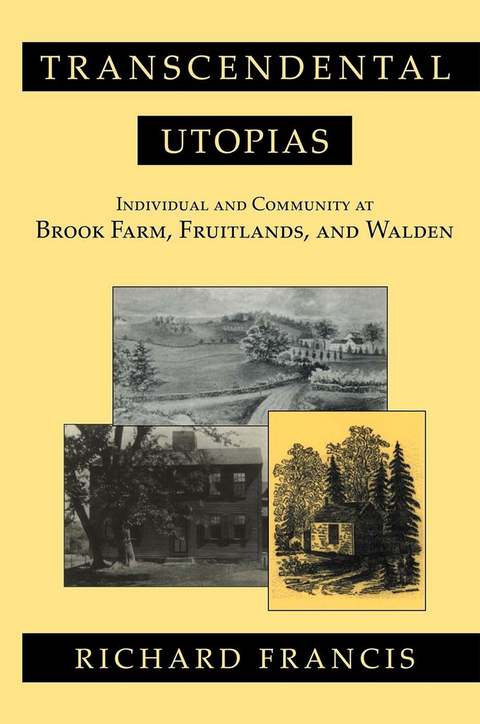
Transcendental Utopias (eBook)
264 Seiten
Cornell University Press (Verlag)
978-1-5017-2419-0 (ISBN)
New England Transcendentalism was a vibrant and many-sided movement whose members are probably best remembered for their utopian experiments, their attempts to reconcile the contingent world of history with what they perceived as the stable and...
New England Transcendentalism was a vibrant and many-sided movement whose members are probably best remembered for their utopian experiments, their attempts to reconcile the contingent world of history with what they perceived as the stable and patterned world of nature. Richard Francis has written the first book to explore in detail the ideological basis of the three famous experiments during the 1840s: Brook Farm, Fruitlands, and Henry David Thoreau's "community of one" on the shores of Walden Pond.
Francis suggests that at the heart of Transcendentalism was a belief that all phenomena are connected in a repetitive sequence. The task was to explain how human society could be reordered to benefit from this seriality. Some members of the movement believed in evolutionary progress, whereas others hoped to be the agents of a sudden millennial transformation. They differed, as well, in their views as to whether the fundamental social unit was the individual, the family, the phalanstery, or the community.
The story of the three communities was, inevitably, also the story of particular individuals, and Francis highlights the lives and ideas of such leaders as George Ripley, W. H. Channing, Bronson Alcott, Charles Lane, and Theodore Parker. The consistent underlying beliefs of the New England Transcendentalists have exerted a powerful influence on American intellectual and cultural history ever since.
New England Transcendentalism was a vibrant and many-sided movement whose members are probably best remembered for their utopian experiments, their attempts to reconcile the contingent world of history with what they perceived as the stable and patterned world of nature. Richard Francis has written the first book to explore in detail the ideological basis of the three famous experiments during the 1840s: Brook Farm, Fruitlands, and Henry David Thoreau's "community of one" on the shores of Walden Pond.Francis suggests that at the heart of Transcendentalism was a belief that all phenomena are connected in a repetitive sequence. The task was to explain how human society could be reordered to benefit from this seriality. Some members of the movement believed in evolutionary progress, whereas others hoped to be the agents of a sudden millennial transformation. They differed, as well, in their views as to whether the fundamental social unit was the individual, the family, the phalanstery, or the community. The story of the three communities was, inevitably, also the story of particular individuals, and Francis highlights the lives and ideas of such leaders as George Ripley, W. H. Channing, Bronson Alcott, Charles Lane, and Theodore Parker. The consistent underlying beliefs of the New England Transcendentalists have exerted a powerful influence on American intellectual and cultural history ever since.
Richard Francis is Professor of Creative Writing at Bath Spa University College. His is the author of nine novels and of biographies of Ann Lee, the founder of the Shakers, and Samuel Sewall, one of the Salem witch trial judges.
| Erscheint lt. Verlag | 18.10.2018 |
|---|---|
| Verlagsort | Ithaca |
| Sprache | englisch |
| Maße | 150 x 150 mm |
| Themenwelt | Literatur ► Essays / Feuilleton |
| Kunst / Musik / Theater ► Kunstgeschichte / Kunststile | |
| Geschichte ► Allgemeine Geschichte ► Neuzeit (bis 1918) | |
| Geisteswissenschaften ► Geschichte ► Regional- / Ländergeschichte | |
| Geisteswissenschaften ► Sprach- / Literaturwissenschaft ► Anglistik / Amerikanistik | |
| Geisteswissenschaften ► Sprach- / Literaturwissenschaft ► Literaturgeschichte | |
| Sozialwissenschaften ► Politik / Verwaltung ► Staat / Verwaltung | |
| ISBN-10 | 1-5017-2419-3 / 1501724193 |
| ISBN-13 | 978-1-5017-2419-0 / 9781501724190 |
| Informationen gemäß Produktsicherheitsverordnung (GPSR) | |
| Haben Sie eine Frage zum Produkt? |
 PDF (Adobe DRM)
Kopierschutz: Adobe-DRM
Adobe-DRM ist ein Kopierschutz, der das eBook vor Mißbrauch schützen soll. Dabei wird das eBook bereits beim Download auf Ihre persönliche Adobe-ID autorisiert. Lesen können Sie das eBook dann nur auf den Geräten, welche ebenfalls auf Ihre Adobe-ID registriert sind.
Details zum Adobe-DRM
Dateiformat: PDF (Portable Document Format)
Mit einem festen Seitenlayout eignet sich die PDF besonders für Fachbücher mit Spalten, Tabellen und Abbildungen. Eine PDF kann auf fast allen Geräten angezeigt werden, ist aber für kleine Displays (Smartphone, eReader) nur eingeschränkt geeignet.
Systemvoraussetzungen:
PC/Mac: Mit einem PC oder Mac können Sie dieses eBook lesen. Sie benötigen eine
eReader: Dieses eBook kann mit (fast) allen eBook-Readern gelesen werden. Mit dem amazon-Kindle ist es aber nicht kompatibel.
Smartphone/Tablet: Egal ob Apple oder Android, dieses eBook können Sie lesen. Sie benötigen eine
Geräteliste und zusätzliche Hinweise
Buying eBooks from abroad
For tax law reasons we can sell eBooks just within Germany and Switzerland. Regrettably we cannot fulfill eBook-orders from other countries.
aus dem Bereich