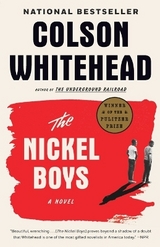
The Nickel Boys
Dday Gen Adult (Verlag)
978-0-385-54544-0 (ISBN)
- Titel erscheint in neuer Auflage
- Artikel merken
NATIONAL BOOK CRITICS CIRCLE AWARD FINALIST
ONE OF TIME MAGAZINE'S 10 BEST FICTION BOOKS OF THE DECADE
WINNER OF THE KIRKUS PRIZE
LONGLISTED FOR THE NATIONAL BOOK AWARD
In this bravura follow-up to the Pulitzer Prize, and National Book Award-winning #1 New York Times bestseller The Underground Railroad, Colson Whitehead brilliantly dramatizes another strand of American history through the story of two boys sentenced to a hellish reform school in Jim Crow-era Florida.
As the Civil Rights movement begins to reach the black enclave of Frenchtown in segregated Tallahassee, Elwood Curtis takes the words of Dr. Martin Luther King to heart: He is "as good as anyone." Abandoned by his parents, but kept on the straight and narrow by his grandmother, Elwood is about to enroll in the local black college. But for a black boy in the Jim Crow South of the early 1960s, one innocent mistake is enough to destroy the future. Elwood is sentenced to a juvenile reformatory called the Nickel Academy, whose mission statement says it provides "physical, intellectual and moral training" so the delinquent boys in their charge can become "honorable and honest men."
In reality, the Nickel Academy is a grotesque chamber of horrors where the sadistic staff beats and sexually abuses the students, corrupt officials and locals steal food and supplies, and any boy who resists is likely to disappear "out back." Stunned to find himself in such a vicious environment, Elwood tries to hold onto Dr. King's ringing assertion "Throw us in jail and we will still love you." His friend Turner thinks Elwood is worse than naive, that the world is crooked, and that the only way to survive is to scheme and avoid trouble.
The tension between Elwood's ideals and Turner's skepticism leads to a decision whose repercussions will echo down the decades. Formed in the crucible of the evils Jim Crow wrought, the boys' fates will be determined by what they endured at the Nickel Academy.
Based on the real story of a reform school in Florida that operated for one hundred and eleven years and warped the lives of thousands of children, The Nickel Boys is a devastating, driven narrative that showcases a great American novelist writing at the height of his powers.
Colson Whitehead is the #1 New York Times bestselling author of The Underground Railroad, which in 2016 won the Pulitzer Prize in Fiction and the National Book Award and was named one of the Ten Best Books of the Year by The New York Times Book Review, as well as The Noble Hustle, Zone One, Sag Harbor, The Intuitionist, John Henry Days, Apex Hides the Hurt, and The Colossus of New York. He is also a Pulitzer Prize finalist and a recipient of the MacArthur and Guggenheim Fellowships. He lives in New York City. Colson Whitehead is available for select speakingengagements. To inquire about a possible appearance,please contact Penguin Random House Speakers Bureauat speakers@ penguinrandomhouse.com or visitwww.prhspeakers.com.
Elwood received the best gift of his life on Christmas Day 1962, even if the ideas it put it in his head were his undoing. Martin Luther King At Zion Hill was the only album he owned and it never left the turntable. His grandmother Hattie had a few gospel records, which she only played when the world discovered a new mean way to work on her, and Elwood wasn't allowed to listen to the Motown groups or popular songs like that on account of their licentious nature. The rest of his presents that year were clothes - a new red sweater, socks - and he certainly wore those out, but nothing endured such good and constant use as the record. Every scratch and pop it gathered over the months was a mark of his enlightenment, tracking each time he entered into a new understanding of the Reverend's words. The crackle of truth. They didn't have a TV set but Dr. King's speeches were such a vivid chronicle -- containing all that the Negro had been and all that he would be -- that the record was almost as good as television. Maybe even better, grander, like the towering screen at the Davis Drive-In, which he'd been to twice. Elwood saw it all: Africans persecuted by the white sin of slavery, Negroes humiliated and kept low by segregation, and that luminous image to come, when all those places closed to his race were opened. The speeches had been recorded all over, Detroit and Charlotte and Montgomery, connecting Elwood to the rights struggle across the country. One speech even made him feel like a member of the King family. Every kid had heard of Fun Town, been there or envied someone who had. In the third cut on Side A, Dr. King spoke of how his daughter longed to visit the amusement park on Stewart Ave in Atlanta. Yolanda begged her parents whenever she spotted the big sign from the expressway or the commercials came on TV. Dr. King had to tell her in his low, sad rumble about the segregation system that kept colored boys and girls on the other side of the fence. Explain the misguided thinking of some whites -- not all whites, but enough whites - that gave it force and meaning. He counseled his daughter to resist the lure of hatred and bitterness and assured her that "Even though you can't go to Fun Town, you are as good as anyone who gets to go to Fun Town." That was Elwood -- good as anyone. A hundred miles south of Atlanta, in Tallahassee. Sometimes he saw a Fun Town commercial while visiting his cousins in Georgia. Lurching rides and happy music, chipper white kids lining up for the Wild Mouse Roller Coaster, Dick's Mini Golf. Strap into the Atomic Rocket for a Trip to the Moon. A perfect report card guaranteed free admission, the commercials said, if your teacher stamped a red mark on it. Elwood got all A's and kept his stack of evidence for the day they opened Fun Town to all God's children, as Dr. King promised. "I'll get in free every day for a month, easy," he told his grandmother, lying on the front room rug and tracing a threadbare patch with his thumb. His grandmother Hattie had rescued the rug from the alley behind the Richmond Hotel after the last renovation. The bureau in her room, the tiny table next to Elwood's bed, and three lamps were also Richmond castoffs. Hattie had worked at the hotel since she was fourteen, when she joined her mother on the cleaning staff. Once Elwood entered high school, the hotel manager Mr. Parker made it clear he'd hire him as a porter whenever he wanted, smart kid like him, and the white man was disappointed when the boy began working at Marconi's Tobacco & Cigars. Mr. Parker was always kind to the family, even after he had to fire Elwood's mother for stealing. Elwood liked the Richmond and he liked Mr. Parker, but adding a fourth generation to the hotel's accounts made him uneasy in a way he found difficult to describe. Even before the encyclopedias. When he was younger, he sat on a crate in the hotel kitchen after school, reading comic books and Ha
| Erscheinungsdatum | 03.07.2019 |
|---|---|
| Sprache | englisch |
| Themenwelt | Literatur ► Historische Romane |
| Literatur ► Romane / Erzählungen | |
| Schlagworte | 100 best novels • african american urban fiction • American History • award winning books for adults • best books of 2019 • best fiction books of 2019 • best sellers 2019 • bestsellers 2019 • best sellers list new york times 2019 • black authors • book club gifts • book club recommendations 2019 • books • Fiction • Historical • historical fiction • historical fiction best sellers • new york times best sellers 2019 fiction • Novel • pulitzer prize books • pulitzer prize winners • pulitzer prize winners fiction • Underground Railroad |
| ISBN-10 | 0-385-54544-4 / 0385545444 |
| ISBN-13 | 978-0-385-54544-0 / 9780385545440 |
| Zustand | Neuware |
| Informationen gemäß Produktsicherheitsverordnung (GPSR) | |
| Haben Sie eine Frage zum Produkt? |
aus dem Bereich