Curse of the Clan (eBook)
298 Seiten
Barbara Cartland eBooks Ltd (Verlag)
978-1-78213-921-8 (ISBN)
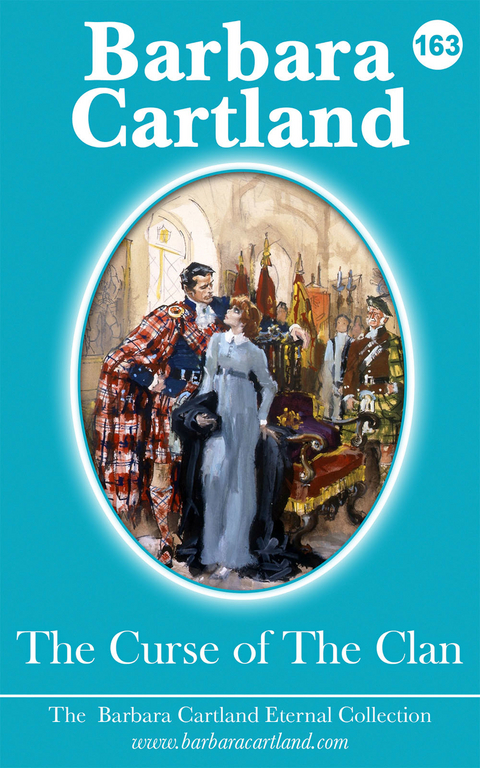
Waif-like and half-starved the beautiful eighteen-year-old Tara has no second name and no family.
Orphaned when her mother died tragically in a carriage crash, she was raised in the appalling 'Orphanage of the Nameless' in London and has no knowledge at all of the world outside.
The drunken Matron of the Orphanage, Mrs. Barrowfield, relies on Tara to control, feed and look after the many orphans while she spends most of the money intended for their food on drink.
Then one day Mr. Falkirk comes to inform her that the Orphanage's owner and patron, the Duke of Arkcraig, has ordered her to Scotland to work in Castle Arkcraig.
Arriving, timid and overawed to meet her new Master, she is appalled to find that she has been seriously misled.
She is there not to work as a servant but to become the imperiously handsome Duke's bride - willing or not!
All of a sudden she is embroiled in the terrible enmity between the McCraig Clan and the equally warlike Kildonnons and the curse that hangs over them like a black cloud.
Worst of all, she finds that she has lost her heart to the husband for whom she had never asked and yet who now seems to be cold and aloof.
Has she been rescued from poverty and the horrors of the Orphanage and brought to the Duke's majestic Castle only to spend a lifetime starved of love
Waif-like and half-starved the beautiful eighteen-year-old Tara has no second name and no family. Orphaned when her mother died tragically in a carriage crash, she was raised in the appalling 'Orphanage of the Nameless' in London and has no knowledge at all of the world outside. The drunken Matron of the Orphanage, Mrs. Barrowfield, relies on Tara to control, feed and look after the many orphans while she spends most of the money intended for their food on drink.Then one day Mr. Falkirk comes to inform her that the Orphanage's owner and patron, the Duke of Arkcraig, has ordered her to Scotland to work in Castle Arkcraig.Arriving, timid and overawed to meet her new Master, she is appalled to find that she has been seriously misled. She is there not to work as a servant but to become the imperiously handsome Duke's bride - willing or not!All of a sudden she is embroiled in the terrible enmity between the McCraig Clan and the equally warlike Kildonnons and the curse that hangs over them like a black cloud. Worst of all, she finds that she has lost her heart to the husband for whom she had never asked and yet who now seems to be cold and aloof. Has she been rescued from poverty and the horrors of the Orphanage and brought to the Duke's majestic Castle only to spend a lifetime starved of love
Chapter Two
Tara leaned forward in the coach to exclaim,
“It is all so green! I knew that the countryside would be green, but not as green as this!”
Mr. Falkirk was just about to reply when she added in a tone of rapture,
“And that field is gold – really gold!”
“Corn,” Mr. Falkirk remarked laconically and then asked, “Surely you have been in the country before?”
Tara shook her head.
“No. Mrs. Barrowfield allowed me to take the older children into Hyde Park, but lately there have been too many little ones to look after and she could not spare me.”
“The children must have gone out,” Mr. Falkirk protested.
“They played on the ground behind the Orphanage,” Tara replied. “It is quite small and very muddy in the winter, but at least they were in the fresh air.”
She turned her face towards him while she answered the question, but now once again she bent forward and gazed out of the window.
“If only the children could see this,” she sighed beneath her breath.
Mr. Falkirk had already realised that her thoughts were seldom away from the children she had left behind her.
There had been an emotional scene, which he had found strangely moving when he collected Tara from the Orphanage.
The smaller children had clung to her crying and wailing and the older ones had shouted almost despairingly until the carriage was out of sight.
Even Mrs. Barrowfield had appeared to be sentimental at the thought of losing Tara, but Mr. Falkirk could not help thinking her sorrow was more for herself because she would be without an able assistant.
But for whatever reason it was obviously very difficult for Tara to say ‘goodbye’.
When finally she disentangled herself from the clinging arms of the younger children and joined Mr. Falkirk in the coach, the tears were streaming down her cheeks.
It took her some time to gain control of herself and only when they had driven for some minutes did she manage to say,
“Wh-what will the – ch-children do without me? I am – sure that the younger ones will – go hungry.”
“That is what I was going to tell you, Tara,” Mr. Falkirk answered. “I have realised that the children are not having enough to eat and the whole Orphanage has fallen into a lamentable state of disrepair which should never have been allowed.”
He saw that Tara was looking at him with a desperate look of anxiety in her wet eyes and he said quickly because he did not wish her to go on suffering,
“I have made arrangements that I feel sure will meet with your approval.”
“Wh-what are – they?” Tara asked, her voice catching in a little sob.
“The housekeeper at Arkcraig House is an elderly woman but a very capable one. She remembers the Orphanage being built when she was young and she also served Duchess Anne and knew the personal interest that she took in the orphans.”
“It was only after Her Grace died that things became so bad,” Tara ventured.
“That is what I realised,” Mr. Falkirk answered. “I have told Mrs. Kingston to engage a cook who will buy adequate food for the children.”
The expression of joy on Tara’s thin face seemed to transform it.
Mr. Falkirk knew he had been right in thinking that most of the money that had been paid to the orphanage weekly by the Duke’s Solicitors had been spent by Mrs. Barrowfield on drink.
“Mrs. Kingston will also find some young girls who will clean the place,” he went on, “and help in looking after the children.”
He paused and then said almost sharply,
“What I cannot understand is what happened to the teachers. There were, I know, quite a number of them in the Duchess Anne’s time.”
“Two of them retired and they were not replaced,” Tara answered, “and the last one left about six months ago when she found that she could not control the older boys.”
She sighed and in almost a pleading tone said,
“It’s not that they are so naughty, but she did not teach very well.”
She looked at Mr. Falkirk apprehensively as if she thought that he would be angry and added,
“I have been teaching the younger ones myself when I had time, but when there were babies to care for it was very difficult.”
“And so you told them stories,” Mr. Falkirk said with a smile. “I am sure they preferred it.”
“That is why I made the stories a treat,” Tara explained, “and it kept them quiet.”
“I am sure it did,” he said. “But I shall speak to His Grace and make sure that proper teachers are appointed to the Orphanage as there used to be in the past.”
“That will be wonderful!” Tara cried. “Oh, dear, I wish I could be there. There is so much I want to learn.”
Mr. Falkirk looked at her with a smile and asked her,
“I am sure you must have had quite a lot of lessons in your time?”
“Not enough,” Tara replied. “The Minister was very kind to me, but he died last year.”
There was a note in her voice that told Mr. Falkirk that the Minister’s death had been a loss that still hurt her.
“Where did the Minister come from?” he enquired.
“From the Presbyterian Church in Chelsea,” Tara answered. “I think perhaps it is the only one in London.”
“And he held services in the Orphanage?”
“Every Sunday, but he also came two or three times a week to instruct us all in the Scriptures.”
She gave another little sigh.
“His lessons were so interesting. I used to look forward to them more than to anything else and he lent me books.”
“So you can read fluently.”
“I love reading,” Tara replied, “but when the Minister died I had only the Bible that he had given me.”
She looked at Mr. Falkirk with a shy smile and added,
“I think sometimes I must know it by heart.”
That would account for the extremely good English she spoke, Mr. Falkirk thought.
He had noticed already what a cultured way she had of speaking and that her vocabulary was far greater than he would have expected from a child brought up in an Orphanage.
“His Grace has a very extensive library at The Castle,” he told her.
He saw the look of excitement in Tara’s eyes.
Then it was dimmed as she said,
“I don’t expect that His Grace would allow me to – touch his books,”
“I am quite certain that he would lend them to you if you were careful with them,” Mr. Falkirk answered. “And if not I have a considerable collection myself to which you are very welcome.”
“Do you really mean that, sir?”
He was amused by the way she spoke, which was one of awe and excitement.
“I actually have some books with me now,” he said. “When we stop tonight, I will unpack them and you can choose what would interest you to read on the journey. I am afraid though, you may find them rather heavy and dull.”
“I would find nothing I could read dull,” Tara replied. “I long to read and have longed to have enough money to buy a newspaper. But Mrs. Barrowfield always said that we could not afford to buy one.”
Mr. Falkirk’s lips tightened.
He had already made up his mind that he would urge the Duke to pension off Mrs. Barrowfield and put a sensible motherly woman in her place.
Someone must be found who would not only care for the children but prepare them for the world outside into which the majority of the orphans were precipitated at the age of twelve.
One thing, however, that had worried him more than anything else was the obvious lack of food and decent clothing at the Orphanage.
He looked at Tara now and was relieved to find that her grey dress with its white collar was not only clean but also in a fairly good state of repair.
He thought that it was an ugly uniform and the severity of it, especially the tight helmet-shaped cap, was what might have been expected to be the choice of the Duchess Harriet.
The founder of The Orphanage of the Nameless had been an austere Scotswoman who could be colloquially described as ‘having no frills about her’.
He thought that Tara might in fact be quite attractive if she was not so pitiably thin and the bones of her wrists when they protruded from the black cloth cloak she was travelling in were not so distressingly prominent.
“I am going to make a bargain with you,” he said aloud.
“A bargain?”
“Yes, I will lend you my books on condition that you eat everything that is put in front of you until we reach Scotland.”
Tara gave a little laugh.
“You will not find me saying ‘no’, sir, to any food you offer me.”
But that, Mr. Falkirk was to find, was an optimistic aspiration that she could not fulfil.
When they stopped at the first posting inn at Baldock where they were to stay the night, Tara found the bedroom she had been allotted upstairs exceeded all her imaginings of comfort and luxury.
She washed her hands and face, changed into another grey cotton gown that was identical to the one she had been wearing and went downstairs to join Mr. Falkirk.
She guessed that he would change for supper from something he had said when they had arrived at the inn and only some of their luggage had been lifted down from the top of the coach.
But she was not prepared for the difference his evening dress made and she stared in wide-eyed astonishment at the elegance of his cut-away coat with long tails and the crisp muslin cravat at his throat.
But her admiration for Mr. Falkirk was superseded by her astonishment at the amount of food which was being carried into the sitting room by the...
| Erscheint lt. Verlag | 6.2.2019 |
|---|---|
| Sprache | englisch |
| Themenwelt | Literatur ► Historische Romane |
| ISBN-10 | 1-78213-921-4 / 1782139214 |
| ISBN-13 | 978-1-78213-921-8 / 9781782139218 |
| Informationen gemäß Produktsicherheitsverordnung (GPSR) | |
| Haben Sie eine Frage zum Produkt? |
 EPUB (Adobe DRM)
Kopierschutz: Adobe-DRM
Adobe-DRM ist ein Kopierschutz, der das eBook vor Mißbrauch schützen soll. Dabei wird das eBook bereits beim Download auf Ihre persönliche Adobe-ID autorisiert. Lesen können Sie das eBook dann nur auf den Geräten, welche ebenfalls auf Ihre Adobe-ID registriert sind.
Details zum Adobe-DRM
Dateiformat: EPUB (Electronic Publication)
EPUB ist ein offener Standard für eBooks und eignet sich besonders zur Darstellung von Belletristik und Sachbüchern. Der Fließtext wird dynamisch an die Display- und Schriftgröße angepasst. Auch für mobile Lesegeräte ist EPUB daher gut geeignet.
Systemvoraussetzungen:
PC/Mac: Mit einem PC oder Mac können Sie dieses eBook lesen. Sie benötigen eine
eReader: Dieses eBook kann mit (fast) allen eBook-Readern gelesen werden. Mit dem amazon-Kindle ist es aber nicht kompatibel.
Smartphone/Tablet: Egal ob Apple oder Android, dieses eBook können Sie lesen. Sie benötigen eine
Geräteliste und zusätzliche Hinweise
Buying eBooks from abroad
For tax law reasons we can sell eBooks just within Germany and Switzerland. Regrettably we cannot fulfill eBook-orders from other countries.
aus dem Bereich