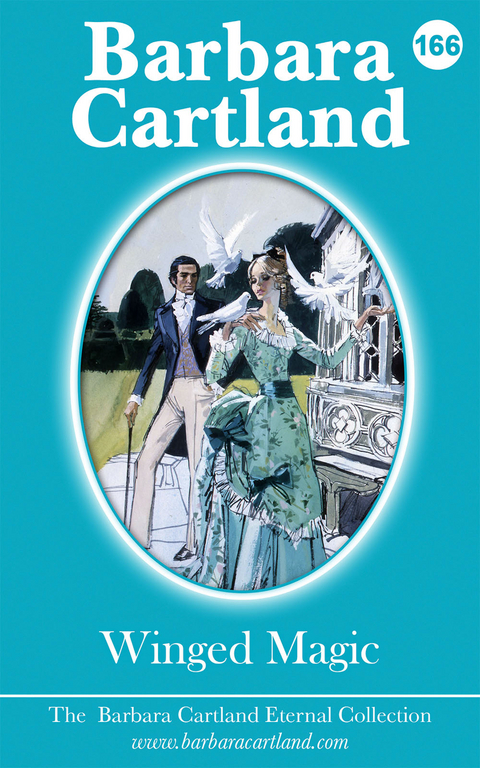
Winged Magic (eBook)
298 Seiten
Barbara Cartland eBooks Ltd (Verlag)
978-1-78213-940-9 (ISBN)
Aged just sixteen and still at school, Christine Lydford is appalled when she is ordered by her stepmother to leave school to live with the Marquis of Ventnor on his grand estate where he is to oversee her continued education.
As if that was not bad enough, the Marquis is a notorious rake and even worse, her lady's maid lets slip that secretly Christine's hated stepmother has arranged for her to marry the Marquis.
And once Christine is safely married her stepmother will be able to continue her clandestine affaire-de-coeurwith him. But little does she know that the Marquis is already becoming bored with her and is looking elsewhere.
But Christine is already in love with another. She elopes with her intended to Rome, after persuading her friend, the orphaned beauty, Mina Shaldon, to pass herself off as Christine, just until her friend is married and safe from the Marquis's clutches.
Timid little Mina is terrified, utterly in awe of the dashing sophisticated aristocrat, but she does not realise that he, like the entire household and the birds and animals in the gardens and the woods that are drawn to her as if by some special magic of hers, is smitten.
Soon Mina too has lost her heart, although she knows that a Society Nobleman such as he would never dally with a mere orphan such as her if he found out that she was an impostor.
Aged just sixteen and still at school, Christine Lydford is appalled when she is ordered by her stepmother to leave school to live with the Marquis of Ventnor on his grand estate where he is to oversee her continued education. As if that was not bad enough, the Marquis is a notorious rake and even worse, her lady s maid lets slip that secretly Christine s hated stepmother has arranged for her to marry the Marquis. And once Christine is safely married her stepmother will be able to continue her clandestine affaire-de-coeurwith him. But little does she know that the Marquis is already becoming bored with her and is looking elsewhere. But Christine is already in love with another. She elopes with her intended to Rome, after persuading her friend, the orphaned beauty, Mina Shaldon, to pass herself off as Christine, just until her friend is married and safe from the Marquis s clutches. Timid little Mina is terrified, utterly in awe of the dashing sophisticated aristocrat, but she does not realise that he, like the entire household and the birds and animals in the gardens and the woods that are drawn to her as if by some special magic of hers, is smitten. Soon Mina too has lost her heart, although she knows that a Society Nobleman such as he would never dally with a mere orphan such as her if he found out that she was an impostor.
CHAPTER TWO
The Marquis of Ventnor, riding back across the fields, realised that he had made a mistake.
Previously he had always avoided becoming amorously involved with any of his neighbours, knowing that when the affair was over, which in his case was usually in a short time, it was uncomfortable to meet the lady concerned on County occasions.
But Lady Bartlett had been very persistent in her pursuit of him and, as Lord Bartlett was frequently in attendance on the Prince of Wales, they met continually in London.
Very alluring with dark hair and slanting green eyes that promised exotic delights even when she was speaking of the most banal and commonplace things, Lady Bartlett had succeeded in strongly attracting the Marquis, but only after she had made him aware that, where she was concerned, he was the most exciting man she had ever met.
Eloise Bartlett had a way of talking to a man as if he was the one person she had ever wanted to know and what he said to her was as enticing as the Song of Solomon.
Because the Marquis and Lord Bartlett sat together on many Hertfordshire committees and were frequently involved in dealing with agricultural difficulties, he did his best to prevent himself from being caught in the net that Lady Bartlett spread for him.
He was well aware that it was a net and he knew as much about her reputation as she knew about his.
In fact it was not surprising that Lady Bartlett had evoked the disapproval of the Queen, for, although Her Majesty spent so much time at Windsor Castle, she was extremely well informed as to what was happening in the Social world.
Especially she was suspicious, resentful and positively antagonistic to those who were friendly with her son, the Prince of Wales, and whom she considered to be a bad influence.
Lady Bartlett undoubtedly came into the last category.
The Prince of Wales had for a short while been obviously infatuated with her and the gossip must have reached Windsor quicker than any carrier pigeon could have conveyed it.
When the Prince transferred his affections, Lady Bartlett looked quickly around for another lover.
He would have to be distinguished, otherwise she would have lost face amongst her contemporaries who were already triumphant in knowing that she had lost the heir to the Throne.
She had kept him interested for a while, but his affection had waned even more quickly than she had anticipated, leaving her conscious that her position must be rectified.
The Prince of Wales was undoubtedly the greatest prize that the Social world could offer to any woman.
But not far behind him came the Marquis of Ventnor.
There were, of course, several Dukes on the Social scale in between, but the Marquis went unrivalled in respect of wealth and reputation.
He had also just finished a liaison with a very attractive widow, who might have lasted longer had she not been so obviously intent on marrying him.
The Marquis’s marriage was a subject of bets in White’s Club and a great number of other Clubs.
Time after time it had seemed to his contemporaries that he was on the brink of becoming leg-shackled, whether he liked it or not, but always by some instinct for self-preservation he had managed to escape at the eleventh hour.
The widow had, however, somewhat foolishly not only overplayed her hand in public but had told him in private at a very intimate moment how desperately she wished to belong to him, for Eternity’.
The mere word was enough to make the Marquis shudder.
He was well aware that it was a fault in his character, which he could not rectify, that he found that every woman he was involved with bored him sooner or later.
He often asked himself why?
Some of the women he had been fascinated by were not only alluringly passionate but also intelligent.
They certainly had the type of sharp wit that made him laugh and they would not have been included in the Prince of Wales’s intimate circle had they not been able to add to the amusement of their friends by being entertaining as well as beautiful.
The Marquis had often asked himself what love really was and why he would suddenly realise usually at a most inconvenient moment that a woman could no longer make his heart beat faster and that he had no more desire to kiss or even touch her again.
That was what had happened this afternoon and he said to himself as his horse trotted over the green fields that joined Lord Bartlett’s estate with his,
‘I have been a fool!’
He had met Eloise in the summerhouse, which was situated in the shrubbery of the garden that surrounded Lord Bartlett’s stately home and it was a place that they had often used before.
It was furnished with soft rugs on the floor, a comfortable couch with silk cushions and, because Eloise was experienced in the need to cosset and pamper a man, there was always a bottle of the best champagne open in a silver wine cooler.
When the Marquis reached the summerhouse just before five o’clock, Eloise had been waiting for him with outstretched arms and red lips raised enticingly to his.
It flashed through his mind that she was too impetuous and it would have been more effective if she had left him to make the first overtures and had greeted him less effusively.
Then the fire in her eyes and on her lips had aroused an answering flame in the Marquis and it was only later when, having drunk a glass of champagne, and said that he must leave, that there was any ordinary conversation between them.
“Must you go so soon?” Eloise Bartlett had protested, pouting provocatively at him as she spoke.
“I have things to see to at home,” the Marquis answered evasively.
“What sort of things? I thought you were alone at Vent Royal.”
“I am, except for my grandmother.”
“Fortunately she is an old woman,” Eloise replied, “otherwise I should be jealous.”
The Marquis did not reply. He merely set his glass down and picked up his high hat and riding whip.
Eloise lying back on the couch and looking, as she well knew, very beautiful with her flushed cheeks and slightly dishevelled hair, threw out her arms.
“Come and say ‘goodbye’,” she suggested softly.
The Marquis shook his head.
“I have been caught that way before, Eloise. Instead I will thank you for making me very happy.”
He had put his hand on the door when Eloise gave a little scream.
“When shall I see you again? Can you come tomorrow or the next day?”
“I will send you a message in the usual way,” he answered. “I may be going back to London, I am not yet sure.”
“To London? But you have only just come to the country and you told me that you intended to stay for a week.”
There was no doubt that there was a note of reproach in Lady Bartlett’s voice.
The Marquis knew that, as she disliked the country, the only reason why she had accompanied her husband when he decided to attend the High Sheriff’s garden party was that he had said that he also intended to be there.
“I will let you know when I can come again,” he said.
As he walked out of the summerhouse, he heard Lady Bartlett’s voice still protesting as he moved through the shrubs to where he had left his horse.
As he rode off, he knew with that strange feeling of finality that had come to him before on far too many occasions that he would not go back.
He could not explain why, but quite suddenly and unexpectedly Eloise Bartlett no longer interested him.
He was aware that, when she had asked him to say ‘goodbye’ and he had replied that he had been caught that way before, it was the all too familiar story.
A woman’s desire to go on lovemaking when the peak of passion was passed and to entice a man who was ready to leave to stay just for a little longer inevitably brought about a repetition of what had already occurred.
‘It is like hearing the same tune over and over again, the Marquis thought, ‘until it exasperates one.’
Once again he acknowledged that he had made a mistake in being involved with the wife of his neighbour.
At first it had been rather intriguing to agree to Eloise’s suggestion that they should meet in the summerhouse.
It was so cleverly contrived that he realised that he was not the first man to have used that particular rendezvous.
Yet because he found her fascinating that did not worry him any more than he minded that her servants who arranged the silk cushions and the champagne were well aware that she was meeting somebody surreptitiously.
Nor did he ever consider that his own servants must be curious as to why he went riding late in the afternoon or, as on several other occasions, at night after dinner.
It was no use for the Marquis to hope that none of them would talk for he was quite certain that they would do so and there would be another story to add to those already circulating about him and his numerous affairs.
What he found depressing was the problem that awaited him at Vent Royal and which had started with a letter that had arrived the day before from Lady Lydford.
Lady Lydford had actually, although she was not aware of it, begun to bore him nearly a month ago and, because of his feelings for her, he had returned to Eloise Bartlett who had only appeared on his horizon a short while before Easter.
His affair with Nadine Lydford had lasted longer than most of his liaisons.
At Christmas they had stayed in a Ducal house party that the Marquis had found more amusing than any party that he had attended for years.
He decided that a large part of the attraction had been the fact that Lady...
| Erscheint lt. Verlag | 6.2.2019 |
|---|---|
| Sprache | englisch |
| Themenwelt | Literatur ► Historische Romane |
| ISBN-10 | 1-78213-940-0 / 1782139400 |
| ISBN-13 | 978-1-78213-940-9 / 9781782139409 |
| Informationen gemäß Produktsicherheitsverordnung (GPSR) | |
| Haben Sie eine Frage zum Produkt? |
 EPUB (Adobe DRM)
Kopierschutz: Adobe-DRM
Adobe-DRM ist ein Kopierschutz, der das eBook vor Mißbrauch schützen soll. Dabei wird das eBook bereits beim Download auf Ihre persönliche Adobe-ID autorisiert. Lesen können Sie das eBook dann nur auf den Geräten, welche ebenfalls auf Ihre Adobe-ID registriert sind.
Details zum Adobe-DRM
Dateiformat: EPUB (Electronic Publication)
EPUB ist ein offener Standard für eBooks und eignet sich besonders zur Darstellung von Belletristik und Sachbüchern. Der Fließtext wird dynamisch an die Display- und Schriftgröße angepasst. Auch für mobile Lesegeräte ist EPUB daher gut geeignet.
Systemvoraussetzungen:
PC/Mac: Mit einem PC oder Mac können Sie dieses eBook lesen. Sie benötigen eine
eReader: Dieses eBook kann mit (fast) allen eBook-Readern gelesen werden. Mit dem amazon-Kindle ist es aber nicht kompatibel.
Smartphone/Tablet: Egal ob Apple oder Android, dieses eBook können Sie lesen. Sie benötigen eine
Geräteliste und zusätzliche Hinweise
Buying eBooks from abroad
For tax law reasons we can sell eBooks just within Germany and Switzerland. Regrettably we cannot fulfill eBook-orders from other countries.
aus dem Bereich