


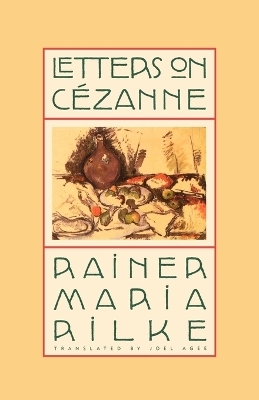
Letters on Cezanne
Seiten
2002
|
2nd ed.
North Point Press (Verlag)
978-0-86547-639-4 (ISBN)
North Point Press (Verlag)
978-0-86547-639-4 (ISBN)
Rilke's prayerful responses to the french master's beseeching art
For a long time nothing, and then suddenly one has the right eyes.
Virtually every day in the fall of 1907, Rainer Maria Rilke returned to a Paris gallery to view a Cezanne exhibition. Nearly as frequently, he wrote dense and joyful letters to his wife, Clara Westhoff, expressing his dismay before the paintings and his ensuing revelations about art and life.
Rilke was knowledgeable about art and had even published monographs, including a famous study of Rodin that inspired his New Poems. But Cezanne's impact on him could not be conveyed in a traditional essay. Rilke's sense of kinship with Cezanne provides a powerful and prescient undercurrent in these letters -- passages from them appear verbatim in Rilke's great modernist novel, The Notebooks of Malte Laurids Brigge. Letters on Cezanne is a collection of meaningfully private responses to a radically new art.
For a long time nothing, and then suddenly one has the right eyes.
Virtually every day in the fall of 1907, Rainer Maria Rilke returned to a Paris gallery to view a Cezanne exhibition. Nearly as frequently, he wrote dense and joyful letters to his wife, Clara Westhoff, expressing his dismay before the paintings and his ensuing revelations about art and life.
Rilke was knowledgeable about art and had even published monographs, including a famous study of Rodin that inspired his New Poems. But Cezanne's impact on him could not be conveyed in a traditional essay. Rilke's sense of kinship with Cezanne provides a powerful and prescient undercurrent in these letters -- passages from them appear verbatim in Rilke's great modernist novel, The Notebooks of Malte Laurids Brigge. Letters on Cezanne is a collection of meaningfully private responses to a radically new art.
Rainer Maria Rilke (1975-1926) was born in Prague and traveled throughout Europe, returning frequently to Paris, where he wrote his finest works: the two volumes of New Poems and the great modernist novel The Notebooks of Malte Laurids Brigge. He lived the last years of his life in Switzerland, where he completed his two poetic masterworks, the Duino Elegies and Sonnets to Orpheus. Joel Agee has translated Elias Canetti, Friedrich Durenmatt, and Gottfried Benn. He won the Helen and Kurt Wolff Translator's Prize for his work on Heinrich von Kleist's verse play Penthesilea. He is the author of Twelve Years: An American Boyhood in East Germany.
| Erscheint lt. Verlag | 19.9.2002 |
|---|---|
| Übersetzer | Joel Agee |
| Verlagsort | Berkeley, California |
| Sprache | englisch; deutsch |
| Maße | 137 x 203 mm |
| Gewicht | 68 g |
| Themenwelt | Literatur ► Briefe / Tagebücher |
| Kunst / Musik / Theater ► Kunstgeschichte / Kunststile | |
| ISBN-10 | 0-86547-639-X / 086547639X |
| ISBN-13 | 978-0-86547-639-4 / 9780865476394 |
| Zustand | Neuware |
| Informationen gemäß Produktsicherheitsverordnung (GPSR) | |
| Haben Sie eine Frage zum Produkt? |
Mehr entdecken
aus dem Bereich

aus dem Bereich
Das Tagebuch einer Frauenschreibgruppe während der Machtübernahme der …
Buch | Hardcover (2025)
Verlagshaus Jacoby & Stuart
CHF 38,90


