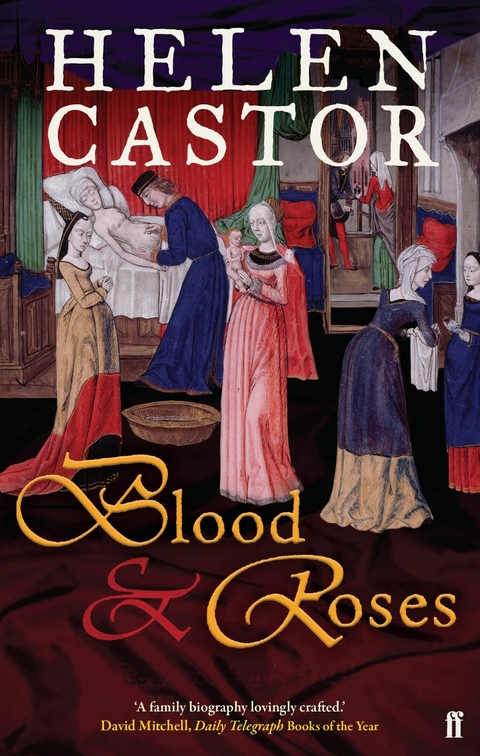
Blood and Roses (eBook)
368 Seiten
Faber & Faber (Verlag)
978-0-571-28680-5 (ISBN)
Helen Castor is a historian of medieval England, and a Fellow of Sidney Sussex College, Cambridge. Her first book, Blood & Roses, a biography of the fifteenth-century Paston family, was longlisted for the Samuel Johnson Prize in 2005 and won the English Association's Beatrice White Prize in 2006. Her second book, She-Wolves, was made into a BBC2 tv series. She lives in London with her husband and son.
The Wars of the Roses turned England upside down. Between 1455 and 1485 four kings, including Richard III, lost their thrones, more than forty noblemen lost their lives on the battlefield or their heads on the block, and thousands of the men who followed them met violent deaths. As they made their way in a disintegrating world, the Paston family in Norfolk family were writing letters - about politics, about business, about shopping, about love and about each other, including the first valentine. Using these letters - the oldest surviving family correspondence in English - Helen Castor traces the extraordinary history of the Paston family across three generations. Blood & Roses tells the dramatic, moving and intensely human story of how one family survived one of the most tempestuous periods in English history. Longlisted for the Samuel Johnson Prize in 2005 and winner of the English Association's Beatrice White Prize in 2006.
'Castor ... manages to convey an intimate understanding of the correspondents, giving a sense of how their minds and their emotions worked; and it isn't just a series of episodes that she recounts, but a single developing story of one family's attempts to establish themselves as people of standing by acquiring land ... this is a work of scholarship that will catch readers' imagination ... It isn't a book written primarily for academics: Castor is always ready to explain and inform, but she does it in a way that assumes her readers lack specialist knowledge rather than intelligence. She slips much of the information into parentheses or similar subclauses, so that even those familiar with the subject don't feel they are being taught what they already know ... Castor remains faithful to the language her characters spoke and wrote, modernising spelling but not translating. She is also exceptionally good at explaining the niceties of 15th-century law as well as the complexities of family and patronage ties. This is a book that demonstrates how serious history can now achieve a generous market beyond the academy, without compromising its standards or its priorities.'
'Helen Castor's affectionate, detailed history offers a compelling portrait of the life and times of an upwardly mobile family which, however grand it became, was forever trying to escape the ignominy of its humble origins.'
Gripping as any historical novel, it's packed with contemporary resonance.
'dramatic, moving and intensely human story of how one family survived one of the most tempestuous periods in English history'
'Her great skill is to show how the Pastons' fortunes were tipped this way and that by the balance of forces in the great world of the court and feuding nobility.'
'Castor cleverly weaves explanation of contemporary social structure, legal procedure, marital customs and other aspects of fifteenth-century life.'
'This absorbing account of a family living through the Wars of the Roses is based on a remarkable collection of private letters ... It gives a vivid and detailed evocation of the late medieval world, highlighting both its differences from and similarities with our own experience of family life ... a fascinating book and an invaluable resource for anyone wanting to know more about England during this period.'
'Castor's artful writing means that the Pastons' opinions, the squabbles, trials and tribulations emerge from this delightful text to bring the family to life. It's a human, compelling story of a family surviving internal and external pressures and it makes 500 years seem not so very long ago.'
'Sharply written, impeccably documented, structured with the trip and pace of a good thriller.'
'Castor sustains the narrative, admirably simplifying where necessary, to carry the reader along. She cleverly weaves explanation of contemporary social structure, legal procedure, marital customs and other aspects of fifteenth-century life into the story and makes just the right level of reference to and exposition of the unfolding political context. She is particularly good on Norfolk society, the jostling for advantage among the landed elite, the relationships with and impact of the great noble families, the dukes of Suffolk, Norfolk and Oxford, and the constant interconnection between events in the country and developments in court.'
'a family biography lovingly crafted from letters written by the Pastons of Norfolk during dark and bloody decades before, during and after the Wars of the Roses.'
'With patience and insight, which the Cambridge scholar Helen Castor possesses in superabundance, the Paston letters can be made to tell a family story of depth and subtlety. ... Castor's great skill is to show how the Pastons' fortunes were tipped this way and that by the balance of forces in the great world of the court and feuding nobility.'
'The verve and skill of this account will attract the growing general audience for history, but its academic credentials equally mean that students will learn a great deal about 15th century society and politics. ... Castor both instructs and entertains, allowing the irresistible charm of the letters' voices to speak clearly through her well-crafted text.'
In 1378, in a small village near the north-east Norfolk coast, there lived ‘a good plain husbandman’ named Clement, who took his surname, Paston, from the place where he lived. Clement was a peasant farmer who held some arable land and ‘a little poor watermill running by a little river’. That was the sum total of his estate; ‘other livelihood nor manors had he none, there nor in none other place’. He was a careful man who worked hard to make his living from the land. The single surviving document describing his life tells how he ‘went at one plough both winter and summer, and he rode to mill on the bare horseback with his corn under him, and brought home meal again under him’. After the harvest each year he drove his cart the fifteen miles or so down the coast to Winterton to sell his grain, ‘as a good husbandman ought to do’.1 Perhaps it was at Winterton market that he met a woman named Beatrice Goneld, whose family came from the neighbouring village of Somerton. Clement and Beatrice married, and in 1378 Beatrice gave birth to their only surviving child, a son named William. More than six hundred years later, there is little more that can be said about the lives of Clement and Beatrice Paston. Even the fact that these few details survive makes the couple unusual; most people of their time and class have left no trace in the written records which would allow even the sketchiest outline of their life stories to be drawn. One thing, however, can be concluded with some certainty: Clement and Beatrice were determined to do everything they could to give their son greater opportunities than they had ever had.
The figure of the self-made man from a poor background whose success founds a dynasty has become one of the iconic archetypes of modern fact and fiction, but the phenomenon is centuries old. Medieval English culture was deeply infused with the belief that the order of God’s creation manifested itself in a social and political hierarchy within which every man should know and keep his place, but behind this image of rigid social stratification lay a wealth of opportunities for those with ability and ambition, even if their origins were humble. This was true more than ever at the end of the fourteenth century. The Black Death, which struck England in 1348, killed nearly half the country’s population – perhaps three million people – in little more than eighteen months. Contemporary chroniclers, in shock, described how those left alive struggled to bury the corpses of the scores who died each day. The plague itself was no respecter of persons; it ‘seizes young and old alike, sparing no one, and reducing rich and poor to the same level’, King Edward III wrote after his fourteen-year-old daughter succumbed to the disease in the autumn of 1348.2 Even if their bodies remained unscathed, the aristocracy soon made the uncomfortable discovery that their purses might not escape the effects of mortality on such a horrifying scale. The sudden and overwhelming shortage of peasant labour gave those who survived an economic bargaining-power unimaginable in previous centuries. Only a year after the epidemic’s first outbreak, the government reacted by trying to fix the cost of labour at pre-plague levels – the imposition of a maximum rather than a minimum wage – but population loss was so immense that the economic tide could not be held back for long. Once the immediate crisis was over, those who were left in the towns and the countryside began to take advantage of the new opportunities for advancement which had opened up all around them. The futility of the government’s attempt to block social mobility altogether was already becoming apparent by 1363, when a statute was passed specifying detailed restrictions to the ‘outrageous and excessive apparel’ which many people were now affecting, ‘contrary to their estate and degree’.3
For those who were determined to improve their lot, there were few better places to be than Norfolk at the turn of the fifteenth century. It was one of the most prosperous counties in England, with rich soils to grow grain, and pastureland for the thousands of sheep on which the flourishing local wool and cloth industries depended. The flat East Anglian landscape offered easy transport by river and road, and ships laden with cloth and grain sailed from the ports of Yarmouth and Lynn to markets elsewhere in England, and to the continent via Calais, the Low Countries and the Baltic. The sea coast provided opportunities to make money in fishing as well as shipping, and sea water was used for the production of salt, a valuable commodity essential for preserving meat, fish, butter and cheese. The commercial centre of the shire was the city of Norwich, which suffered badly during the plague, but recovered so rapidly that during the fifteenth century it overtook York and Bristol to become the second-largest city in England after the capital, with more than 10,000 inhabitants. If there was plenty of money to be made, there was also enough flexibility in local society to accommodate those who made it. The Norfolk gentry were numerous, wealthy and independent-minded. While several great magnates had estates in the county, none had an interest large enough to guarantee a controlling stake in the social and political life of the region. As a result, successful merchants, tradesmen and professionals – clerics, lawyers or administrators – who aspired to convert their earnings into the status and influence conferred by landownership had a better chance of establishing themselves among the landed classes in Norfolk than in most other parts of the country.
If the young William Paston was to be one of them, he would first of all need an education. Clement scrimped, saved and borrowed to send his son to school, perhaps at Bromholm Priory, only a mile from Paston, or perhaps to a grammar school in Norwich. Such schools, often established on a very small scale, were springing up in increasing numbers in towns around the country; the boys who attended were taught to read and write and given instruction in Latin, the formal language of the Church and the law – two of the potential careers to which the acquisition of such skills gave an entrée. William chose the latter. In doing so, he was following in the footsteps of his maternal uncle Geoffrey Goneld, or Somerton as he now called himself, after his family’s home village. Geoffrey Somerton was a modestly successful attorney with no children of his own, and he helped his brother-in-law Clement with the cost of sending William to London to train as a lawyer.
The four great central law courts sat a mile and a half outside the City of London in the Great Hall of the royal palace of Westminster: the court of Common Pleas on the west side of the Hall, the Chancery and the court of King’s Bench on the dais at the south end, and the Exchequer in antechambers to the north. When all four were in session the vast space was filled with a hum of voices rising from the press of people to the magnificent hammer-beam roof forty feet above their heads. This was where William Paston came with his fellow students to sit in the ‘crib’, the place reserved for lawyers-in-training to observe the courts in action. Legal proceedings were conducted in English but recorded in Latin; until as recently as 1362 they had been conducted in French, the language of aristocratic society since the Conquest more than three hundred years earlier, although it was now being superseded by English in everyday use even among the highest social classes. William and the other students were expected to take notes on the cases they observed, and on the explanatory comments which the judges from time to time aimed in their direction. In the evenings, the students returned to their lodgings in one of the four Inns of Court – Gray’s Inn, Lincoln’s Inn, and the Inner and Middle Temple – which lay between Westminster and the City. The Inns had first developed as a convenient form of accommodation in the capital for lawyers working away from home, but by the early fifteenth century they were also offering courses of instruction in the intervals between the legal terms, when the courts were not in session. Students attended ‘readings’ given by senior members of the Inn – seminars where statutes were discussed in detail, clause by clause – and took part in ‘moots’, mock-trials in which they themselves had the chance to argue cases before their peers and their teachers.
William was a clever young man who made the most of the opportunities which his parents and his uncle had worked so hard to give him. His choice of career was a shrewd one. The English legal system in the late Middle Ages was the most centralised and sophisticated in Europe, with a network of royal officials which reached into every corner of local society. However, while the power of the law was theoretically all-encompassing, the reality was somewhat different. The state had no police force or standing army at its disposal through which decisions taken in royal courts could be directly enforced. Even had such a force existed, its deployment would have presented insuperable problems: the difficulties of communication – at a time when it took three days by road for...
| Erscheint lt. Verlag | 3.11.2011 |
|---|---|
| Verlagsort | London |
| Sprache | englisch |
| Themenwelt | Literatur ► Briefe / Tagebücher |
| Literatur ► Romane / Erzählungen | |
| Geschichte ► Allgemeine Geschichte ► Mittelalter | |
| Geschichte ► Allgemeine Geschichte ► Neuzeit (bis 1918) | |
| Geisteswissenschaften ► Geschichte ► Hilfswissenschaften | |
| Geisteswissenschaften ► Geschichte ► Regional- / Ländergeschichte | |
| Geisteswissenschaften ► Sprach- / Literaturwissenschaft ► Literaturwissenschaft | |
| Schlagworte | blood sisters sarah gristwood • bring up the bodies hilary mantel • joan of arc helen castor • the hollow crown dan jones • The Paston letters • the paston women • Wars of the Roses |
| ISBN-10 | 0-571-28680-1 / 0571286801 |
| ISBN-13 | 978-0-571-28680-5 / 9780571286805 |
| Informationen gemäß Produktsicherheitsverordnung (GPSR) | |
| Haben Sie eine Frage zum Produkt? |
 EPUB (Adobe DRM)
Kopierschutz: Adobe-DRM
Adobe-DRM ist ein Kopierschutz, der das eBook vor Mißbrauch schützen soll. Dabei wird das eBook bereits beim Download auf Ihre persönliche Adobe-ID autorisiert. Lesen können Sie das eBook dann nur auf den Geräten, welche ebenfalls auf Ihre Adobe-ID registriert sind.
Details zum Adobe-DRM
Dateiformat: EPUB (Electronic Publication)
EPUB ist ein offener Standard für eBooks und eignet sich besonders zur Darstellung von Belletristik und Sachbüchern. Der Fließtext wird dynamisch an die Display- und Schriftgröße angepasst. Auch für mobile Lesegeräte ist EPUB daher gut geeignet.
Systemvoraussetzungen:
PC/Mac: Mit einem PC oder Mac können Sie dieses eBook lesen. Sie benötigen eine
eReader: Dieses eBook kann mit (fast) allen eBook-Readern gelesen werden. Mit dem amazon-Kindle ist es aber nicht kompatibel.
Smartphone/Tablet: Egal ob Apple oder Android, dieses eBook können Sie lesen. Sie benötigen eine
Geräteliste und zusätzliche Hinweise
Buying eBooks from abroad
For tax law reasons we can sell eBooks just within Germany and Switzerland. Regrettably we cannot fulfill eBook-orders from other countries.
aus dem Bereich