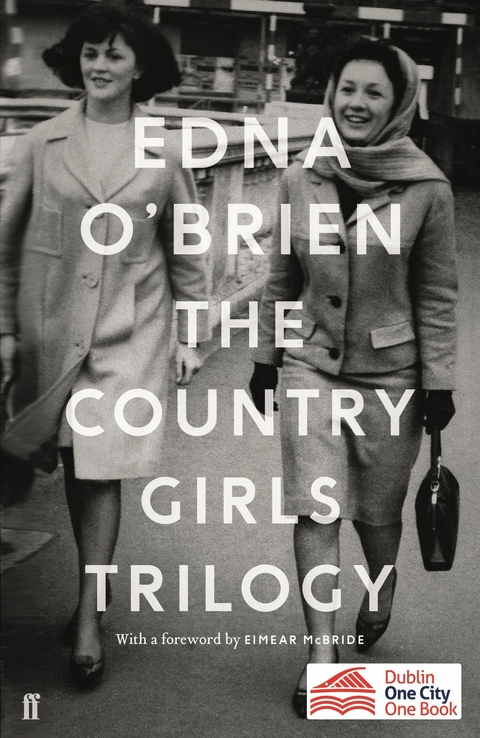
Country Girls Trilogy (eBook)
704 Seiten
Faber & Faber (Verlag)
978-0-571-33054-6 (ISBN)
Edna O'Brien wrote more than twenty celebrated works of fiction, including her classic The Country Girls trilogy, as well as plays and four works of non-fiction, which have been translated into over thirty languages. Her final novel Girl was awarded the Kerry Group Irish Novel of the Year in 2020. She was the recipient of many honours, including the Irish PEN Lifetime Achievement Award, the Frank O'Connor International Short Story Award, the PEN/Nabokov Award for Achievement in International Literature, and the David Cohen Prize for Literature, as well as being appointed an honorary Dame Commander of the Order of the British Empire in 2017. In 2021, O'Brien was also named Commandeur de l'Ordre des Arts et des Lettres. Born and raised in the west of Ireland, she lived in London for many years before her death in July 2024.
Edna O'Brien's beloved and controversial modern classics reveal the lives and loves of two girls in rural 1950s Ireland (with a foreword by Eimear McBride). 'The taboo-breaking, the fabulous prose - there's no one like Edna O'Brien ... Beautiful.' Anne Enright'Surprising and beautiful and courageous .. A beacon.' Megan Nolan'Brilliant and brave.' Ann Patchett'Glittering energy.' Colm ToibinONE OF THE BBC'S '100 NOVELS THAT SHAPED OUR WORLD'Caithleen 'Kate' Brady and Bridget 'Baba' Brennan are growing up in a repressive Irish village after World War II. Kate is a romantic, looking for love; Baba is a reckless survivor. After being expelled from convent school, they dream of the bright lights of Dublin - and are rewarded with bad luck and bad sex; marry for the wrong reasons; but continue to fight the expectations forced upon 'girls' of every era to become brave new women. Edna O'Brien's debut novels revolutionised Irish literature in the 1960s. Banned by the authorities as 'indecent' and burned by the clergy, they were notorious for their frank portrayal of sexual desire: but scandal turned to fame, and made this glorious coming-of-age tale an instant classic that inspires and delights readers to this day.
lt;p>Edna O'Brien has written more than twenty works of fiction. She is the recipient of many awards, including the Irish PEN Lifetime Achievement Award, the American National Arts Gold Medal, the Frank O'Connor Prize and the PEN/Nabokov Award For Achievement in International Literature. Born and raised in the west of Ireland, she has lived in London for many years. Her new novel, Girl, was published by Faber in September 2019.
Eimear McBride is the author of two novels: The Lesser Bohemians (James Tait Black Memorial Prize) and A Girl is a Half-formed Thing (Bailey's Women's Prize for Fiction, Irish Novel of the Year, the Goldsmiths Prize, and others). She was the inaugural creative fellow at the Beckett Research Centre, University of Reading and occasionally writes for the Guardian, TLS, New Statesman and the Irish Times.
lt;b>A literary great.
I wakened quickly and sat up in bed abruptly. It is only when I am anxious that I waken easily and for a minute I did not know why my heart was beating faster than usual. Then I remembered. The old reason. He had not come home.
Getting out, I rested for a moment on the edge of the bed, smoothing the green satin bedspread with my hand. We had forgotten to fold it the previous night, Mama and me. Slowly I slid onto the floor and the linoleum was cold on the soles of my feet. My toes curled up instinctively. I owned slippers but Mama made me save them for when I was visiting my aunts and cousins; and we had rugs, but they were rolled up and kept in drawers until visitors came in the summertime from Dublin.
I put on my ankle socks.
There was a smell of frying bacon from the kitchen, but it didn’t cheer me.
Then I went over to let up the blind. It shot up suddenly and the cord got twisted around it. It was lucky that Mama had gone downstairs, as she was always lecturing me on how to let up blinds properly, gently.
The sun was not yet up, and the lawn was speckled with daisies that were fast asleep. There was dew everywhere. The grass below my window, the hedge around it, the rusty paling wire beyond that, and the big outer field were each touched with a delicate, wandering mist. The leaves and the trees were bathed in the mist, and the trees looked unreal, like trees in a dream. Around the forget-me-nots that sprouted out of the side of the hedge were haloes of water. Water that glistened like silver. It was quiet, it was perfectly still. There was smoke rising from the blue mountain in the distance. It would be a hot day.
Seeing me at the window, Bull’s-Eye came out from under the hedge, shook himself free of water, and looked up lazily, sadly, at me. He was our sheep dog and I named him Bull’s-Eye because his eyes were speckled black and white, like canned sweets. He usually slept in the turf house, but last night he had stayed in the rabbit hole under the hedge. He always slept there to be on the watch-out when Dada was away. I need not ask, my father had not come home.
Just then Hickey called from downstairs. I was lifting my nightgown over my head, so I couldn’t hear him at first.
“What? What are you saying?” I asked, coming out onto the landing with the satin bedspread draped around me.
“Good God, I’m hoarse from saying it.” He beamed up at me, and asked, “Do you want a white or a brown egg for your breakfast?”
“Ask me nicely, Hickey, and call me dotey.”
“Dotey. Ducky. Darling. Honeybunch, do you want a white or a brown egg for your breakfast?”
“A brown one, Hickey.”
“I have a gorgeous little pullet’s egg here for you,” he said as he went back to the kitchen. He banged the door. Mama could never train him to close doors gently. He was our workman and I loved him. To prove it, I said so aloud to the Blessed Virgin, who was looking at me icily from a gilt frame.
“I love Hickey,” I said. She said nothing. It surprised me that she didn’t talk more often. Once, she had spoken to me, and what she said was very private. It happened when I got out of bed in the middle of the night to say an aspiration. I got out of bed six or seven times every night as an act of penance. I was afraid of hell.
Yes, I love Hickey, I thought; but of course what I really meant was that I was fond of him. When I was seven or eight I used to say that I would marry him. I told everyone, including the catechism examiner, that we were going to live in the chicken run and that we would get free eggs, free milk, and vegetables from Mama. Cabbage was the only vegetable they planted. But now I talked less of marriage. For one thing, he never washed himself, except to splash rainwater on his face when he stooped in over the barrel in the evenings. His teeth were green, and last thing at night he did his water in a peach tin that he kept under his bed. Mama scolded him. She used to lie awake at night waiting for him to come home, waiting to hear him raise the window while he emptied the peach-tin contents onto the flag outside.
“He’ll kill those shrubs under that window, sure as God,” she used to say, and some nights when she was very angry she came downstairs in her nightgown and knocked on his door and asked him why didn’t he do that sort of thing outside. But Hickey never answered her, he was too cunning.
I dressed quickly, and when I bent down to get my shoes I saw fluff and dust and loose feathers under the bed. I was too miserable to mop the room, so I pulled the covers up on my bed and came out quickly.
The landing was dark as usual. An ugly stained-glass window gave it a mournful look as if someone had just died in the house.
“This egg will be like a bullet,” Hickey called.
“I’m coming,” I said. I had to wash myself. The bathroom was cold, no one ever used it. An abandoned bathroom with a rust stain on the handbasin just under the cold tap, a perfectly new bar of pink soap, and a stiff white facecloth that looked as if it had been hanging in the frost all night.
I decided not to bother, so I just filled a bucket of water for the lavatory. The lavatory did not flush, and for months we had been expecting a man to come and fix it. I was ashamed when Baba, my school friend, went up there and said fatally, “Still out of order?” In our house things were either broken or not used at all. Mama had a new clippers and several new coils of rope in a wardrobe upstairs; she said they’d only get broken or stolen if she brought them down.
My father’s room was directly opposite the bathroom. His old clothes were thrown across a chair. He wasn’t in there, but I could hear his knees cracking. His knees always cracked when he got in and out of bed. Hickey called me once more.
Mama was sitting by the range, eating a piece of dry bread. Her blue eyes were small and sore. She hadn’t slept. She was staring directly ahead at something only she could see, at fate and at the future. Hickey winked at me. He was eating three fried eggs and several slices of home-cured bacon. He dipped his bread into the runny egg yolk and then sucked it.
“Did you sleep?” I asked Mama.
“No. You had a sweet in your mouth and I was afraid you’d choke if you swallowed it whole, so I stayed awake just in case.” We always kept sweets and bars of chocolate under the pillow and I had taken a fruit drop just before I fell asleep. Poor Mama, she was always a worrier. I suppose she lay there thinking of him, waiting for the sound of a motorcar to stop down the road, waiting for the sound of his feet coming through the wet grass, and for the noise of the gate hasp—waiting, and coughing. She always coughed when she lay down, so she kept old rags that served as handkerchiefs in a velvet purse that was tied to one of the posts of the brass bed.
Hickey topped my egg. It had gone hard, so he put little knobs of butter in to moisten it. It was a pullet’s egg that came just over the rim of the big china egg cup. It looked silly, the little egg in the big cup, but it tasted very good. The tea was cold.
“Can I bring Miss Moriarty lilac?” I asked Mama. I was ashamed of myself for taking advantage of her wretchedness to bring the teacher flowers, but I wanted very much to outdo Baba and become Miss Moriarty’s pet.
“Yes, darling, bring anything you want,” Mama said absently. I went over and put my arms around her neck and kissed her. She was the best mama in the world. I told her so, and she held me very close for a minute as if she would never let me go. I was everything in the world to her, everything.
“Old mammypalaver,” Hickey said. I loosened my fingers, which had been locked on the nape of her soft white neck, and I drew away from her, shyly. Her mind was far away, and the hens were not yet fed. Some of them had come down from the yard and were picking at Bull’s-Eye’s food plate outside the back door. I could hear Bull’s-Eye chasing them and the flap of their wings as they flew off, cackling violently.
“There’s a play in the town hall, missus. You ought to go over,” Hickey said.
“I ought.” Her voice was a little sarcastic. Although she relied on Hickey for everything, she was sharp with him sometimes. She was thinking. Thinking where was he? Would he come home in an ambulance, or a hackney car, hired in Belfast three days ago and not paid for? Would he stumble up the stone steps at the back door waving a bottle of whiskey? Would he shout, struggle, kill her, or apologize? Would he fall in the hall door with some drunken fool and say: “Mother, meet my best friend, Harry. I’ve just given him the thirteen-acre meadow for the loveliest greyhound …” All this had happened to us so many times that it was foolish to expect that my father might come home sober. He had gone, three days before, with sixty pounds in his pocket to pay the rates.
“Salt, sweetheart,” said Hickey, putting a pinch between his thumb and finger and sprinkling it onto my egg.
“No, Hickey, don’t.” I was doing without salt at that time. As an affectation. I thought it was very grown-up not to use salt or sugar.
“What will I do, mam?” Hickey asked, and took advantage of her listlessness to butter his bread generously on both...
| Erscheint lt. Verlag | 15.11.2018 |
|---|---|
| Vorwort | Eimear McBRide |
| Verlagsort | London |
| Sprache | englisch |
| Themenwelt | Literatur ► Romane / Erzählungen |
| Schlagworte | adolescence • Angela's Ashes • Anne Enright • bbc imagine • colm toibin • country girls trilogy • dublin one city one book • edna o brien • Eimear McBride • little red chairs • long gaze back • relationships • Rites of Passage • rural Ireland • sally rooney • scandal • Small Great Things • the corner shop • the strawberry thief |
| ISBN-10 | 0-571-33054-1 / 0571330541 |
| ISBN-13 | 978-0-571-33054-6 / 9780571330546 |
| Informationen gemäß Produktsicherheitsverordnung (GPSR) | |
| Haben Sie eine Frage zum Produkt? |
 EPUB (Adobe DRM)
Kopierschutz: Adobe-DRM
Adobe-DRM ist ein Kopierschutz, der das eBook vor Mißbrauch schützen soll. Dabei wird das eBook bereits beim Download auf Ihre persönliche Adobe-ID autorisiert. Lesen können Sie das eBook dann nur auf den Geräten, welche ebenfalls auf Ihre Adobe-ID registriert sind.
Details zum Adobe-DRM
Dateiformat: EPUB (Electronic Publication)
EPUB ist ein offener Standard für eBooks und eignet sich besonders zur Darstellung von Belletristik und Sachbüchern. Der Fließtext wird dynamisch an die Display- und Schriftgröße angepasst. Auch für mobile Lesegeräte ist EPUB daher gut geeignet.
Systemvoraussetzungen:
PC/Mac: Mit einem PC oder Mac können Sie dieses eBook lesen. Sie benötigen eine
eReader: Dieses eBook kann mit (fast) allen eBook-Readern gelesen werden. Mit dem amazon-Kindle ist es aber nicht kompatibel.
Smartphone/Tablet: Egal ob Apple oder Android, dieses eBook können Sie lesen. Sie benötigen eine
Geräteliste und zusätzliche Hinweise
Buying eBooks from abroad
For tax law reasons we can sell eBooks just within Germany and Switzerland. Regrettably we cannot fulfill eBook-orders from other countries.
aus dem Bereich